

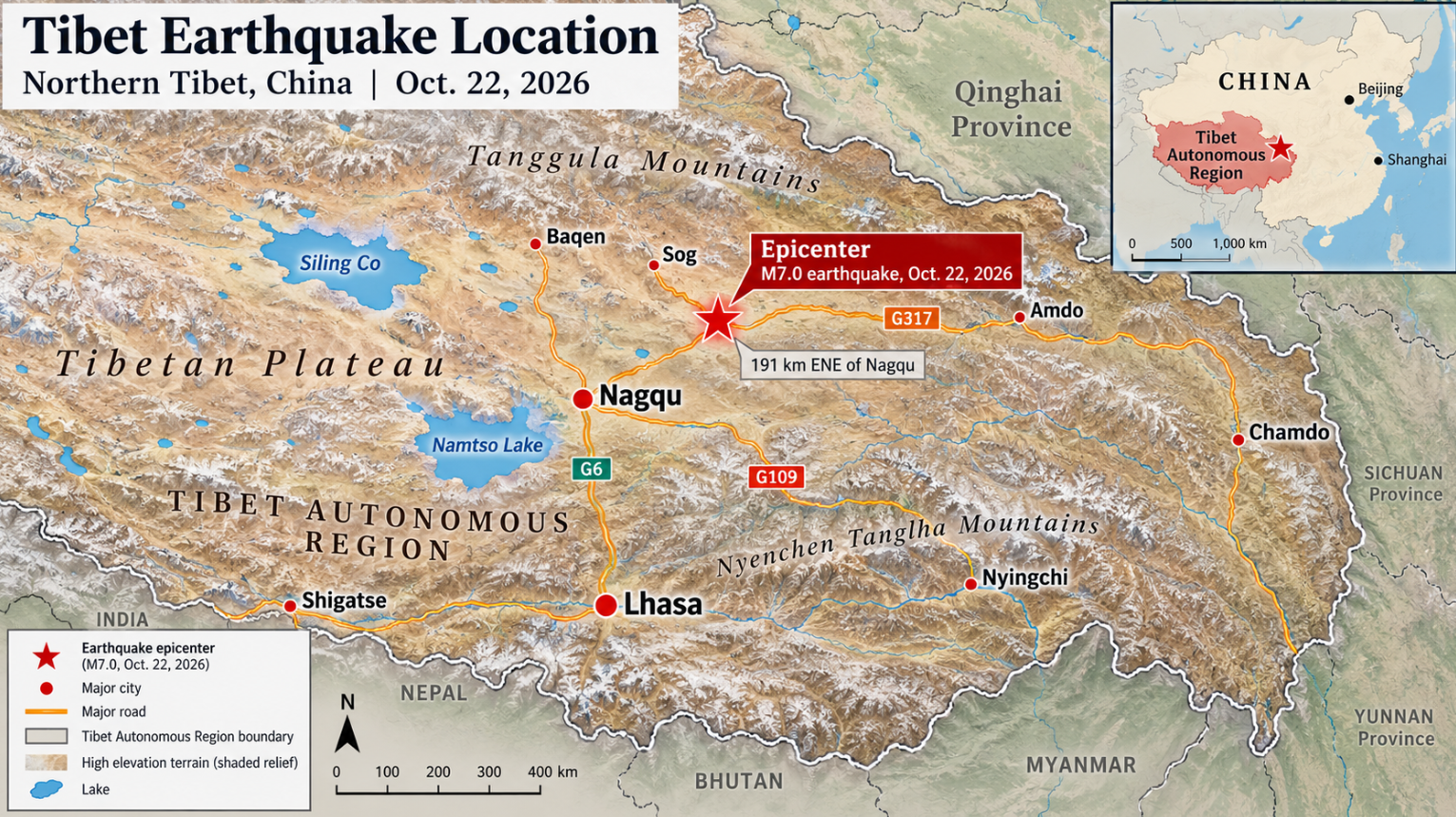
A powerful magnitude 7.0 earthquake struck northern Tibet on Thursday, October 22, 2026, killing at least 16 people and injuring 54 others. The earthquake destroyed hundreds of homes in a remote, mountainous region of southwestern China, prompting a major rescue operation as authorities worked to reach affected communities.
The earthquake struck at 10:33 p.m. local time near Baqen County in the Nagqu area of the Tibet Autonomous Region. The U.S. Geological Survey placed the epicenter approximately 191 kilometers (119 miles) east-northeast of Nagqu, at a depth of about 18 kilometers (11 miles).
Chinese authorities reported that 339 homes and 20 livestock sheds had collapsed. More than 1,600 emergency personnel were deployed as rescue operations continued into the night and authorities assessed damage across surrounding villages.
The Associated Press reported that Chinese President Xi Jinping ordered authorities to organize comprehensive rescue and medical assistance. Emergency supplies, including prefabricated housing, tents, beds, winter clothing and flashlights, were sent to the disaster area.
The earthquake occurred in one of China's most isolated and difficult-to-reach regions. High elevations, mountainous roads and scattered settlements complicated efforts to evaluate the full extent of the destruction.
Rescue Teams Dispatched After Powerful Shaking
China's earthquake authorities activated a Level-II emergency response shortly after the earthquake. The designation mobilized additional rescue resources and increased coordination between national and regional emergency agencies.
An initial response team of seven firefighters from the Nagqu Battalion of the Lhasa Fire and Rescue Mobile Detachment was dispatched with life-detection equipment and specialized rescue tools. Larger teams followed as officials received reports of collapsed buildings and injured residents.
Video released after the earthquake showed people rushing out of buildings as the ground shook. Other footage captured rescue personnel preparing equipment and emergency vehicles departing for affected communities.
Local authorities initially reported at least two injuries in a village near the epicenter, along with cracks in several homes. The figures rose as emergency workers reached more settlements and collected additional information.
By Thursday evening, the reported death toll had reached at least 16, with 54 people injured. Officials were continuing to search damaged buildings and determine whether additional residents had been trapped.
The collapse of hundreds of homes raised concerns about families who had lost shelter. Emergency officials moved temporary accommodation and essential supplies into affected areas as rescue crews worked to restore access to damaged communities.
The earthquake also disrupted communications and transportation. Local authorities reported temporary interruptions to railway services, while rockfalls forced the closure of a section of National Highway 317.
The highway closure created additional difficulties for emergency vehicles attempting to reach affected areas. Crews needed to assess damaged roads and remove debris before some routes could safely reopen.
Earthquake Centered in Remote Northern Tibet
The earthquake occurred in a sparsely populated section of the Tibetan Plateau, where communities are separated by long distances and difficult terrain. Nagqu lies more than 300 kilometers north of Lhasa, the regional capital.
The China Earthquake Networks Center reported the epicenter near 32.40 degrees north latitude and 93.79 degrees east longitude. Its initial measurements placed the earthquake at a depth of approximately 10 kilometers.
The U.S. Geological Survey calculated a slightly different epicenter and a depth of 18 kilometers. Such differences are common because seismic agencies use different data and processing methods to estimate earthquake locations and depths.
Both agencies classified the event as a magnitude 7.0 earthquake. Tremors of this strength can cause severe damage near the epicenter, particularly where buildings are not designed to withstand intense ground movement.
The USGS issued an orange alert for potential economic losses and a yellow alert for earthquake-related fatalities. Those assessments were preliminary estimates based on shaking intensity, population exposure and the vulnerability of local structures.
The remote location made immediate damage assessments difficult. Although fewer people live near the epicenter than in major cities, scattered villages may contain homes built from materials vulnerable to strong shaking.
The earthquake occurred late at night, when many residents would normally have been inside their homes. Nighttime earthquakes can create additional challenges because darkness makes evacuation and rescue operations more difficult.
Aftershocks Raise Concerns About Additional Damage
Seismologists recorded several aftershocks following the main earthquake. The USGS identified at least seven significant aftershocks, including tremors strong enough to be felt across parts of the surrounding region.
Aftershocks can continue for days, weeks or longer following a major earthquake. They are usually smaller than the original event but can still damage buildings already weakened by the initial shaking.
Emergency personnel must therefore balance the urgency of searching damaged homes against the danger of further collapses. Residents returning to affected buildings may also face risks from unstable walls, roofs and foundations.
Authorities were examining damage in communities surrounding the epicenter while rescue workers searched for people who might need assistance. The full number of displaced residents had not been established in the initial reports.
Weather conditions presented another concern. Forecasts called for intermittent snow during the following three days, potentially making road travel and emergency shelter operations more difficult.
Northern Tibet experiences harsh conditions because of its elevation and exposed landscape. Cold weather can become especially dangerous when families lose their homes or heating supplies.
Emergency teams were therefore delivering winter clothing and temporary housing alongside medical supplies and rescue equipment. The immediate priorities included treating injured residents, locating missing people and providing shelter to displaced families.
Why Tibet Experiences Powerful Earthquakes
Tibet lies within one of the world's most active tectonic regions. The Indian and Eurasian tectonic plates continue to push against each other, creating enormous geological pressure beneath the Himalayan mountains and Tibetan Plateau.
That continuing movement has produced numerous destructive earthquakes throughout the region. Although the collision is gradual, stress can accumulate along faults until the rocks suddenly move and release seismic energy.
The October 22 earthquake was not the first major disaster to affect Tibet in recent years. In January 2025, a powerful earthquake struck Dingri County in the Shigatse area, killing more than 100 people and damaging thousands of buildings.
The earlier disaster exposed the challenges of conducting rescue operations in high-altitude communities with limited road connections and severe winter conditions. Similar logistical difficulties confronted emergency personnel responding to the latest earthquake.
However, the two earthquakes occurred in different areas of Tibet. Scientists would need detailed fault measurements and geological analysis before determining whether any direct connection existed between them.
Earthquakes cannot currently be predicted with reliable precision. Scientists can identify regions at elevated risk and estimate the likelihood of future seismic activity, but they cannot determine the exact time of a destructive earthquake.
Emergency Operations Continue Across Affected Villages
Chinese authorities continued coordinating rescue teams, emergency transportation and relief supplies as information emerged from the disaster area. Medical personnel were directed toward injured residents, while other workers assessed collapsed homes and damaged infrastructure.
Officials were also checking whether the earthquake had disrupted essential services in nearby communities. Communication interruptions and blocked roads made it more difficult to obtain a complete picture of conditions in some locations.
The initial casualty figures could change as rescue workers reach isolated settlements and authorities complete additional inspections. The number of people requiring temporary shelter also remained uncertain.
For residents of northern Tibet, the immediate danger extended beyond the original earthquake. Aftershocks, damaged buildings, blocked roads and approaching snowfall created additional challenges for families and emergency crews.
More than 1,600 rescue personnel had been deployed as authorities worked to locate survivors, provide medical care and establish temporary housing. Further casualty and damage assessments were expected as emergency teams continued reaching communities near the epicenter.