

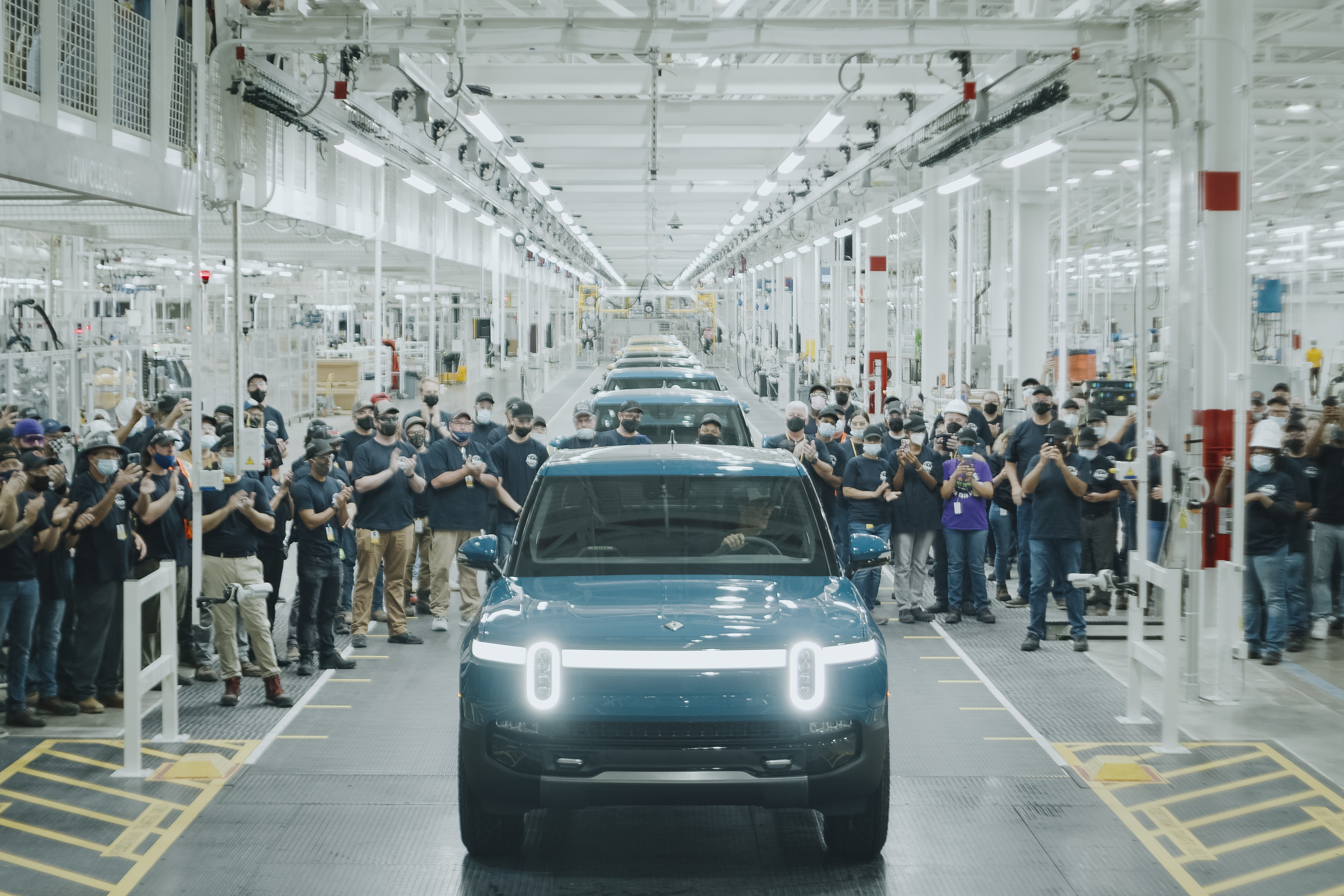
Rivian Automotive reported record vehicle deliveries and stronger-than-expected revenue for the third quarter of 2026, driven by growing demand for its new R2 electric SUV. The company generated $2.155 billion in revenue, a 38% increase from a year earlier, while reducing its losses and raising its full-year delivery forecast.
The Irvine, California-based electric vehicle manufacturer announced its results Thursday, October 29, after the stock market closed. Rivian delivered 19,248 vehicles during the quarter, a company record and an increase of approximately 46% compared with the same period in 2025.
The results exceeded Wall Street expectations in several important areas, including revenue and adjusted earnings. Rivian reported an adjusted loss of 48 cents per share, compared with analyst expectations of approximately 61 to 64 cents per share, depending on the survey.
Despite the improvement, Rivian remains unprofitable. The company reported a quarterly net loss attributable to common shareholders of $913 million, compared with a loss of $1.173 billion a year earlier.
Rivian R2 Becomes Company's Best-Selling Vehicle
The biggest development in Rivian's third-quarter results was the performance of the R2, a smaller electric SUV designed to reach more customers than the company's higher-priced R1 vehicles. Deliveries of the R2 began in June, making the third quarter its first full reporting period on the market.
Rivian confirmed that the R2 outsold its R1 lineup and electric delivery vans during the quarter. The company did not disclose the exact number of R2 vehicles sold, but said the model accounted for much of the increase in deliveries.
Rivian produced 19,751 vehicles at its manufacturing facility in Normal, Illinois, during the three months ending September 30. That represented a substantial increase from the 10,720 vehicles manufactured during the same quarter last year.
The R2 is central to Rivian's effort to expand beyond the premium electric vehicle market. Its smaller size and lower starting price are intended to attract buyers who might not consider the more expensive R1S SUV or R1T pickup truck.
The initial R2 Performance model starts at $57,990, while more affordable versions are scheduled to follow. Rivian plans to introduce a Standard model priced at approximately $45,000 in 2027.
The company has also expanded production operations to meet demand. Reuters reported that Rivian added a second manufacturing shift as it increased R2 output and prepared for higher delivery volumes.
Chief Executive Officer RJ Scaringe said customer response to the R2 had exceeded the company's expectations. He also emphasized that the new model would play an important role in improving production efficiency and reducing manufacturing costs.
Rivian expects the R2 to account for the majority of its vehicle deliveries during the fourth quarter. That would represent a major change in the company's sales mix compared with previous years, when the R1S and R1T were its primary consumer products.
Revenue Climbs as Quarterly Losses Narrow
Rivian's third-quarter revenue reached $2.155 billion, compared with $1.558 billion during the same period in 2025. Automotive revenue increased 36% to $1.55 billion, while software and services revenue climbed 45% to $605 million.
The company also reported $176 million in consolidated gross profit, up from $24 million a year earlier. Gross profit measures revenue remaining after the direct costs of producing vehicles and delivering services, before expenses such as research and administration.
The improvement is significant because Rivian has struggled to generate positive gross margins while expanding production. However, the consolidated results also show how heavily the company depends on revenue outside traditional vehicle manufacturing.
Rivian's automotive division recorded an $80 million gross loss during the quarter. Although that was an improvement from its $130 million gross loss a year earlier, the division continued to spend more directly producing and selling vehicles than it generated in automotive revenue.
The company said the R2 manufacturing expansion contributed approximately $120 million in additional costs during the quarter. Higher production volumes helped offset some expenses, but the transition to a new model remains costly.
Rivian also benefited from $81 million in revenue associated with regulatory credits. These credits can provide additional income for electric vehicle manufacturers, but their availability and value depend partly on government regulations and market conditions.
A tariff-related refund receivable also supported the quarter's financial results. These benefits helped improve reported margins, although they do not necessarily indicate that Rivian's vehicle business can consistently operate profitably without such support.
On a broader financial basis, Rivian reported an operating loss of $881 million, down from $983 million a year earlier. Its adjusted earnings before interest, taxes, depreciation and amortization showed a $435 million loss, compared with a $602 million loss in the prior-year quarter.
The adjusted figures exclude certain expenses and accounting items, making them useful for comparing operations over time. They do not eliminate the company's continuing need to fund manufacturing expansion, product development and other business activities.
Software and Volkswagen Partnership Support Profits
Rivian's software and services division remained an important source of positive gross profit during the quarter. The business generated $605 million in revenue and $256 million in gross profit, representing a margin of approximately 42%.
Much of that revenue came from Rivian's technology partnership with Volkswagen Group. The joint venture accounted for $354 million, or approximately 59%, of software and services revenue during the quarter.
The partnership involves developing electrical architecture and software systems that can be used in future Volkswagen vehicles. It allows Rivian to generate revenue from its technology without relying entirely on sales of its own electric vehicles.
Other software and services revenue came from maintenance, vehicle-related services and the company's Autonomy+ driver-assistance subscription. Rivian has been developing more advanced software features as part of its strategy to generate recurring revenue from vehicle owners.
Scaringe said the company's technology development is progressing toward a new capability called Point to Point. The feature is designed to allow vehicles to navigate selected routes with driver supervision, including city streets and highway interchanges.
Rivian expects a limited release of the feature before the end of 2026, followed by broader availability in 2027. The company has not presented it as a fully autonomous system that permits drivers to stop supervising the vehicle.
Rivian is also working with Uber on future autonomous transportation services. The companies have discussed deploying driverless R2 vehicles through Uber's network beginning in 2028, although that project remains dependent on development milestones and other conditions.
Reuters reported that Rivian expects to qualify for another $250 million investment from Uber if it reaches an autonomy-related milestone by the end of the year. The agreement provides a potential source of additional capital but does not guarantee that all planned funding will be received.
Rivian Raises 2026 Delivery Forecast
Following the stronger third-quarter performance, Rivian increased its full-year delivery guidance to 67,000 to 70,000 vehicles, compared with its previous projection of 65,000 to 70,000.
The company also improved its forecast for adjusted operating losses. Rivian now expects a full-year adjusted EBITDA loss between $1.75 billion and $1.85 billion, an improvement of $100 million at the midpoint of its previous guidance.
Planned capital spending was reduced as well. Rivian now expects capital expenditures of $1.4 billion to $1.5 billion for 2026, reflecting changes in the timing of planned investments.
Through September, Rivian had delivered 41,807 vehicles. Reaching the updated annual target will require approximately 25,200 to 28,200 deliveries during the fourth quarter.
That would represent another increase over the record third-quarter performance. Much of the additional volume is expected to come from higher production and deliveries of the R2.
The updated forecast indicates growing confidence in the company's manufacturing plans, although the targets remain projections. Production problems, parts shortages or weaker customer demand could still affect the final results.
Cash Position Remains Important as Rivian Expands
Rivian ended September with approximately $3.51 billion in cash and cash equivalents, along with another $1.99 billion in short-term investments. Together, those holdings totaled approximately $5.5 billion.
However, the company continues to use substantial amounts of cash to support its operations. During the third quarter, Rivian used $758 million in operating activities and spent $366 million on capital expenditures.
That spending reflects the costs of manufacturing vehicles, expanding production capacity and developing future products. Rivian must continue managing those expenses while increasing sales and working toward sustainable profitability.
The company has also secured additional financing through its relationship with Volkswagen. In October, Rivian announced funding of a $1 billion loan facility connected to the automotive partnership.
Rivian's longer-term plans depend on expanding R2 production and bringing manufacturing costs down. The company has said it expects the new vehicle to help it reach a positive automotive gross margin exit rate by the end of 2026, although that goal has not yet been achieved.
The latest results demonstrate progress in deliveries, revenue and the reduction of annual losses. They also show that Rivian's software business remains essential to its current financial performance.
For investors, the next major test will be whether R2 production can continue increasing without placing too much pressure on costs and cash reserves. Rivian's fourth-quarter deliveries and year-end automotive margins will provide important measures of its progress toward building a profitable electric vehicle business.