

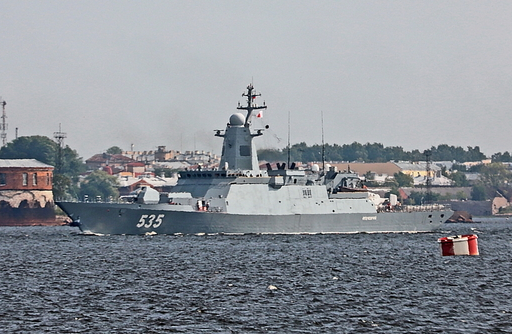
A Russian warship was severely damaged and partially submerged following a suspected Ukrainian naval drone attack at a military port in Benghazi, Libya, on Sunday, November 22, 2026. The vessel, identified as the Russian Navy corvette Merkury, suffered an explosion and fire while docked at the eastern Libyan naval base. Local authorities reported ten minor injuries and launched an investigation into an incident that has raised concerns about the spread of the Russia-Ukraine war into the Mediterranean.
Satellite photographs showed extensive damage to the vessel, with most of its hull overturned or underwater. The attack took place while the ship was reportedly stopping for fuel and supplies before returning to Russia.
Although Libyan military officials accused Ukrainian forces of launching the attack, no organization had formally claimed responsibility.
Russian Corvette Severely Damaged in Benghazi
The explosion occurred at Benghazi Naval Base, a military facility on Libya's Mediterranean coast.
Officials from the eastern-based Libyan government said preliminary findings indicated that the vessel had been attacked by unmanned drones. The explosion caused a fire that emergency personnel later extinguished.
Satellite imagery examined by commercial intelligence companies provided additional evidence of the damage.
Vantor, a satellite imagery provider, identified the vessel as Merkury, a Russian Navy corvette belonging to the Steregushchiy class.
Images taken after the explosion showed that most of the warship had capsized, leaving only its bow visible above the water. Smoke rose from the damaged vessel, and debris was scattered across the nearby pier.
Corvettes are relatively small warships designed for coastal patrols, escort operations and other naval missions. Their size allows them to operate in waters where larger vessels may be less practical.
The extent of the damage suggested the ship could require extensive repairs or may be beyond recovery. However, Russian authorities had not publicly confirmed its final condition.
Libyan Officials Report Ten Injuries
Two medical sources told Reuters that ten Russian and Libyan personnel suffered minor injuries during the incident.
The injured were receiving treatment in Benghazi, and no deaths had been reported.
Libyan authorities said the fire was contained and surrounding port facilities, including warehouses, remained secure.
The eastern government also stated that normal operations resumed after emergency crews brought the situation under control.
Local broadcaster Almasar aired footage showing flames erupting from a vessel at the port.
The images drew attention to the apparent scale of the explosion, although video footage alone could not establish the identity of those responsible.
Officials said the incident was being investigated jointly with Russia to determine the source of the attack and identify those involved.
Ukraine Suspected but Responsibility Remains Unconfirmed
Two Libyan military officials told the Associated Press that an initial investigation pointed toward Ukrainian naval drones launched from western Libya.
According to their account, several unmanned surface vessels approached the naval base. At least four were intercepted and destroyed, while two struck the Russian warship.
The officials spoke anonymously because they were not authorized to discuss the investigation publicly.
Their statements have not been independently confirmed, and the precise launch location remains uncertain.
Neither the Ukrainian government nor Russian authorities immediately issued a formal statement accepting or assigning responsibility for the attack.
The eastern Libyan government said it wanted an international investigation into the circumstances.
Prime Minister Osama Hamad also requested that the United Nations examine allegations that drones had been launched from western Libya and determine whether Ukrainian specialists were operating there.
Those claims remain allegations rather than established findings.
Second Drone Attack Strikes Commercial Vessel
Another maritime incident was reported near Benghazi later Sunday.
Two Libyan military sources said an unmanned surface vessel struck a Maltese-flagged commercial ship off the coast.
The vessel was separate from the Russian warship attacked at the naval base.
Libyan naval personnel rescued the commercial ship's crew, and health officials reported that injured personnel were in stable condition.
The precise extent of the commercial vessel's damage was not immediately established.
Military sources also reported that Libyan naval and air forces intercepted more than 20 drone boats operating near Benghazi that evening.
The reports have not been independently verified, and investigators have not established whether both attacks were conducted by the same organization.
The incidents nevertheless caused concern among Libyan officials about the vulnerability of commercial shipping and military installations along the Mediterranean coast.
Libya Condemns Attack as Violation of Sovereignty
Libya has remained politically divided since the 2011 uprising that removed longtime leader Muammar Gaddafi, who was subsequently killed.
A United Nations-supported administration operates from Tripoli in western Libya, while a rival eastern administration maintains authority in Benghazi and surrounding areas.
The Libyan National Army, led by Khalifa Haftar, exercises control over much of the country's eastern and southern territory.
Russia has developed close relationships with eastern Libyan authorities, including cooperation involving military facilities and maritime operations.
The eastern government condemned Sunday's suspected attack as an infringement of Libyan sovereignty and a threat to maritime security.
It emphasized that Libya was not a participant in Russia's war against Ukraine and should not become a location for attacks involving foreign powers.
Officials said they would pursue diplomatic and legal measures against those determined to be responsible.
The government in Tripoli also expressed concern about international conflicts spreading into Libya.
Its statement warned against allowing foreign military activities to expose civilian ports and infrastructure to danger.
Previous Attacks Targeted Russian Shipping
The Benghazi explosion follows other reported attacks on Russian-linked vessels outside the Black Sea.
Since Russia launched its full-scale invasion of Ukraine in February 2022, Ukrainian forces have used explosive naval drones to strike Russian ships and maritime facilities.
These attacks have damaged or destroyed several Russian vessels and forced Moscow to reconsider how it protects ships operating near contested waters.
In December 2025, Ukraine said it had attacked a Russian-linked oil tanker in the Mediterranean using aerial drones.
The precise location of that operation was not publicly established.
In March 2026, Russia accused Ukraine of using naval drones launched from the Libyan coast to attack a Russian liquefied natural gas tanker near Maltese waters.
Ukrainian officials did not publicly confirm responsibility for that incident.
The Associated Press previously reported allegations from Libyan officials that Ukrainian drone specialists were operating from military facilities in western Libya, including locations near Misrata, Tripoli and Zawiya.
Those reported deployments have not been independently established through a public Ukrainian acknowledgment.
United Nations Calls for Investigation
The United Nations Support Mission in Libya expressed serious concern about the reported drone attacks and called for an independent investigation.
The mission did not identify a responsible party.
The incidents raise questions about the security of international shipping routes and the involvement of foreign forces in Libya's competing political and military networks.
Benghazi is an important Mediterranean port, and any sustained threat to its maritime facilities could affect both military operations and commercial activity.
For Russia, the apparent loss or severe damage of Merkury would represent another setback involving its naval forces during the continuing war with Ukraine.
For Libya, the immediate concern is preventing further attacks and protecting its ports from becoming targets in conflicts originating beyond its borders.
Investigators must still establish who launched the drones, where they originated and whether the attacks on the two vessels were connected. Those questions remain unanswered as Libyan authorities seek international assistance with the investigation.