

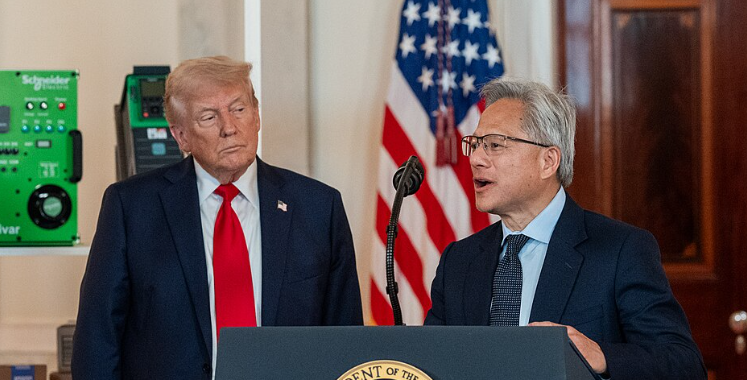
President Donald Trump is facing bipartisan criticism after personally intervening to secure Jensen Huang's return as chief executive of Nvidia. The semiconductor company's board reinstated Huang on Monday, November 23, 2026, just 11 days after his resignation amid revelations about extramarital affairs and concerns involving alleged Chinese intelligence connections.
Trump defended his involvement, arguing that Huang's leadership was essential to maintaining American competitiveness in artificial intelligence. However, lawmakers from both major political parties have questioned whether the administration adequately addressed the national security concerns surrounding his return.
The controversy has also increased scrutiny of Trump's financial interests in Nvidia and the relationship between his administration and powerful technology executives.
Trump Personally Pressed Nvidia's Board
Trump acknowledged communicating with Nvidia's directors during interviews following the company's announcement. He indicated that his involvement helped persuade the board to reverse its earlier position.
In an interview with CNBC, Trump suggested that losing Huang's expertise could represent a greater threat to American interests than reinstating him.
Nvidia's processors are essential components in many advanced artificial intelligence systems. American technology companies depend heavily on its products to develop and operate increasingly sophisticated AI models.
The president argued that maintaining Nvidia's leadership was particularly important as the United States competes with China in artificial intelligence development.
ABC News reported that Trump consulted Attorney General Todd Blanche and Director of National Intelligence Jay Clayton before recommending Huang's reinstatement.
The Washington Post also reported that Vice President JD Vance participated in efforts to bring Huang back, citing people familiar with the discussions.
Administration Defends National Security Assessment
Huang resigned on November 12 following revelations about extramarital relationships. One reportedly involved a woman suspected of having connections to Chinese intelligence.
The allegations raised questions about whether the relationship could have exposed sensitive corporate information or created opportunities for foreign intelligence gathering.
However, the existence of such concerns does not establish that Huang participated in espionage or improperly disclosed confidential information.
Trump said federal authorities had found no evidence that Huang engaged in unlawful conduct. Nvidia's board similarly stated that government input had given it confidence that his reinstatement did not present a national security risk.
Blanche defended the administration's assessment on Tuesday, describing consultation between federal departments as a routine part of government decision-making.
Nevertheless, questions remain about the scope of those consultations and the evidence examined. The administration has not publicly released a comprehensive account of its national security assessment.
Republican and Democratic Lawmakers Demand Answers
The decision received criticism from members of Congress across party lines.
Several Republican lawmakers expressed concerns about restoring Huang to a position of considerable influence while questions about foreign intelligence connections and semiconductor exports remain unresolved.
Democrats also called for greater oversight of Nvidia's operations and the administration's involvement in the company's leadership decision.
Senator Elizabeth Warren argued that Huang's return increased the urgency of passing bipartisan legislation strengthening restrictions on advanced semiconductor exports.
Senator Ruben Gallego questioned whether personal relationships with the president were receiving greater consideration than national security concerns.
House Democratic leader Hakeem Jeffries called for stronger safeguards against the transfer of advanced American AI technology to China.
The criticism has brought together lawmakers who may disagree on other aspects of technology policy but share concerns about protecting sensitive American technology.
Trump's Financial Holdings Receive Renewed Scrutiny
The president's personal financial interests have become another significant part of the controversy.
A Reuters review of Trump's annual financial disclosure for 2025 and securities trading disclosures for 2026 found that he held Nvidia shares valued between $11 million and $55 million.
Federal financial disclosures generally report assets within value ranges rather than providing exact holdings.
The president's ownership of Nvidia stock raises questions about potential conflicts of interest when government decisions could influence the company's market value.
However, the financial disclosures alone do not establish that Trump intervened to increase his personal wealth or that his actions violated any law.
Critics have called for greater transparency regarding the administration's communications with Nvidia. Trump has maintained that his involvement was motivated by the company's importance to American economic and technological interests.
Nvidia Shares Retreat Following Initial Rally
Investors initially welcomed Huang's return, sending Nvidia shares sharply higher on Monday.
The rally reflected renewed confidence among some investors in the leadership of the executive who helped transform Nvidia into a dominant supplier of artificial intelligence processors.
However, the gains did not recover all the losses recorded following Huang's resignation.
The initial enthusiasm also proved short-lived. Nvidia shares closed 5.9 percent lower on Tuesday as investors continued evaluating the political, legal, and corporate governance risks surrounding the company's leadership.
The changing market reaction demonstrates that Huang's reinstatement has not eliminated uncertainty about Nvidia's future operations.
Semiconductor Export Restrictions Remain Central
Much of the congressional concern involves the potential transfer of advanced American AI technology to China.
The United States has established export restrictions intended to limit China's access to semiconductor technology that could support advanced military and intelligence applications.
Nvidia has advocated for continued access to international markets, arguing that American technology companies must remain competitive globally.
Lawmakers concerned about national security have pushed for stronger restrictions and more effective enforcement.
Huang's return could intensify disagreements between the administration, Congress, and technology companies over how to balance commercial opportunities with national security obligations.
Nvidia has announced additional corporate oversight measures addressing national security and export control compliance. Independent investigations into matters surrounding Huang also remain active.
Congressional Scrutiny Continues
Huang's reinstatement has not ended congressional efforts to examine Nvidia's business practices or its compliance with American technology export restrictions.
Lawmakers are preparing hearings that could address the circumstances of his departure, the government's assessment of national security risks, and the decision to return him to the company's leadership.
The president continues to defend Huang's reinstatement as beneficial to American competitiveness. Congressional critics maintain that the administration must provide sufficient evidence to support its assessment.
The immediate questions facing lawmakers include which government officials participated in the review, what information they provided to Nvidia's directors, and whether continuing investigations could uncover additional security concerns.