

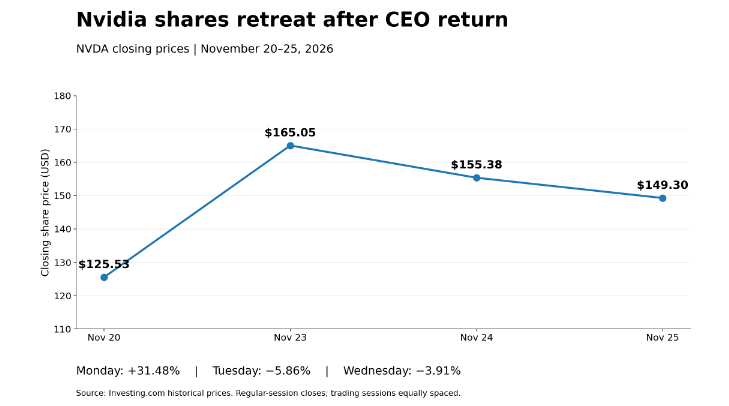
Nvidia shares fell 3.91 percent Wednesday, November 25, 2026, closing at $149.30 as the initial enthusiasm surrounding Jensen Huang's return as chief executive continued to fade. The decline followed a 5.9 percent loss Tuesday, reversing a substantial portion of Monday's dramatic rally.
The semiconductor manufacturer remains under scrutiny following Huang's brief departure and subsequent reinstatement. Questions about corporate governance, national security and political involvement have added to uncertainty surrounding the company.
Meanwhile, broader concerns about artificial intelligence investments, persistent inflation and international trade tensions have contributed to volatility across global financial markets.
Nvidia Shares Continue Their Decline
Nvidia experienced another turbulent trading session Wednesday. Its shares fell more than 9 percent during the day before recovering some of those losses.
The stock reached an intraday low of $141.17 before closing at $149.30. Wednesday's performance marked the second consecutive session of losses following Monday's surge.
Investors initially welcomed Huang's reinstatement because of his central role in establishing Nvidia as a leading supplier of artificial intelligence processors.
However, his return has not resolved broader concerns about the company's governance or the financial outlook for the AI industry.
The recent volatility also demonstrates how developments involving individual technology companies can influence major stock market indexes.
Questions Remain Over Huang's Reinstatement
Nvidia formally announced Huang's return Monday, November 23, following a unanimous decision by its board of directors.
In a statement filed with the Securities and Exchange Commission, the board said discussions with Huang had restored its confidence in his leadership.
The board also said it had received information from senior U.S. government officials that addressed concerns about potential national security risks.
Huang's reinstatement followed controversy involving reports about his personal relationships and allegations concerning possible foreign intelligence connections.
The espionage-related allegations have not been established as fact.
Nvidia board chairman Harvey C. Jones expressed confidence in Huang's ability to lead the company. Chief Financial Officer Colette Kress, who briefly served as interim chief executive, returned to her regular executive responsibilities.
President Donald Trump acknowledged supporting Huang's reinstatement, bringing additional political attention to the board's decision.
Justice Department Review Faces Questions
The circumstances surrounding the government's assessment of Huang have attracted considerable scrutiny in Washington.
Reuters reported Wednesday that the Justice Department had not opened a formal investigation into Huang before his reinstatement.
Vice President JD Vance said Attorney General Todd Blanche had informed him that Huang was not under investigation. Vance also questioned the reliability of allegations based on anonymous accounts.
The statements have raised questions about how federal officials evaluated the potential security concerns.
The absence of a formal criminal investigation does not establish that every allegation surrounding Huang has been independently examined. It also does not provide evidence that he committed a crime.
Separately, Democratic Sen. Cory Booker of New Jersey requested information from Nvidia concerning Huang's return.
The inquiry adds to congressional interest in the semiconductor manufacturer's leadership, market influence and relationship with the federal government.
Artificial Intelligence Stocks Face Renewed Pressure
Nvidia was not the only technology company to experience significant volatility Wednesday.
The Associated Press reported that investors remain concerned about whether substantial investments in artificial intelligence will generate enough revenue to justify current company valuations.
The S&P 500 initially fell more than 3 percent before recovering much of its early decline. Technology shares also regained some ground during the afternoon.
The three major U.S. stock indexes finished Wednesday with mixed results.
- Dow Jones Industrial Average: 50,182.95, up approximately 0.3 percent.
- S&P 500: 7,182.78, down approximately 0.3 percent.
- Nasdaq Composite: 23,585.80, down approximately 0.6 percent.
Microsoft finished the session lower, while Meta Platforms and Salesforce recorded gains.
Artificial intelligence developer Anthropic also experienced considerable volatility. Its stock recovered from earlier losses to finish slightly higher at $82.79, just below its initial public offering price.
The performance reflects growing uncertainty about whether AI companies can generate sustainable profits while spending heavily on computing infrastructure.
Technical Indicators Add to Investor Concerns
Market analysts have also been examining Nvidia's recent performance using technical indicators that track changes in share prices over time.
One indicator attracting attention is the death cross, which occurs when a stock's 50-day moving average falls below its 200-day moving average.
Some traders interpret this pattern as evidence that a longer period of declining prices may be developing.
However, moving averages reflect historical trading activity. They cannot reliably establish whether a stock will continue falling or begin recovering.
Nvidia's recent fluctuations illustrate how unexpected corporate announcements can rapidly change market conditions, regardless of previously established technical patterns.
Inflation and Trade Tensions Complicate the Outlook
The technology sector's difficulties have coincided with renewed concerns about inflation and monetary policy.
The latest personal consumption expenditures price index showed that annual inflation reached 3.8 percent in October, compared with 3.6 percent in September.
The Federal Reserve closely monitors this measure when considering changes to its benchmark interest rate.
Persistent inflation could increase pressure on policymakers to raise borrowing costs. Higher interest rates can reduce the attractiveness of technology stocks whose valuations depend heavily on expectations of future growth.
International trade policies remain another source of uncertainty. The Trump administration has announced plans to increase tariffs affecting China, the European Union and other trading partners.
Semiconductor manufacturers face particular exposure to international trade restrictions because their supply chains involve multiple countries.
Changes to import duties, export restrictions and access to international customers could affect manufacturing costs and future revenue.
Thanksgiving Holiday Brings Shortened Trading Week
Investors will have a brief interruption in trading as U.S. financial markets observe Thanksgiving.
The New York Stock Exchange and Nasdaq will remain closed Thursday, November 26. Regular stock trading will resume Friday but conclude early at 1 p.m. Eastern time.
Reduced trading activity around holidays can sometimes contribute to larger price fluctuations, although the effect varies according to market conditions.
Nvidia enters the holiday break with Huang back in charge but several questions surrounding the company's leadership and regulatory environment still unresolved.
Investors will continue monitoring congressional inquiries, federal monetary policy and evidence of whether major artificial intelligence investments can deliver the financial returns anticipated by the technology industry.