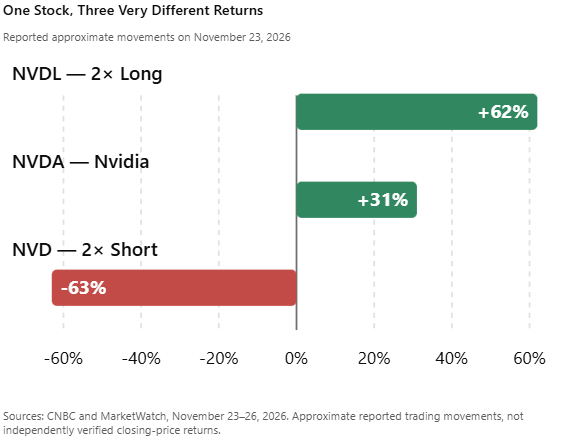
Nvidia's reinstatement of Jensen Huang as chief executive officer on Monday, November 23, 2026, triggered dramatic movements in exchange-traded funds tied to the company's stock. Some leveraged investment products lost more than half their value in a single trading session, while others recorded substantial gains.
The GraniteShares 2x Short NVDA Daily ETF fell approximately 63 percent Monday as Nvidia shares surged around 31 percent. Its counterpart, the GraniteShares 2x Long NVDA Daily ETF, gained approximately 62 percent.
The opposing movements illustrate how quickly leveraged investment products can generate substantial gains or losses when individual stocks experience unusually large price changes.
Huang's Return Triggers Technology Stock Rally
Nvidia's board reinstated Huang as president, chief executive officer and a member of its board of directors following his resignation on November 12.
His departure had contributed to a broader sell-off involving artificial intelligence companies. The announcement of his return encouraged investors to reconsider their positions in technology stocks.
However, the initial rally did not eliminate uncertainty surrounding Nvidia's corporate governance or the outlook for artificial intelligence investments.
Reuters reported that Nvidia shares declined more than six percent Tuesday as the momentum generated by Monday's announcement weakened.
On Wednesday, Moody's said Huang's reinstatement had reduced uncertainty surrounding the company but left its credit ratings unchanged.
The rapid changes in Nvidia's share price created particularly challenging conditions for investors holding leveraged funds.
How Leveraged Nvidia ETFs Work
Exchange-traded funds, commonly known as ETFs, allow investors to purchase shares in investment portfolios that trade on stock exchanges.
Traditional ETFs often track broad market indexes containing numerous companies. However, single-stock ETFs concentrate their exposure on one company.
The GraniteShares 2x Long NVDA Daily ETF, which trades under the symbol NVDL, seeks to deliver twice Nvidia's daily percentage performance before fees and expenses.
The GraniteShares 2x Short NVDA Daily ETF, which trades under the symbol NVD, seeks to deliver twice the inverse of Nvidia's daily performance.
Consequently, when Nvidia shares increase by 10 percent in a single session, the long fund aims to gain approximately 20 percent. The inverse fund would target a loss of approximately 20 percent.
Actual investment returns can differ from these objectives because of fees, financing costs, trading conditions and other factors.
Monday's extraordinary movements demonstrated the potential consequences of using these funds when the underlying stock experiences extreme volatility.
Financial Experts Warn About Leverage
Mike Akins, a founding partner of financial research company ETF Action, discussed the recent movements during an appearance on CNBC's ETF Edge.
Akins expressed concern about the speed and magnitude of the recent market declines and recoveries. He explained that such extreme fluctuations were not typical of a healthy market.
Will Rhind, founder and chief executive officer of GraniteShares, also participated in the discussion.
The company has continued expanding its selection of leveraged investment products, reflecting demand from traders seeking amplified exposure to individual stocks.
Karen Finerman, co-founder and chief executive officer of Metropolitan Capital Advisors, warned that leverage could expose investors to particularly damaging losses.
The Securities and Exchange Commission has previously issued similar warnings regarding leveraged and inverse ETFs. These products can be difficult to understand, particularly when investors hold them beyond their intended daily investment period.
Daily Resets Can Amplify Investment Risks
One of the most important characteristics of leveraged ETFs is that most reset their investment exposure every trading day.
This means their performance over several days or weeks may differ considerably from twice the overall movement of the underlying stock.
For example, consider a stock initially worth $100 that falls 20 percent on the first day before rising 25 percent the following day. The stock returns to its original value of $100.
A hypothetical two-times leveraged long ETF starting at $100 would lose 40 percent on the first day, leaving it worth $60. A subsequent 50 percent increase would bring its value to $90.
Despite the underlying stock fully recovering, the leveraged fund would still have lost 10 percent.
This simplified example excludes fees and other expenses, but demonstrates how daily compounding can affect investment returns during volatile periods.
AI Investments Remain Under Pressure
Nvidia's recent share price movements have occurred amid broader concerns about the financial sustainability of artificial intelligence investments.
Technology companies have committed substantial resources to advanced semiconductor equipment, data centers and computing infrastructure.
Investors are increasingly examining whether anticipated revenue and profits will justify these expenditures.
Nvidia occupies a central position in the industry because its graphics processing units are widely used to develop and operate advanced artificial intelligence systems.
Changes in the company's leadership, financial outlook or corporate strategy can therefore influence investor sentiment throughout the technology sector.
American stock exchanges remained closed Thursday for Thanksgiving, with trading scheduled to resume Friday during a shortened session.
Investors holding leveraged Nvidia funds will face another daily reset as markets reopen, regardless of whether the underlying stock continues its recovery or experiences renewed selling pressure.