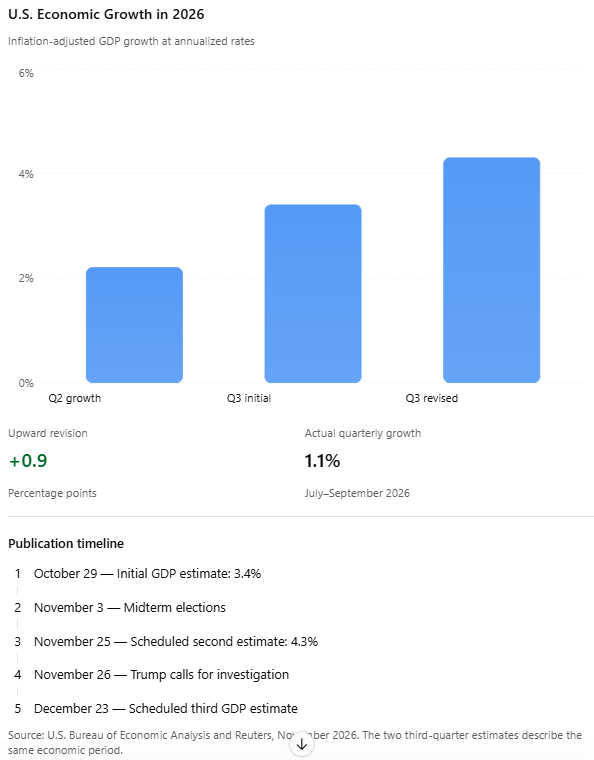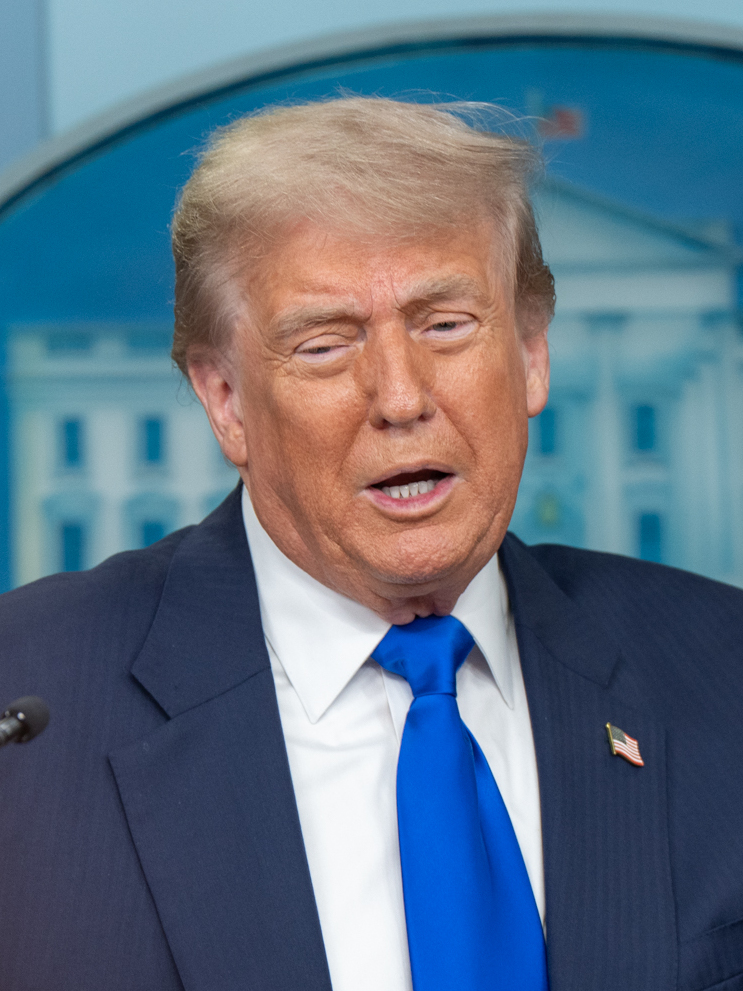
President Donald Trump accused the Commerce Department on Thursday, November 26, 2026, of deliberately understating economic growth before the midterm elections. He called for an immediate investigation after federal statisticians revised their estimate of third-quarter growth from 3.4 percent to 4.3 percent.
The president suggested that the original figures may have influenced the November 3 elections, in which Republicans lost control of both chambers of Congress.
However, Trump did not provide evidence that government employees intentionally manipulated the data. The revised figures were released according to a schedule established before Election Day.
Trump Questions Timing of Economic Report
In a Thanksgiving Day post on Truth Social, Trump accused government officials of releasing inaccurate economic figures shortly before voters went to the polls.
“Why wasn’t the correct number issued before the Election?” Trump wrote.
The president characterized the difference between the two estimates as a deliberate error and demanded an investigation.
Later Thursday, while speaking to reporters at his Mar-a-Lago property in Florida, Trump questioned how the original estimate could differ from the updated figure by almost an entire percentage point.
The Commerce Department did not immediately respond to requests for comment. Most federal government offices were closed for the Thanksgiving holiday.
What the Revised GDP Figures Show
The Bureau of Economic Analysis released its second estimate of third-quarter gross domestic product on Wednesday, November 25.
GDP measures the value of goods and services produced within a country's economy. Economists use changes in inflation-adjusted GDP to evaluate whether economic activity is expanding or contracting.
The latest report estimated that the American economy grew at an annualized rate of 4.3 percent between July and September. The economy had grown at a 2.2 percent annualized rate during the previous quarter.
The revised figure represents an increase of 0.9 percentage points from the initial estimate published on October 29.
According to the Bureau of Economic Analysis, the revision primarily reflected updated information about business investment and consumer spending.
New and revised data concerning software, pharmaceutical products, recreational goods and energy purchases contributed to the higher estimate. Updated information about healthcare spending partially offset those increases.
The 4.3 percent figure represents an annualized growth rate rather than the actual increase in economic output during the three-month period. Measured on a quarterly basis, the economy expanded approximately 1.1 percent.
Why Government Economists Revise GDP Estimates
The federal government regularly revises economic statistics as more complete information becomes available.
The first GDP estimate for each quarter typically appears approximately one month after that quarter ends. At that point, some information about consumer purchases, business inventories and international trade remains incomplete.
Economists use available information and statistical estimates to calculate economic growth. Subsequent reports incorporate additional survey results and updated figures.
The second estimate normally appears approximately one month after the initial release, followed by a third estimate the following month.
The October 29 report explicitly identified November 25 as the scheduled date for the second estimate. The latest revision therefore occurred on its previously announced publication date rather than following an unexpected delay.
Historical economic records can also undergo further revisions as government agencies receive more comprehensive information or update their statistical methods.
Such revisions can increase or decrease previously reported growth rates.
Large Revisions Have Occurred Before
Trump described the latest adjustment as historically unprecedented. However, previous economic reports have included revisions of similar magnitude.
Reuters cited research co-authored by Bureau of Economic Analysis Director Vipin Arora showing that quarterly GDP revisions approaching or exceeding one percentage point have occurred several times over the past 25 years.
Although the latest revision was relatively large, its size alone does not establish that the original figure was inaccurate because of deliberate misconduct.
The Bureau of Economic Analysis has also published technical information explaining which updated data contributed to the revised estimate.
Previous Disputes Over Economic Statistics
The latest controversy follows an earlier dispute between Trump and federal officials responsible for producing employment statistics.
In August 2025, Trump dismissed Bureau of Labor Statistics Commissioner Erika McEntarfer after the agency released a weaker-than-expected employment report.
The initial July 2025 report estimated that employers had added 73,000 jobs. It also included substantial downward revisions to employment growth during previous months.
Trump accused McEntarfer of manipulating employment statistics for political purposes but did not publicly establish evidence supporting that allegation.
The Bureau of Labor Statistics operates within the Department of Labor, while the Bureau of Economic Analysis operates within the Commerce Department.
Both agencies produce statistics used by businesses, investors, government officials and researchers when making economic decisions.
Economic Growth and Household Concerns
The stronger GDP estimate arrives amid continuing concerns about inflation and household living costs.
Economic growth and consumer sentiment do not necessarily move together. An expanding economy can coexist with financial difficulties among households facing high housing costs, expensive groceries or rising borrowing costs.
Investment in technology and other business activities can also contribute substantially to GDP growth without immediately improving the financial circumstances of every household.
These distinctions help explain why favorable economic statistics do not always translate into positive public assessments of economic conditions.
The Federal Reserve must also consider inflation, employment and other economic indicators when determining whether to adjust interest rates.
Stronger economic growth may influence those decisions, but it does not automatically establish what action central bank officials will take.
Another GDP Estimate Is Scheduled for December
The Bureau of Economic Analysis is scheduled to publish its third estimate of economic growth for the July-to-September period on December 23, 2026.
That report could contain further revisions as additional economic information becomes available.
Trump has called for an investigation into the earlier figures, but the scope and procedures of any formal inquiry have not been announced.
The government's published release schedule and technical documentation remain available for examining how the latest GDP estimates were produced.