

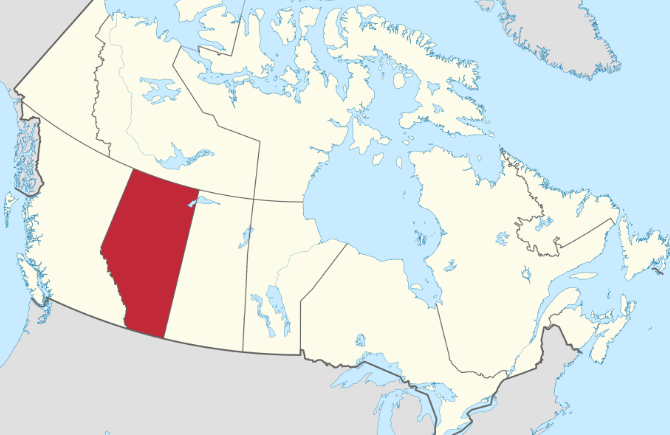
Canadian Prime Minister Mark Carney has taken his campaign for national unity directly to Alberta as voters prepare to decide whether the province should begin a legal process that could eventually lead to a binding referendum on separation from Canada.
Speaking Thursday, October 15, at a Forever Canadian rally in Calgary, Carney warned that outside forces are trying to exploit divisions inside the country. He said the October 19 referendum comes at a dangerous time as Canada faces economic pressure from the United States and renewed questions about its sovereignty.
“Some outside our borders are working to break us so they can own us,” Carney told the crowd.
Carney did not name the United States in that sentence. However, he has repeatedly connected the national unity debate to President Donald Trump’s trade policies and past statements about making Canada the 51st U.S. state.
A Vote on the Path, Not Immediate Independence
Alberta voters are not being asked Monday to approve immediate independence. The key question asks whether Alberta should remain a province of Canada or whether the provincial government should begin the legal process required to hold a future binding referendum on separation.
Elections Alberta says the separation question is nonbinding. It is Question 10 on a broader referendum containing 10 questions, including issues involving immigration, provincial programs and voter identification.
The wording gives voters two choices. They can vote for Alberta to remain in Canada or direct the provincial government to begin the constitutional process that could lead to a later binding referendum.
Even if the second option wins, Alberta would not automatically leave Canada. Separation would involve constitutional requirements, negotiations with Ottawa and major questions involving federal assets, debt, borders, trade and Indigenous treaty rights.
Carney Urges Albertans Not to “Send a Message”
Carney urged voters not to treat the referendum as a protest vote against Ottawa.
He argued that choosing the separation path simply to pressure the federal government could produce years of uncertainty. He called for a decisive result that would settle the immediate question about Alberta’s place in Canada.
The prime minister also drew on his personal connection to the province. Carney grew up in Alberta and attended school in Edmonton. In recent months, he has emphasized federal investment in housing, transportation and energy projects as evidence that Alberta can gain more influence and opportunity while remaining inside Canada.
One of the most important projects is Pacific Link, the proposed oil pipeline from Alberta to the West Coast. The federal government designated the project as being in the national interest on October 1.
The project is intended to give Canadian oil producers more access to overseas markets and reduce dependence on the United States. Carney has made economic diversification a major part of his response to U.S. tariffs and trade pressure.
Danielle Smith Opposes Separation
Alberta Premier Danielle Smith has often criticized federal policy, especially in areas involving energy, taxation and provincial authority. However, she has said clearly that she supports Alberta remaining in Canada.
Smith has said the province should use its constitutional powers more aggressively while staying inside the federation. She also said she would personally vote for Alberta to remain a Canadian province.
The separation question was added after months of political pressure and petition campaigns on both sides of the issue. Smith has said roughly 700,000 Albertans signed either the Forever Canada petition or the Stay Free Alberta petition seeking a public vote on the province’s future.
A court ruling complicated an earlier citizen-led effort to force a separation referendum. Smith’s government responded by adding a different, nonbinding question to the October ballot that asks whether the province should begin the legal process toward a future vote.
The Alberta government has also commissioned research into the possible costs and benefits of separation. The province says the goal is to provide voters with factual information before the referendum.
Longstanding Alberta Grievances
Support for Alberta separation has grown from longstanding complaints about the province’s relationship with Ottawa. Separatist activists argue that Alberta contributes too much to federal finances while facing national policies that limit development of its oil and gas industry.
They also object to federal environmental rules, equalization payments and what they describe as excessive federal control over provincial decisions.
Opponents say separation would create new economic risks and difficult legal questions. Alberta is landlocked, depends heavily on trade routes through other provinces and the United States, and would have to negotiate arrangements involving currency, pensions, federal programs, national debt and access to markets.
Indigenous governments would also play a major role in any serious separation process. Treaties covering much of Alberta were made with the Crown, and First Nations have argued that provincial separation cannot simply override treaty and constitutional rights.
U.S. Tensions Add Another Layer
The referendum is taking place while Canada is trying to reduce its economic exposure to the United States. Trump’s tariffs on Canadian products have already disrupted industries including steel, aluminum and automobiles.
Carney has responded by promoting domestic investment and new trade relationships outside the United States. His government has also argued that infrastructure such as Pacific Link would give Canada more control over where it sells its natural resources.
That wider conflict explains why Carney has framed Alberta’s referendum as more than an internal political dispute. In his view, a divided Canada would have less leverage when dealing with a much larger neighboring economy.
Separatist supporters reject the idea that remaining in Canada is necessary for economic security. They argue that an independent Alberta could negotiate its own trade and energy arrangements.
Monday’s referendum will show how much support exists for moving that argument into a formal constitutional process.
Advance voting began October 13 and continues through October 17. The final day of voting is October 19, with polls scheduled to close at 8 p.m. local time. Elections Alberta says unofficial results should be available within 48 hours after all voting locations close, while official results are scheduled for October 29.