

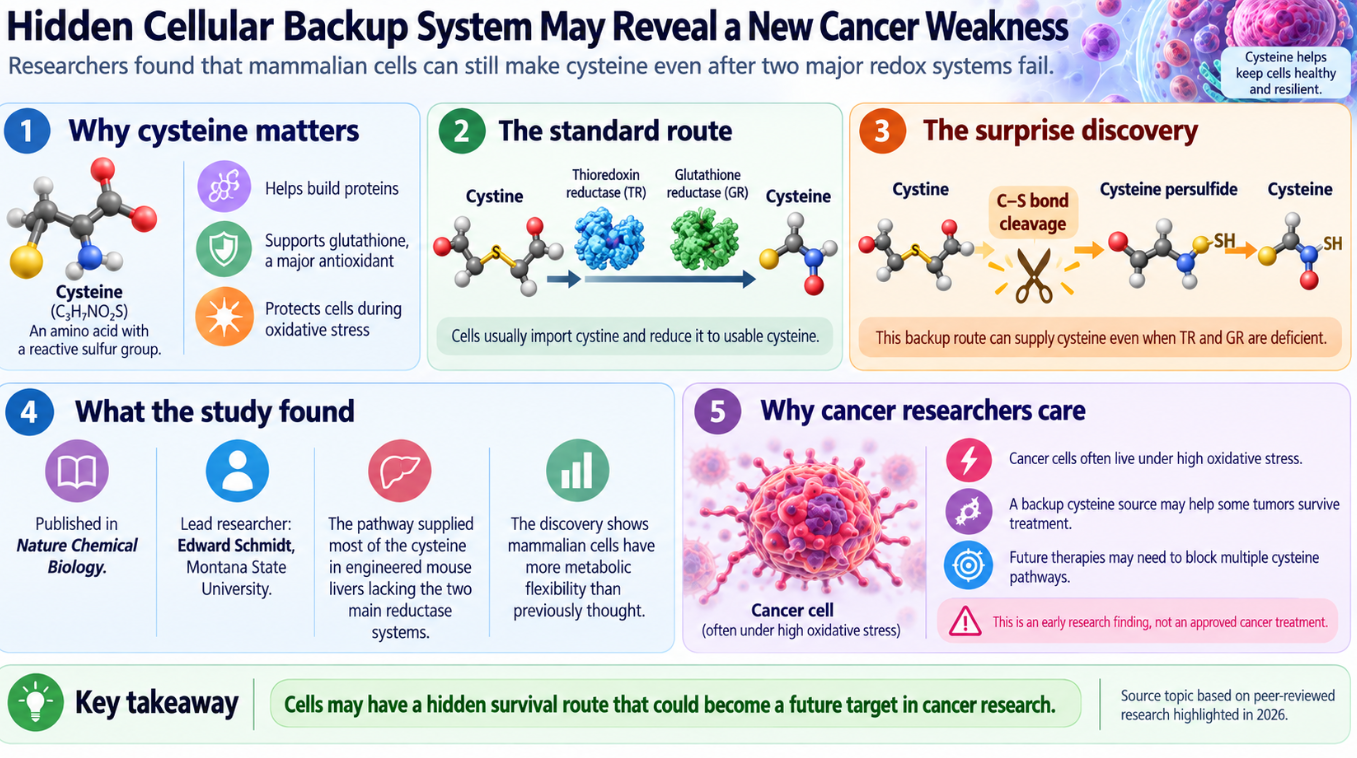
A cellular survival system once thought impossible is getting new attention because it may help explain how some cells endure severe chemical stress. Researchers found that mammalian cells can make the amino acid cysteine even after two major systems used to maintain the cell’s supply have been disabled. The discovery could eventually help scientists identify new weaknesses in some cancers.
The research was published May 21 in Nature Chemical Biology and was highlighted again on September 24 by Montana State University. It was led by Edward Schmidt of Montana State, with collaborators in the United States, Hungary, and Spain.
Cysteine is an amino acid that cells need for many basic jobs. It is used to build proteins and helps cells control damaging chemical reactions. It is also needed to make glutathione, one of the cell’s major antioxidant molecules.
Cells therefore need a dependable supply of cysteine.
Outside cells, much of this sulfur-containing nutrient exists as cystine. Cystine consists of two cysteine molecules connected by a disulfide bond. Cells normally bring in cystine and then chemically reduce it to produce usable cysteine.
Two enzyme systems have long been considered central to that process. They involve thioredoxin reductase and glutathione reductase, often shortened to TR and GR. These enzymes help cells convert oxidized molecules back into forms that can be used in normal metabolism.
In bacteria and yeast, losing both systems is lethal.
That history led scientists to believe mammalian cells would face the same problem. Yet genetically engineered mice provided an unexpected result. Mice whose liver cells lacked both thioredoxin reductase and glutathione reductase continued to survive.
According to the Montana State University research account, Schmidt first encountered the unexpected result in work dating back to 2014. His team had created mice whose liver cells lacked the known machinery that researchers believed was necessary for reducing cystine. Instead of failing as expected, the livers remained functional enough for the animals to live.
The observation raised a basic question: Where was the cysteine coming from?
Finding the answer took years of work.
The team discovered that mammalian cells have another route for extracting cysteine from cystine. Rather than breaking the disulfide bond in the usual way, the backup pathway breaks a neighboring carbon-sulfur bond.
The reaction creates a molecule called cysteine persulfide. That molecule can then break down without an enzyme and release cysteine that the cell can use.
The researchers found that this pathway supplied most of the cysteine in the livers of mice that lacked the two main reductase systems. A separate pathway called transsulfuration provided some cysteine, but it did not explain most of the supply.
This means mammalian cells have more metabolic flexibility than scientists had recognized.
The new pathway appears to become important when cystine builds up inside the cell. The researchers reported that it is regulated by levels of sulfur-containing metabolites and may act as a protective response when ordinary cystine-processing systems are overwhelmed or unavailable.
That could help cells survive oxidative stress.
Oxidative stress happens when reactive molecules build up faster than a cell can control them. These molecules can damage proteins, DNA, cell membranes, and other structures. Cells use antioxidant systems, including those involving cysteine and glutathione, to keep that damage under control.
Schmidt and his colleagues suggest that the backup pathway may have evolved as protection against reactive chemicals and toxins encountered by early multicellular organisms. It could have allowed cells to remain alive when their normal redox systems were disrupted.
The same ability could have a downside.
Cancer cells often experience high levels of metabolic and oxidative stress. Many cancer treatments also work partly by increasing damage or pushing tumor cells beyond what their protective systems can handle.
If cancer cells can activate this newly identified cysteine-producing pathway, it might provide another way for them to survive treatment.
That possibility is not yet a cancer therapy.
The study primarily established the biochemical pathway and demonstrated its importance in mammalian liver cells under unusual experimental conditions. Researchers have not shown that blocking the pathway cures cancer in people, and no treatment based on the discovery has been approved.
There is, however, a strong reason for scientists to investigate the connection.
A review published in the journal Cancers has described cysteine metabolism as particularly important to many tumors. Cancer cells can depend heavily on cystine from their surroundings to maintain cysteine supplies, produce glutathione, control oxidative stress, and continue growing.
Researchers have already been studying ways to interfere with cystine uptake or cysteine metabolism in tumors. The newly discovered pathway adds another piece to that picture because it shows that mammalian cells have a backup route that could help them compensate when better-known systems are blocked.
That could matter when designing drugs.
A treatment aimed at one cysteine pathway might be less effective if a tumor can switch to another route. Understanding the full network of cysteine production and recycling could help researchers identify combinations that leave cancer cells with fewer ways to adapt.
It also creates a challenge because healthy cells use these protective systems too.
Any future cancer treatment would need to damage tumor defenses without causing unacceptable harm to normal tissues. The newly discovered pathway may be an especially interesting target if researchers find that certain cancers depend on it more heavily than healthy cells do.
Scientists still need to identify exactly which enzymes drive the carbon-sulfur bond cleavage under different conditions. They also need to determine how widely the mechanism operates across tissues and cancer types.
The work involved researchers from Montana State University, the University of Veterinary Medicine in Budapest, Hungary’s National Institute of Oncology, the Moffitt Cancer Center, the University of Seville, Semmelweis University, and other institutions.
The findings change a long-standing assumption about how mammalian cells keep themselves alive. Removing the two best-known cystine-reduction systems does not necessarily cut off the cell’s supply of cysteine.
Instead, cells can reroute their chemistry.
For cancer research, the most important question is now whether tumors regularly use this hidden pathway when treatment puts them under stress. If they do, the mechanism could become another target in efforts to make resistant cancer cells easier to destroy.