

Scientists have created two large catalogs that could greatly expand the search for unusual quantum materials. The work focuses on two-dimensional materials, which can be only one or a few atoms thick. By stacking these sheets and turning one layer slightly, researchers can change how electrons move and interact.
The two studies were published on September 24 in Science. Together, they examine thousands of possible materials that could be used in a field known as twistronics.
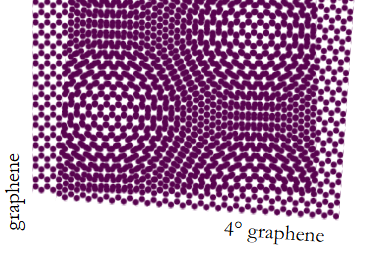
Twistronics grew from experiments with graphene, a sheet of carbon only one atom thick. Researchers found that putting two graphene layers together at certain angles can produce electronic behavior that does not exist in either layer by itself. Small changes in the angle can strongly affect how electrons travel through the combined material.
The effect happens because the two atomic patterns create a larger repeating pattern called a moiré pattern. A similar visual effect can appear when two screens, meshes, or striped patterns overlap at slightly different angles. At the atomic scale, these larger patterns can reshape the energy landscape experienced by electrons.
That gives researchers a new way to change the properties of matter without changing its basic chemical ingredients.
According to a Princeton University research summary, the first new study examined 8,872 entries from two computational databases of two-dimensional materials. Researchers used a method called topological quantum chemistry to study the electronic structures of those materials. They found 4,073 entries that had nontrivial topology or another unusual electronic arrangement known as an obstructed atomic limit.
The study identified 905 topological insulators. These materials can behave as insulators in their interiors while allowing electricity to move along their edges under certain conditions. Such protected edge behavior is of interest to researchers studying quantum electronics and other technologies that may need electronic states that are less sensitive to some forms of disturbance.
The researchers also identified 1,003 obstructed atomic insulators. In these materials, the centers of electronic charge can be forced by symmetry to sit in locations that do not line up with the atoms themselves. This can create unusual electronic behavior at edges or surfaces.
The catalog does not mean that every listed material will become a useful device. Many entries are computational candidates, and some may be difficult or impossible to produce in a practical form.
Still, the catalog gives researchers a much larger map of possible starting materials.
The second Science study asked a more specific question. Which of these thin materials appear suitable for stacking and twisting in ways that scientists can model and eventually test?
Researchers developed a high-throughput screening method and identified 61 semimetal candidates and 1,568 insulating candidates that appear especially suitable for twisting. The materials include several types of crystal structures, including hexagonal, square, rectangular, and oblique lattices.
That variety matters because different atomic patterns can cause electrons to behave in very different ways. A twisted square lattice, for example, may help researchers study versions of the Hubbard model, a major theoretical model used to understand how interacting electrons behave in solids. The Hubbard model is often discussed in research involving magnetism and high-temperature superconductivity.
Rectangular materials could offer another opportunity. They may allow researchers to study electronic behavior that resembles electrons moving through one-dimensional chains, even though the material itself is a two-dimensional sheet.
The arXiv version of the twistable-material study explains that scientists have already studied twisted bilayer graphene and twisted transition metal dichalcogenides extensively. The new database is designed to move beyond those familiar systems and identify a much wider range of possibilities.
The researchers are not relying only on computer calculations.
Teams involved in the project have already grown crystals of several promising compounds. These include tin diselenide, hafnium disulfide, tin disulfide, gallium telluride, and zirconium nitride chloride. Initial work showed that some of these crystals can be peeled down into extremely thin layers suitable for further experiments.
The scientists also calculated the behavior of selected twisted bilayers. Some produced narrow electronic energy bands, which are important because narrow bands can increase the influence that electrons have on one another.
Strong electron interactions can lead to unusual collective behavior. Depending on the material and conditions, that can include magnetism, superconductivity, and other quantum states that are difficult to produce or study in ordinary materials.
Harvard researchers describe twistronics as the study of structural and electronic changes that appear when layered crystals are rotated relative to one another. The resulting moiré structures can have properties that are very different from the individual layers.
The new catalogs could make that process more systematic. Instead of beginning with a handful of famous materials and experimenting with different angles, scientists can search a large database for layers with specific electronic structures and crystal symmetries.
That could help researchers design materials around a particular physics problem.
For example, a scientist interested in strong electron interactions could search for a material whose electronic bands are expected to flatten after twisting. Another team might look for a material with a particular crystal symmetry that could support a topological state. Researchers could then grow the material, separate it into thin layers, stack those layers, and test whether the predicted behavior appears.
There are still major challenges. Producing clean single layers can be difficult, controlling the twist angle can require great precision, and many unusual quantum effects appear only at very low temperatures. A theoretically interesting candidate may also turn out to be unstable or difficult to manufacture.
The database therefore serves more as a research map than a list of ready-made technologies.
Even so, the scale of the search is significant. The first study organizes electronic information for nearly 9,000 two-dimensional material entries, while the second narrows that collection to more than 1,600 candidates that appear especially useful for twisting.
The work also provides public tools that other scientists can use. The Topological 2D Materials Database allows researchers to examine electronic structures, topological properties, and information about whether materials are thought to be experimentally known or computationally predicted.
Twistronics has already shown that a tiny rotation can produce major changes in electronic behavior. These new studies suggest that graphene may have been only one early example of a much larger family of twistable quantum materials.
The next step will be testing more of those candidates in laboratories and seeing which predicted states actually appear.