

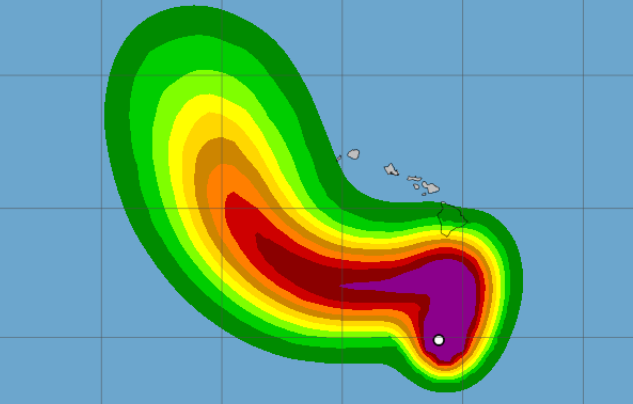
Hurricane Nolo strengthened south of Hawaii on Thursday and is moving toward the Big Island, bringing the threat of dangerous flooding, strong winds and damaging surf. The storm is expected to pass near or just south of Hawaii Island on Friday and Saturday, with the Big Island facing the greatest risk.
As of 5 p.m. Hawaii Standard Time Thursday, Nolo had maximum sustained winds of 75 mph. The storm was about 270 miles south of South Point on Hawaii Island and was moving north-northeast at about 5 mph.
The National Hurricane Center said an Air Force Reserve Hurricane Hunter aircraft confirmed that Nolo had strengthened into a hurricane. Forecasters said the storm could continue to strengthen as it approaches the islands, although its exact path and intensity remain uncertain.
A hurricane watch and tropical storm warning were in effect for Hawaii County. Maui County was also under a tropical storm watch as officials prepared for the possibility of strong winds, heavy rain and flooding.
Rain is expected to be one of the most serious threats.
Forecasters said the Big Island could receive 15 to 30 inches of rain through Saturday, with even higher totals possible in isolated areas. The heaviest rain is expected on windward and southeastern parts of the island, where steep terrain can quickly send water into streams, roads and low-lying communities.
The National Weather Service placed large parts of Hawaii Island and Maui County under a flood watch. It warned that heavy rainfall could lead to dangerous flash flooding, landslides and rapidly rising streams.
The risk is especially serious because parts of the Big Island are still recovering from earlier storms. The Associated Press reported that some of the areas expected to receive the heaviest rain were also hit by Hurricane Lala in August. Roads were washed out and some communities were temporarily isolated during that storm.
John Bravender, a warning coordination meteorologist with the National Weather Service in Honolulu, said the southeastern part of the Big Island is a major concern because the ground there remains wet. Additional heavy rain could make flooding and landslides more likely.
State officials began preparing before Nolo reached hurricane strength.
Hawaii Gov. Josh Green ordered state and county offices, public schools and University of Hawaii facilities on Hawaii Island to close Thursday and Friday. Similar closures are scheduled for Maui County on Friday.
The governor said the closures were intended to keep people off the roads, give families time to prepare and allow emergency crews to move safely. Hawaii also requested a federal emergency declaration that could provide additional support for debris removal, search and rescue, emergency power and other services.
More than 230 Hawaii National Guard members were activated as part of the state's preparations, according to the Associated Press. Officials have also urged residents to assemble emergency supplies, review evacuation plans and follow local alerts.
The Hawaii Department of Land and Natural Resources closed state parks, campgrounds, forest reserves, hiking trails, wildlife sanctuaries and other outdoor areas on Hawaii Island. Similar closures were scheduled to begin Friday on Maui and Molokai.
Officials said the closures are meant to keep people away from places that could become dangerous if streams rise or landslides block roads and trails.
Power outages are another concern.
Hawaiian Electric said it increased staffing and positioned crews and equipment so workers could respond after the storm. Crews that had been helping restore power on Kauai following Hurricane Lowell were being returned to bases on Oahu, Maui and Hawaii Island.
The utility warned that damage to electrical equipment could be extensive depending on Nolo's final track and strength. Some repairs could take longer if roads are blocked or crews cannot safely reach damaged lines.
Residents were advised to charge phones and other devices, prepare flashlights and batteries and keep emergency food and water available. Officials also warned people not to approach fallen power lines.
The ocean around the islands could become dangerous well before the storm's center reaches its closest point.
Large waves and strong currents are expected along exposed shores. Coastal flooding and erosion are possible in some areas, especially where heavy surf combines with high water levels.
The storm is moving through a region where conditions have supported an unusually active Pacific hurricane season. Hawaii has already dealt with several tropical systems in recent weeks, adding pressure to emergency crews and utility workers.
Nolo is also approaching while other powerful storms are active in the Pacific. Hurricane Polo has been affecting Mexico's Pacific coast with dangerous surf and heavy rain, while Hurricane Odalys remains far from land.
For Hawaii, the main concern is not simply whether Nolo's center makes landfall.
A hurricane does not need to move directly over an island to cause major damage. Tropical moisture can produce intense rainfall far from the center, while strong winds can become more severe in mountainous areas because of the terrain.
The storm's slow movement also increases the flooding risk because bands of rain can remain over the same areas for hours.
Emergency officials are asking residents and visitors to take warnings seriously and avoid unnecessary travel once conditions worsen. People living near streams, steep slopes or areas that have flooded before may need to move to safer locations if local officials issue evacuation instructions.
Visitors are also being urged to check with hotels, airlines and local authorities because travel plans could change as the storm approaches.
Forecasters will continue to watch Nolo's turn toward the north and northeast. Even a relatively small change in the track could make a large difference in wind speeds and rainfall totals across Hawaii Island and Maui.
The storm is expected to remain a threat through Saturday.
For residents on the Big Island, the next day will be an important period for final preparations. Officials are urging people to finish securing outdoor items, gather supplies and stay informed as Hurricane Nolo moves closer to Hawaii.