

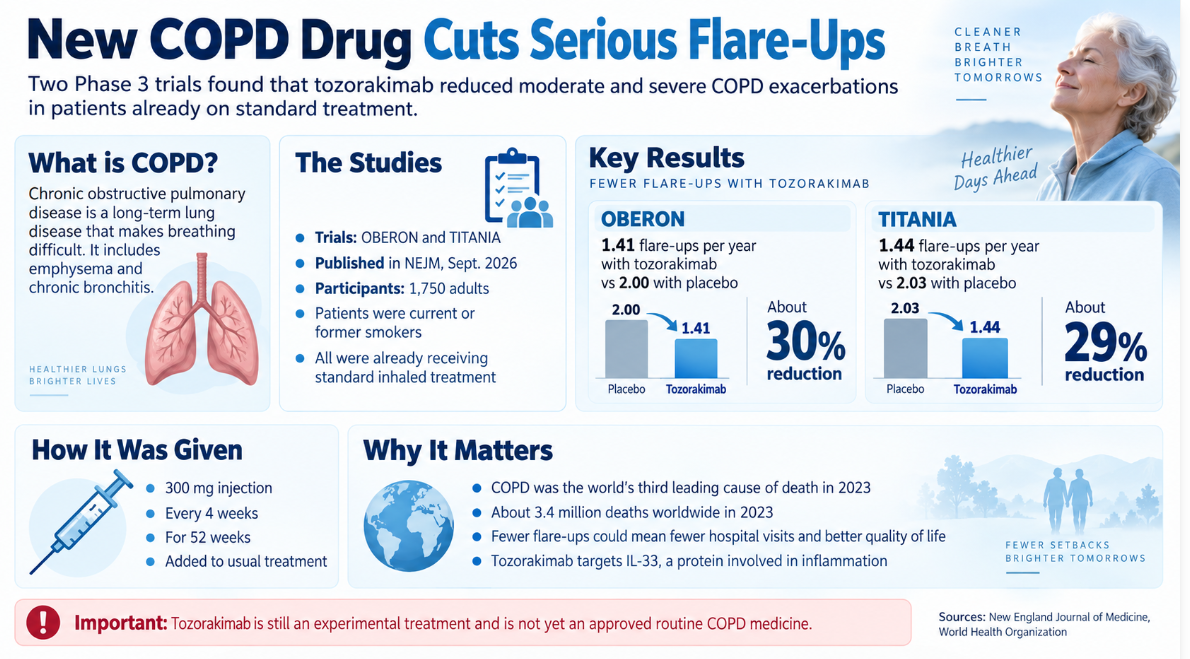
A new experimental drug may give doctors another way to prevent dangerous flare-ups in people with chronic obstructive pulmonary disease, better known as COPD. The drug, called tozorakimab, reduced moderate and severe flare-ups in two large Phase 3 trials. The results could matter to patients who struggle using standard inhaled medicines.
COPD is a long-term lung disease that makes it harder to breathe. It includes conditions such as emphysema and chronic bronchitis. The disease damages the lungs and can cause coughing, wheezing, mucus buildup and shortness of breath.
The World Health Organization says COPD was the third leading cause of death worldwide in 2023. It caused about 3.4 million deaths that year. Smoking is a major cause, while air pollution can also damage the lungs.
There is no cure for COPD.
Treatment usually focuses on controlling symptoms and preventing the disease from getting worse. Patients may use inhalers that open the airways or reduce inflammation. Some people also need oxygen, rehabilitation and help quitting smoking.
A major problem is the sudden worsening of symptoms called an exacerbation, or flare-up. These events can leave a person more short of breath. They may require steroids, antibiotics, an emergency room visit or hospitalization.
Repeated flare-ups can be serious. They can reduce quality of life and make future problems more likely. Researchers have spent years looking for better ways to prevent them.
The new research was published in the New England Journal of Medicine on September 8. Researchers tested tozorakimab in two similar Phase 3 studies called OBERON and TITANIA. Together, the studies included 1,750 adults with COPD who were current or former smokers.
The patients had already been receiving standard inhaled maintenance treatment. They also had a history of COPD flare-ups. Researchers randomly assigned patients to receive either tozorakimab or a placebo in addition to their usual treatment.
The drug was given as a 300-milligram injection every four weeks for 52 weeks.
Tozorakimab is a monoclonal antibody. It is designed to block the activity of interleukin-33, also called IL-33. This protein is involved in inflammation and may contribute to damage and mucus problems in COPD.
The results were similar in both trials. In OBERON, the annual rate of moderate or severe flare-ups was 1.41 in patients receiving tozorakimab. The rate was 2.00 among patients receiving a placebo.
That worked out to about a 30 percent reduction.
In TITANIA, patients receiving the drug had an annual flare-up rate of 1.44. The placebo group had a rate of 2.03. That was about a 29 percent reduction.
Researchers also looked closely at former smokers because they were the main population used for the primary outcome. The drug reduced flare-ups by about 29 percent in OBERON and 34 percent in TITANIA among those patients.
One unusual part of the trials involved eosinophils. These white blood cells can be linked to inflammation. Some biologic treatments work mainly in patients with higher eosinophil levels.
The tozorakimab trials did not require patients to have a certain eosinophil count before joining. The study included people across different eosinophil levels. This could make the treatment useful for a broader group.
Reuters reported that the benefit appeared regardless of smoking status, disease severity or eosinophil level. That broad effect has drawn attention. It could give doctors another option for patients with flare-ups despite standard treatment.
Safety is also important with a treatment that may need to be taken for a long time. In OBERON, adverse events occurred in 70.4 percent of patients receiving tozorakimab and 77.2 percent receiving placebo. In TITANIA, the rates were 80.1 percent and 79.8 percent.
Those numbers do not mean all the events were caused by the drug. Trials count medical problems that happen while participants are being studied.
The treatment is not yet an approved COPD medicine in the United States.
AstraZeneca, which developed tozorakimab and funded the trials, said the Food and Drug Administration accepted its application for priority review. Priority review can shorten the FDA review period. It does not guarantee approval.
The company also has a financial interest in a successful result. The trial publication lists company employees among the authors and states that AstraZeneca supported the research.
The findings are encouraging, but several questions remain. Doctors will want to know how well the benefit continues beyond one year. Researchers will also need to watch for uncommon side effects.
Cost will matter too. Biologic medicines can be expensive because they are more complicated to make than ordinary pills. Insurance coverage could determine how widely the treatment is used.
It is also important to understand what the drug does not do. Tozorakimab did not cure COPD. It was added to standard inhaled therapy for patients who were still having flare-ups.
That means inhalers, smoking cessation and other established treatments would remain important.
For patients with frequent COPD attacks, however, preventing even some flare-ups could have a meaningful effect. Fewer attacks could mean fewer emergency visits and hospital stays. It could also help patients spend more time breathing comfortably.
The two trials provide stronger evidence because they were large, randomized and designed to repeat the same test. Both produced similar reductions in flare-ups. That consistency gives researchers more confidence that the effect was not simply a chance result.
Still, the next major step belongs to regulators and doctors. The FDA must decide whether the evidence supports approval and what patients should receive the medicine. If approved, wider use will show how the drug performs outside controlled trials.
COPD remains a major cause of illness and death around the world. Many patients continue to have serious attacks even with modern inhalers. A treatment that lowers those attacks could become an important addition to COPD care.
For now, tozorakimab is promising rather than proven as a routine treatment. The Phase 3 results show a clear reduction in flare-ups, but long-term safety, cost and access still matter. If those issues can be addressed, the drug could offer new help to people living with a difficult and often progressive lung disease.