Scientists may have discovered one reason harmful aging cells are able to remain in the body instead of being removed by the immune system. The finding could eventually lead to treatments designed to clear these so-called “zombie cells” before they contribute to age-related disease.
Researchers at Cedars-Sinai Health Sciences University identified a protein called PD-L2 that appears to help aging cells avoid immune attack. The study was published September 10 in the journal Cell Metabolism.
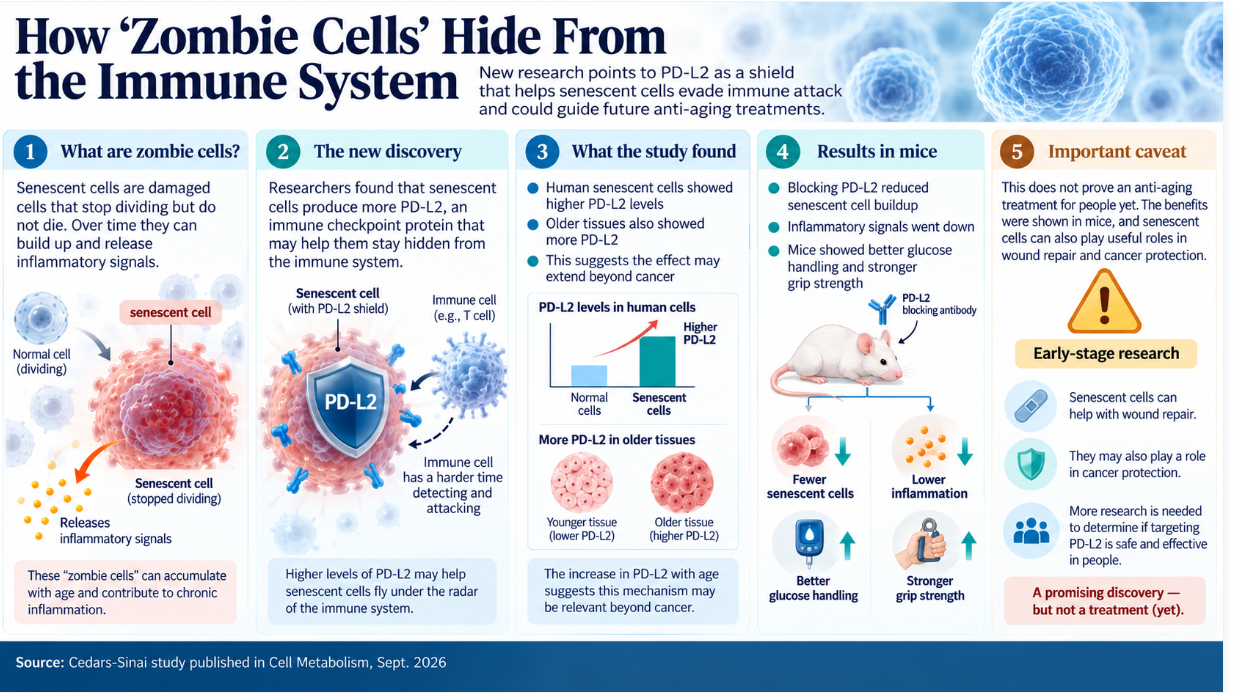
The cells are formally known as senescent cells. They are damaged or stressed cells that stop dividing but do not die. This can be useful for short periods because cellular senescence can help prevent damaged cells from becoming cancerous. Problems can develop when senescent cells remain in tissues and begin to accumulate.
These cells release substances that can cause inflammation and interfere with nearby healthy cells. Their buildup has been linked to several problems associated with aging. Researchers have been trying to find ways to remove them without damaging healthy tissue.
The new study suggests PD-L2 may be one reason senescent cells are difficult for the immune system to eliminate.
PD-L2 is part of an immune checkpoint system. These systems can act like brakes on immune activity. Earlier research found that senescent cancer cells can produce large amounts of PD-L2. This helped the cells escape immune destruction and remain inside tumors.
The new research looked more broadly at senescent cells associated with aging.
Scientists found that human senescent cells produced more PD-L2 than younger cells. Levels of the protein also increased in some human tissues as people aged. This gave the researchers evidence that the process may not be limited to cancer cells.
The researchers then tested what happened when PD-L2 was removed or blocked in laboratory mice.
The number of senescent cells fell. The animals also had lower levels of inflammatory substances produced by those cells. The changes were accompanied by improvements in measures of physical and metabolic health. The mice were better able to process glucose and showed greater grip strength.
Those results raise the possibility that blocking PD-L2 could allow the immune system to recognize and remove cells that would otherwise remain hidden.
Selim Chaib, a research assistant professor of medicine at Cedars-Sinai and one of the study's lead authors, said the findings suggest PD-L2 helps aging cells stay in the body when the immune system would normally remove them.
The discovery could be important because scientists are already studying drugs called senolytics. These treatments are designed to selectively eliminate senescent cells.
PD-L2 offers another possible approach. Instead of directly killing the cells with a drug, researchers may be able to remove part of their protection and allow the body's immune system to do the work.
The protein could also have another use. Researchers believe PD-L2 may eventually serve as a biological marker that helps doctors or scientists estimate how many senescent cells are present in a person. That could make it easier to follow changes during studies of aging treatments.
There is still a major limitation. The study does not show that blocking PD-L2 slows aging in humans.
The experiments showing improved glucose processing and grip strength were conducted in mice. The human portion of the research showed that aging cells and some older tissues had higher levels of PD-L2. Researchers have not yet shown that blocking the protein in people safely removes senescent cells or improves age-related health problems.
That distinction is important because senescent cells are not always harmful. Cellular senescence has roles in areas such as tissue repair and protection against tumor formation. Removing the wrong cells at the wrong time could have unwanted effects. Scientists will need to determine how a treatment could target harmful senescent cells while preserving useful biological functions.
James Kirkland, director of the Center for Advanced Gerotherapeutics at Cedars-Sinai and senior author of the study, said researchers now want to determine whether blocking PD-L2 can safely produce similar benefits in people.
The finding also builds on several years of research into PD-L2. A 2024 study in Nature Cancer found that chemotherapy could create senescent tumor cells that produced high levels of the protein. Researchers found that PD-L2 allowed those cells to escape the immune system and remain inside tumors. The new study suggests a similar process may help aging cells survive throughout the body.
The research team reported several financial interests related to the work. Chaib holds patents or pending patents involving PD-L2 and some have been licensed to a biotechnology company. Other authors reported financial interests involving senolytic drugs and related patents.
The findings are still early but they offer scientists a possible explanation for a long-standing question. The immune system is designed to remove damaged cells. Yet many senescent cells somehow survive for years.
PD-L2 may be part of the answer.
If future studies show that the protein can be blocked safely in humans, researchers may have a new way to help the immune system clear harmful aging cells before they accumulate and damage surrounding tissues.