

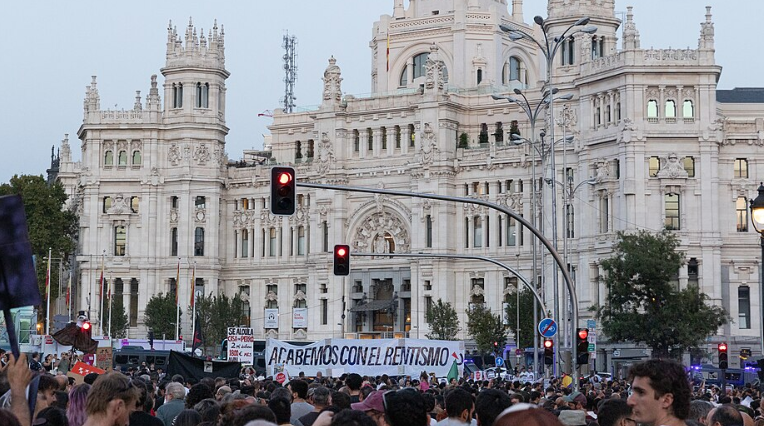
Spain is entering a period of political uncertainty as a housing crisis fuels protests and an early general election. Prime Minister Pedro Sánchez has called the election for November 29 after his minority government suffered a major defeat in Parliament.
The government approved 21 urgent housing measures on October 6 in response to growing public pressure.
The measures are designed to make renting and buying homes more affordable. They also seek to increase housing supply and strengthen protections for vulnerable tenants.
Housing has become one of the biggest concerns for voters across Spain. According to Reuters it has topped surveys of public concerns for three years.
Tens of thousands of people have taken part in housing protests across the country. The demonstrations grew after 87-year-old María del Carmen Abascal was evicted from the Madrid home where she had lived for about 70 years.
Large protests were held in Madrid and other cities. Demonstrations in Barcelona on October 5 ended in clashes between some protesters and police.
The government's latest package includes a €10 billion financing program for housing. It would provide interest-free loans of up to €50,000 for some people buying their first home. The package also includes tax incentives for landlords who offer affordable rents.
Other measures would extend protections for vulnerable people facing eviction. The government also wants tighter rules for seasonal rentals and room rentals that can sometimes be used to avoid normal rent controls.
The measures still require approval from Spain's permanent parliamentary committee because Parliament has been dissolved for the election campaign.
Sánchez announced the snap election after lawmakers rejected two earlier housing decrees. The conservative People's Party; the far-right Vox party; and the Catalan Junts party opposed the previous measures.
The Associated Press reported that Sánchez hopes to make housing the central issue of the election. His opponents are expected to focus on different issues including immigration and corruption allegations involving people close to the prime minister.
The housing crisis has developed despite relatively strong economic growth in Spain. Home prices have risen sharply while many younger adults have found it increasingly difficult to buy or rent homes.
The shortage is especially severe in major cities and popular tourist areas. Critics of rent controls argue that Spain needs to build more homes while tenant groups are demanding stronger restrictions on prices and evictions.
The political situation has also become more complicated because Catalan separatist leader Carles Puigdemont may soon return to Spain.
Spain's Supreme Court lifted an arrest warrant for Puigdemont on October 6 after a Constitutional Court ruling allowed the country's amnesty law to cover charges against him. Puigdemont fled Spain after Catalonia's disputed independence referendum in 2017.
His possible return could bring the Catalonia issue back into the national debate just weeks before the election. Sánchez has defended the amnesty as an attempt to reduce political tensions in Catalonia.
For now Spain's housing crisis remains at the center of both the protests and the election campaign. The coming weeks will determine whether the government's latest measures survive and how voters respond when they go to the polls on November 29.