

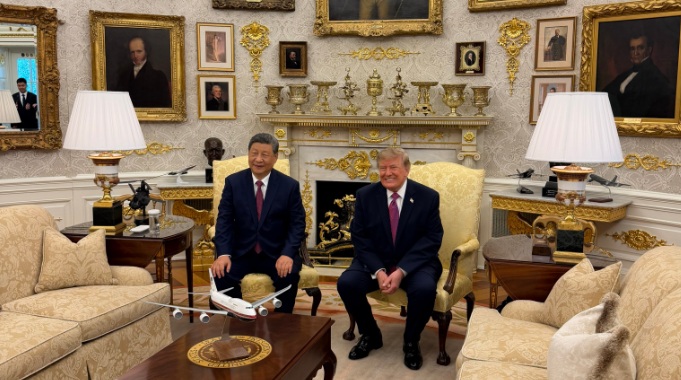
President Donald Trump welcomed Chinese President Xi Jinping to Washington on Thursday for a state visit focused on trade, technology, security, and the relationship between the world’s two largest economies. The meeting came at a time when both governments are trying to prevent competition from turning into a deeper economic crisis.
Xi’s visit is his first to Washington in more than a decade. He last visited the White House in 2015 during the Obama administration.
Trump greeted Xi with an elaborate ceremony and emphasized their personal relationship. He said the two leaders had built a strong friendship. Xi, meanwhile, spoke about the need for cooperation and called for a more stable relationship between the two countries.
The Associated Press reported that the talks came as Washington and Beijing remain divided over trade, artificial intelligence, Taiwan, and the war involving Iran. Both sides have also been trying to manage competition in advanced technology without completely cutting economic ties.
Trade remained one of the biggest issues.
The United States and China have spent years imposing tariffs, export controls, investment restrictions, and other measures on each other. Although some trade disputes have eased, major disagreements remain over market access, government subsidies, industrial policy, and the treatment of foreign companies.
Trump has argued that China has benefited unfairly from trade with the United States. Chinese officials have rejected many of those complaints and have accused Washington of using economic restrictions to contain China’s growth.
Technology was another major topic.
The two governments are competing over artificial intelligence, semiconductors, advanced computing, and other industries important for both economic growth and national security. U.S. officials have limited Chinese access to some advanced chips and manufacturing equipment. China has responded with its own controls on critical materials.
According to Reuters, China’s strength in rare earth minerals has become an important source of leverage in the relationship. Rare earths are used in military equipment, cars, electronics, energy systems, and advanced manufacturing.
One specific concern involves yttrium.
U.S. and Japanese government and business officials recently discussed Chinese restrictions affecting supplies of yttrium. The metal is important for aerospace, semiconductor production, and heat-resistant coatings used in jet engines.
China dominates the global supply chain for many rare earth materials. That has raised concerns in Washington and Tokyo about dependence on Chinese exports. Both countries have been trying to secure alternative supplies, increase domestic production, and build larger stockpiles.
The yttrium issue shows how trade disputes now reach far beyond tariffs.
Critical minerals have become part of a wider struggle involving technology, defense production, and industrial policy. Even a relatively obscure material can affect factories, military suppliers, and major technology companies if supplies are disrupted.
Taiwan also remains a major source of tension.
China considers Taiwan part of its territory and has not ruled out using force to take control of the island. The United States maintains unofficial relations with Taiwan and has continued to support its ability to defend itself.
Xi urged the United States to oppose Taiwan independence during the Washington talks. The issue remains one of the most sensitive subjects in relations between Beijing and Washington.
Military communication was also discussed.
Xi said the two militaries should maintain regular contact to reduce the risk of misunderstandings and accidents. Such communication has become increasingly important as American and Chinese military forces operate in the western Pacific and other contested areas.
Artificial intelligence added another layer to the meeting.
The two countries are competing for leadership in AI while also discussing possible areas of cooperation involving safety. Both governments are concerned about risks from powerful systems, including cyberattacks, biological misuse, and threats to critical infrastructure.
Despite those shared concerns, the two countries remain suspicious of each other’s technology policies.
Washington has accused Chinese companies and researchers of trying to obtain sensitive American technology. Beijing has accused the United States of trying to preserve its technological lead by restricting Chinese access to advanced equipment and software.
Iran was another issue hanging over the summit.
China has maintained economic ties with Iran, while the United States has pressed Beijing to use its influence to encourage changes in Iranian behavior. The conflict involving Iran has complicated the relationship because China has major energy and trade interests in the region.
Xi called for dialogue and a negotiated settlement.
The tone of the summit was warmer than many of the disputes surrounding it.
Trump repeatedly emphasized cooperation and his relationship with Xi. Xi said the two countries should manage their differences and avoid treating competition as permanent hostility.
China’s Foreign Ministry said Xi traveled to the United States to expand cooperation and improve the relationship between the two countries. During the White House arrival ceremony, Xi said China and the United States share responsibilities that extend beyond their own borders.
The White House described the visit as an important milestone because more than a decade had passed since Xi’s previous White House visit.
Ceremony played a large role in the visit. Trump and first lady Melania Trump welcomed Xi and his wife, Peng Liyuan. The visit included formal events at the White House and a state dinner.
The summit did not erase the major disagreements between the two governments.
Trade restrictions remain. Technology controls remain. Taiwan remains disputed. Critical mineral supplies remain a concern. Military competition continues, and both governments are still trying to strengthen their positions in Asia and around the world.
Still, the meeting showed that Washington and Beijing are continuing direct communication at the highest level.
That communication matters because decisions made by the United States and China can affect global trade, technology markets, military security, energy supplies, and financial markets.
The two countries remain competitors in many areas, but they are also deeply connected economically.
For now, the Washington summit appears to be focused less on solving every dispute and more on keeping the relationship manageable. The next test will be whether the warmer language produces practical agreements on trade, technology, critical minerals, and security in the months ahead.