

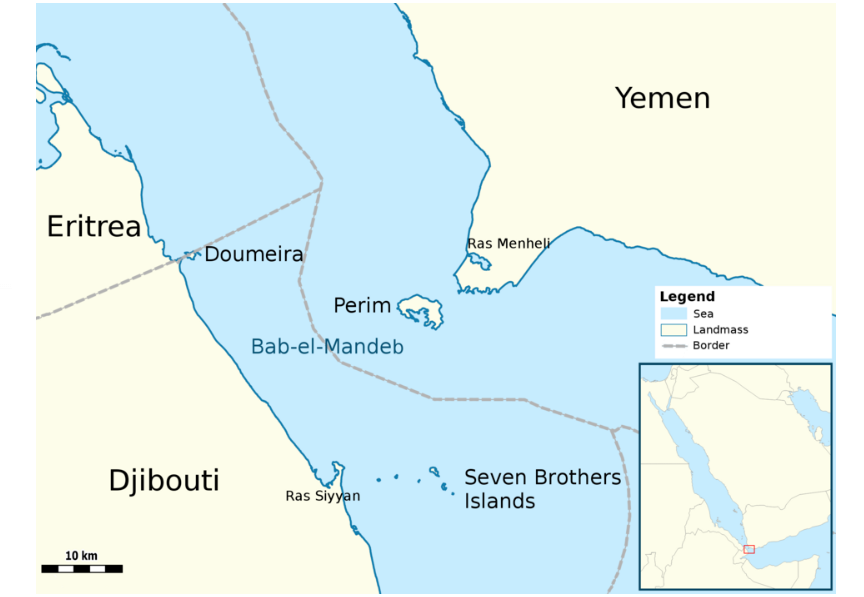
Saudi-backed Yemeni government forces advanced along Yemen’s southwestern coast on Monday, saying they had pushed Houthi fighters from several important positions around the Bab el-Mandeb Strait. The offensive focused on Dhubab and other communities near the narrow waterway that connects the Red Sea with the Gulf of Aden. Government forces also moved toward the port city of Mocha as fighting continued across the region.
The advance is part of a much larger campaign announced by Yemen’s internationally recognized government on Sunday. President Rashad al-Alimi said government forces would try to recover territory held by the Iran-backed Houthis, including areas lost during a major Houthi offensive in September.
Reuters reported that government forces, supported by heavy Saudi airstrikes, reached the outskirts of Mocha late Monday. The Yemeni Defense Ministry said Mocha had fallen, but the full extent of the government gains could not be independently confirmed. Houthi officials rejected the government’s claims.
The Associated Press reported that Yemeni officials said government-aligned forces had retaken Dhubab, along with the towns of Bab and Hadeid. Witnesses told the AP that they saw government tanks and troops entering some of the captured areas. The coalition campaign began under Saudi air cover.
The Bab el-Mandeb Strait is one of the most important shipping chokepoints in the world.
The narrow passage sits between Yemen on the Arabian Peninsula and Djibouti and Eritrea in the Horn of Africa. Ships traveling between the Mediterranean Sea and the Indian Ocean normally pass through the Suez Canal, the Red Sea and Bab el-Mandeb. About 12 percent of global trade passes through the waterway.
Control of Yemen’s coastline near the strait does not give either side complete control over international shipping. However, forces positioned along the coast can threaten vessels with missiles, drones and other weapons. That has made the area especially important as fighting across the Middle East has disrupted other major energy and shipping routes.
The Houthis captured Mocha, nearby islands and stretches of Yemen’s Red Sea coast during a rapid offensive in September. Their advance gave them greater influence over the Yemeni side of Bab el-Mandeb and raised fears that commercial shipping could face additional attacks.
Government forces are now trying to reverse those gains.
Saudi Arabia has provided major military support for the counteroffensive. Saudi coalition spokesman Maj. Gen. Turki al-Malki said 100 fighter jets were supporting Yemeni government forces and that the coalition had attacked hundreds of Houthi targets. He said the coalition was providing air protection over the Bab el-Mandeb area.
The fighting is not moving in only one direction. While government forces made gains along the coast, Houthi fighters advanced in areas around Taiz. Military sources said the Houthis gained parts of a mountain road near the city, although government accounts conflicted over whether the route had been completely cut.
Taiz has been one of the most contested cities in Yemen’s long civil war. The city has a population of more than half a million people and has repeatedly faced shelling, sniper fire and shortages during years of fighting. Renewed battles around the city could make it harder to move food, fuel and military supplies.
The current campaign follows the collapse of a ceasefire that had sharply reduced large-scale fighting since 2022. Yemen’s civil war began in 2014, when the Houthis seized the capital, Sanaa, and forced the internationally recognized government from the city. Saudi Arabia entered the war in 2015 at the head of a coalition supporting the government.
Years of fighting created a severe humanitarian crisis.
The latest escalation has again forced large numbers of Yemenis from their homes. The United Nations migration agency said Monday that about 184,000 people had been displaced since major fighting resumed. An earlier U.N. count put internal displacement at more than 174,000 people and said more than 3,000 others had fled across the water to Djibouti.
Health services have also come under growing pressure. Hospitals and clinics in parts of Taiz province have closed or are operating at reduced capacity, according to Yemen’s government health ministry. Civilian access to fuel, medicine and food could become more difficult if roads remain blocked or damaged.
The fighting is also connected to a wider regional struggle involving Saudi Arabia, Iran and other powers. The Houthis are aligned with Iran and have used missiles and drones against targets in Saudi Arabia. Saudi Arabia, Turkey and Pakistan said Monday that they had agreed to rapidly deploy military forces and capabilities in Saudi Arabia under a joint defense agreement, although details of the deployment were not immediately clear.
The United States has also supported Saudi Arabia during the current campaign. U.S. and regional officials said American assistance included intelligence sharing, target identification and planning. Secretary of State Marco Rubio said Saudi Arabia and the United States have a defense agreement but did not provide details about coordination for the offensive.
Despite the government’s gains, the battle for southwestern Yemen is far from settled. Houthi forces still control Sanaa and large parts of northern and western Yemen. They also retain missile and drone capabilities that can threaten targets beyond areas they directly control.
Even if government forces secure the Yemeni coast around Bab el-Mandeb, shipping risks may not disappear. Houthi forces could still launch drones or missiles from inland positions or from other parts of the coast.
For international markets, the central issue is whether ships can move safely through the strait.
The Bab el-Mandeb route is especially important because it links the Red Sea and Suez Canal with the Arabian Sea and the Indian Ocean. Any prolonged disruption can force ships to travel around Africa, adding time and cost to voyages between Europe and Asia. That can raise freight costs and contribute to higher prices for fuel and other goods.
For Yemen, however, the immediate stakes are even greater. The new offensive could reshape front lines that had remained relatively stable for years, but it also threatens to bring another prolonged period of heavy fighting. With both government forces and the Houthis still capable of launching major attacks, control of Bab el-Mandeb may remain contested even after the latest government advance.