

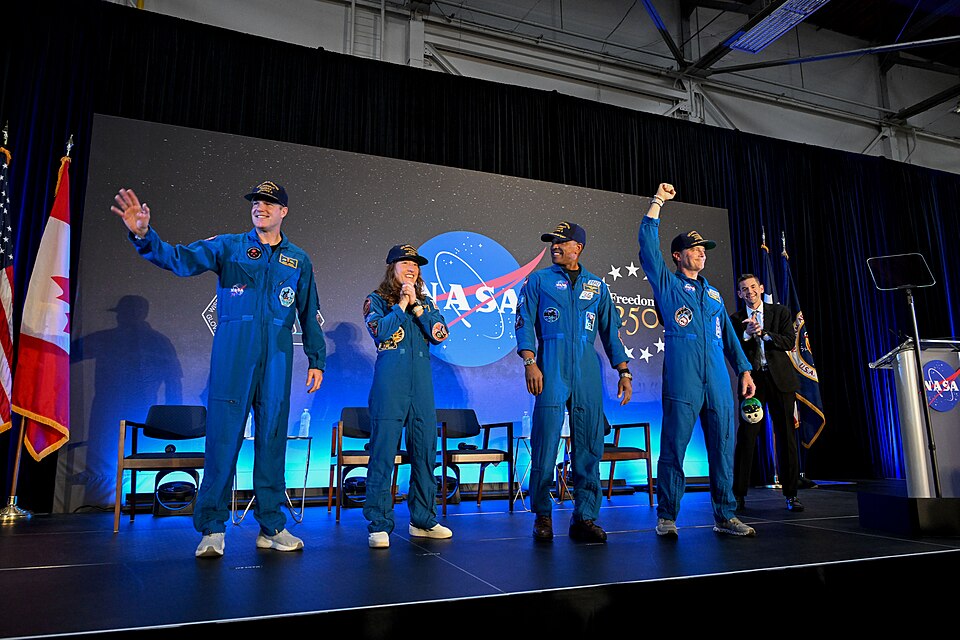
Four astronauts splashed down off the coast of California on Friday, capping a record-breaking journey around the moon that marked humanity's first lunar voyage in more than half a century. Commander Reid Wiseman, pilot Victor Glover, Christina Koch, and Canadian astronaut Jeremy Hansen rode their Orion capsule, dubbed Integrity, through a blazing reentry at 33 times the speed of sound before touching down safely in the Pacific near San Diego. The mission shattered records and made history on multiple fronts. At its farthest point, the capsule traveled 406,771 kilometers from Earth, surpassing the distance record set by Apollo 13 in 1970. Koch became the first woman to fly to the moon, Glover the first Black astronaut to make the journey, and Hansen the first non-American — milestones that drew global attention. "These were the ambassadors from humanity to the stars," NASA Administrator Jared Isaacman said from the recovery ship USS John P. Murtha. Beyond the symbolic firsts, the crew delivered unexpected scientific observations. During their nearly seven-hour lunar flyby, the astronauts described seeing green, brown, and even orange hues on the lunar surface — details invisible from afar that could help scientists understand the moon's composition and geological history. They also observed areas of the far side never directly seen by human eyes. Koch noted a striking optical phenomenon: when Earth came into view alongside the moon, the reflected earthshine was so intense it washed out the surface's subtle colors. "The moon turned into a sponge of light," she said. The glare was bright enough that the crew resorted to covering one window with a spare shirt. The mission also served as a proving ground for NASA's media strategy. Zebulon Scoville, a flight director who was named NASA's "imagery czar" after the uncrewed Artemis I flight in 2022, spent two years overhauling how the agency shares its missions with the public. A new optical laser communications system on the Orion spacecraft enabled higher-resolution video streaming, and NASA maintained continuous live programming across its own platform, social media, and Twitch. The approach paid off: the mission earned millions of views, museums held splashdown watch parties, and teachers integrated the flight into classroom lessons. The successful test flight now positions NASA for its next major step — landing astronauts on the lunar surface within two years and establishing a permanent moon base by the end of the decade. As NASA official Lori Glaze told viewers at the post-splashdown news conference: "We did it. Welcome to our moonshot."
Science
Artemis II Astronauts Return to Earth After Historic Lunar Voyage
NASA's first crewed moon mission in over 50 years ended with a dramatic Pacific splashdown, setting the stage for a lunar landing within two years.
By Free News Press Editorial Team
Published April 11, 2026 at 6:56 AM PDT