In a breakthrough that sounds like science fiction but is firmly grounded in modern physics, scientists have developed light-powered nanorobots capable of hunting, capturing, and relocating bacteria—effectively acting as microscopic cleaning machines inside fluid environments.
The research, published in Nature Communications, demonstrates that these tiny robots—smaller than a single micrometer—can be precisely controlled using light, opening new possibilities in medicine, microbiology, and environmental science.
A New Kind of Microscopic Machine
The nanorobots are incredibly small—less than one-thousandth of a millimeter in size—and operate directly within the microbial world. Unlike traditional mechanical systems, they are powered entirely by light.
Researchers achieved this by using plasmonic nanoantennas, which absorb incoming light and re-emit it in a controlled direction. This creates a tiny recoil force—similar in principle to the kickback of a fired bullet—that propels the robot forward.
Because these robots are so lightweight, even the minuscule force generated by photons is enough to move them quickly and efficiently through liquid environments.
How Light Controls Movement
Steering these microscopic machines is just as innovative as powering them.
Instead of using complex mechanical systems, scientists control direction by adjusting the polarization of light. The nanorobots naturally align themselves with the light’s orientation, allowing researchers to guide their movement with remarkable precision.
This method allows the robots to:
- Make sharp turns (even 90-degree angles)
- Follow complex paths
- Scan areas systematically
In laboratory tests, they reached speeds of up to 50 micrometers per second, which is extremely fast at this scale.
Hunting and Capturing Bacteria
What makes this development especially compelling is what the nanorobots can actually do.
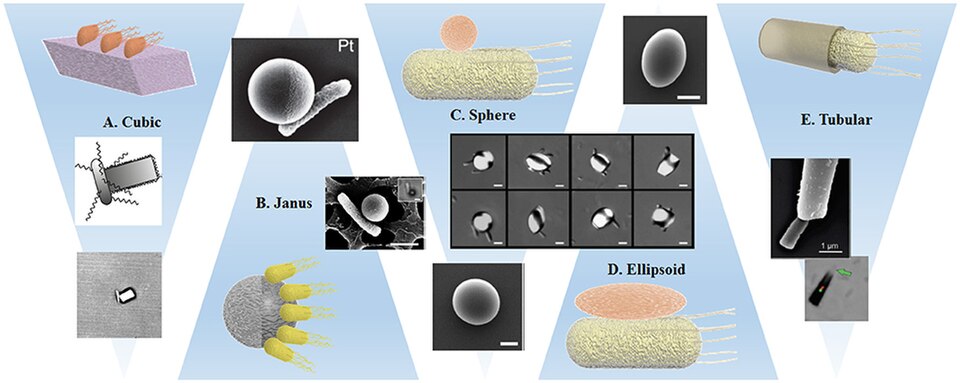
Using subtle thermal and physical effects generated by their light-driven systems, the robots can:
- Attract nearby bacteria
- Trap them around the robot body
- Transport them to a new location
- Release them on demand
This allows them to function as true “microscopic cleaners,” collecting bacteria from a solution and depositing them elsewhere.
Even more impressive, the robots remain maneuverable while carrying bacterial loads hundreds of times their own weight, demonstrating both strength and control at the nanoscale.
Why This Matters
Nanorobotics has long been viewed as a transformative technology, particularly in medicine. Systems like these could eventually be used for:
- Targeted removal of harmful bacteria in the body
- Cleaning biofilms from medical implants
- Precision drug delivery
- Manipulating cells in laboratory research
More broadly, nanorobots represent a growing class of devices designed to operate at the smallest scales, where traditional mechanics no longer apply and physics behaves very differently.
A Step Toward Future Medical Applications
While these nanorobots are still in the experimental stage, the principles demonstrated are significant.
Unlike earlier approaches that required complex laser setups or high energy levels, this system:
- Uses relatively low light intensity
- Minimizes heat damage
- Enables simultaneous manipulation of multiple bacteria
That combination makes it far more practical for real-world biological applications.
Researchers believe future versions could operate in swarms, potentially performing coordinated tasks inside living systems—such as clearing infections or assisting with microsurgery.
The Bigger Picture
The idea of robots cleaning microscopic environments may sound futuristic, but the physics behind it is already proven. As one researcher put it, the work shows that light can do more than just observe the microscopic world—it can actively shape it.
With continued advances in nanotechnology, these tiny machines may one day move from the lab into real-world use, quietly performing tasks at a scale invisible to the human eye.
Sources
- Nature Communications — Original study: A nanoscale robotic cleaner (2026)
- Phys.org — “A nanoscale robotic cleaner can hunt, capture and remove bacteria”
- AZoRobotics — “Light-Powered Nanorobots to Capture And Remove Bacteria”
- Nanorobotics overview (background context)