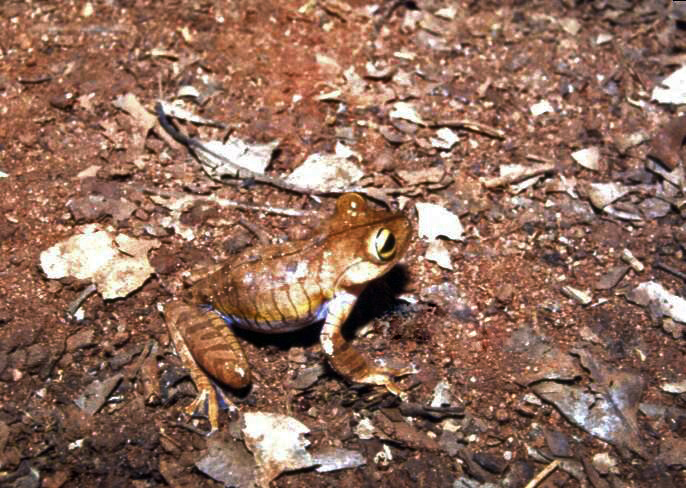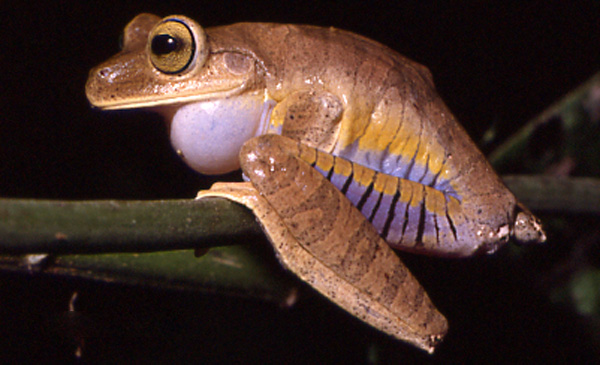
Frogs don't fight disease with their immune systems alone. Beneficial bacteria living on their skin form a crucial line of defense against deadly pathogens — but new research shows that defense crumbles when the habitats frogs depend on become disconnected by farms, roads, and development.
A team led by Penn State biologists studied amphibian populations across 40 sites in Brazil's Atlantic Forest, one of the most biodiverse — and most degraded — ecosystems on Earth. Many frog species there must travel between forest habitat and aquatic breeding sites during their life cycles. When those two environments are linked by continuous natural cover, frogs maintain robust communities of skin microbes capable of inhibiting *Batrachochytrium dendrobatidis*, the chytrid fungus responsible for catastrophic amphibian declines worldwide. But when agriculture or infrastructure physically separates forest from water — a phenomenon the researchers call "habitat split" — those protective microbial communities deteriorate and fungal infection levels rise.
"Animals rely not only on their immune systems, but also on beneficial microbes that live on their bodies and help protect them from pathogens," said Gui Becker, associate professor of biology at Penn State and senior author of the study, published in the *Proceedings of the National Academy of Sciences*. "Our results show that when natural habitats become disconnected, these microbial defenses can be disrupted."
The findings, reported by Phys.org, reveal a layer of biodiversity loss that conservation efforts have largely overlooked. Habitat fragmentation is already recognized as a primary driver of species decline, but its effects on the invisible microbial partners that keep wildlife healthy are only beginning to be understood. First author Daniel Medina, now a lecturer at The School for Field Studies, emphasized that connectivity sustains "multiple levels of biodiversity, from host-associated bacteria with protective functions to their respective host species."
The implications extend beyond frogs. As researchers increasingly recognize the role of environmental microbiomes in animal health, maintaining landscape connectivity could prove essential not just for preserving species, but for preserving the unseen microbial ecosystems those species need to survive.
A common bacterium that lives on human skin can help repair the skin's outer protective layer by triggering the production of ceramides, the fatty molecules that keep moisture in and pathogens out, according to research highlighted by the National Institutes of Health.
The bacterium, Staphylococcus epidermidis, is a normal resident on healthy skin and is distinct from the dangerous staph strains most people know. In experiments with mice, applying S. epidermidis to skin exposed to common irritants measurably reduced water loss through the skin surface.
Researchers traced the effect to a bacterial enzyme called sphingomyelinase. The enzyme breaks down sphingomyelin, a molecule found on skin cells, into ceramides and phosphocholine. The bacteria get a nutrient source from the process. The host gets a strengthened skin barrier. NIH said the findings could eventually support probiotic-style treatments for skin aging or certain skin diseases where ceramide levels run low.
Low ceramide levels are associated with dry skin, aging, and disorders such as eczema, which gives the finding particular relevance for researchers working on barrier-related conditions.
The result fits into a broader shift in how scientists understand skin bacteria. For decades, the dominant view treated skin microbes primarily as something to wash off or suppress. Reviews now in the medical literature describe the skin microbiome as part of an integrated protective system, one that interacts with the barrier through physical, chemical, and immune-related mechanisms, and that helps regulate inflammation and resist invading pathogens.
Scientists are careful to draw limits around that picture. S. epidermidis is widely recognized as a protective colonizer, but it can also behave as an opportunistic pathogen, particularly when medical devices or biofilms are involved. Strain-level differences matter, researchers say. The same species can act very differently depending on which other microbes are present, where on the body it is found, and the overall health of the host.
Even so, therapeutic interest is accelerating. Recent review articles describe growing research into probiotics, postbiotics, and other microbiome-targeted approaches for skin aging, barrier repair, and inflammatory skin disorders. Scientists are investigating whether restoring microbial balance could help patients whose conditions involve chronic barrier breakdown, recurring dryness, or inflammation that standard treatments have not resolved.
Barrier failure is a feature of several skin diseases. Once the barrier weakens, skin becomes more vulnerable to irritation, infection, and moisture loss. If resident microbes help sustain that barrier under normal conditions, the logic of future treatment shifts: rather than suppressing symptoms alone, therapies might also aim to rebuild the skin's microbial ecology.
Researchers caution that most of the work generating excitement is still preclinical or early-stage. Translating microbiome findings into safe, reliable clinical therapies is a long process, and commercial "probiotic skincare" labels carry no guarantee of the evidence standards researchers apply. But the underlying biology, once regarded as peripheral, is now being taken seriously in NIH-backed work and the peer-reviewed literature more broadly.
No clinical trials or regulatory approvals tied to the S. epidermidis ceramide findings have been announced. The next steps described by researchers involve further mapping of how microbial strains interact with barrier function and identifying which patient populations might benefit most from microbiome-targeted approaches.