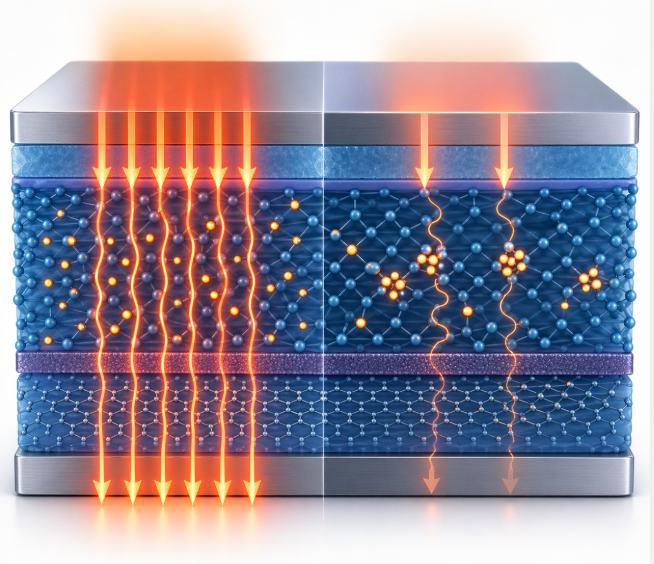
Heat is everywhere, yet it remains one of the hardest forms of energy to control. It dissipates naturally, making storage and precise manipulation a persistent challenge for engineers. Now, a team of researchers from Spain has introduced a prototype device that sidesteps the problem entirely — instead of trapping heat, it controls how heat flows, and it remembers its settings for days.
Unlike conventional cooling approaches that simply try to remove heat, the new device is designed to program how heat moves through a material. Researchers say the film can hold one of two stable thermal states even after the voltage is turned off, effectively giving heat flow a form of memory.
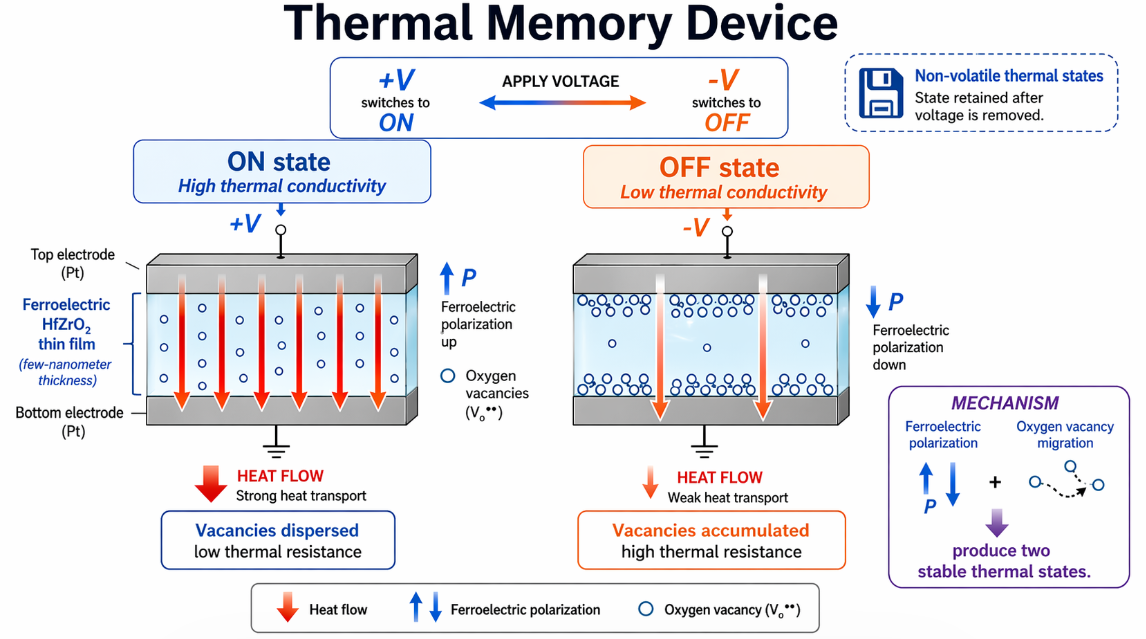
The device, described in a study published in *Advanced Materials*, works like a thermal switch. By applying small electric voltages, researchers can toggle ultra-thin films of hafnium and zirconium oxide between a high thermal conductivity state ("on") and a low thermal conductivity state ("off"). Much like the binary bits underpinning conventional electronics, these states persist even after the voltage is removed, as reported by Phys.org. The films are just a few nanometers thick and possess ferroelectric properties — meaning their internal electric polarization can be flipped and held in place.
The secret lies in atomic-scale defects called oxygen vacancies scattered throughout the material. These vacancies act as barriers to heat transport. When a voltage is applied, it pushes the vacancies to accumulate or disperse, changing how easily heat passes through the film. The interplay between ferroelectric polarization and vacancy migration produces a hysteretic response — two distinct, stable thermal states that the device can hold without power for days with no measurable degradation.
The research was led by scientists at the Center for Research in Biological Chemistry and Molecular Materials (CiQUS) in collaboration with the University of Barcelona and the University of Zaragoza. While the team acknowledges the technology is far from commercial readiness — switching speed, in particular, needs significant improvement — the relatively low operating voltages and long-term stability are encouraging signs.
If the concept matures, it could reshape how engineers handle waste heat in electronics, improve energy conversion systems, and even lay the groundwork for a new class of computing that processes information using heat rather than electrical charge. For now, the prototype stands as proof that heat, long considered the unruly byproduct of technology, might one day be put to precise, programmable use.
For now, the device remains a laboratory demonstration rather than a market-ready component, with switching speed still a major hurdle before it could be used in commercial systems.”