Methanol is one of the most widely produced chemicals in the world, with uses ranging from plastics and paints to fuels and potential carbon-neutral energy carriers. The catalyst that makes its industrial production possible has been in use since the 1960s. Until now, no one had clearly seen what that catalyst actually does while it is working.
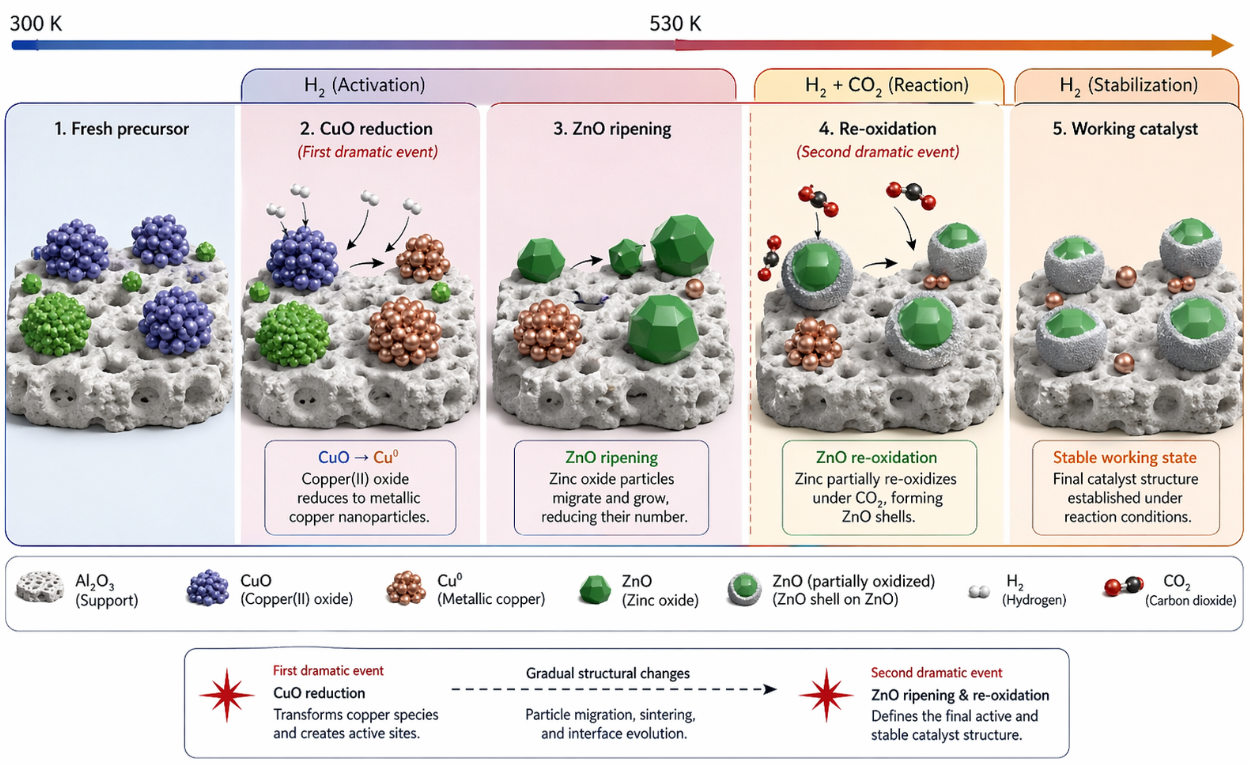
A research team from the Fritz Haber Institute and the Max Planck Institute for Chemical Energy Conversion has published findings in Nature Catalysis showing that the copper-zinc oxide-aluminum oxide catalyst, written as Cu/ZnO/Al₂O₃, undergoes continuous and reversible structural changes during the reaction. Temperature drives those changes, and those changes appear to be the key to why the catalyst works so well.
The core question the researchers set out to answer had been open for decades: copper and zinc oxide individually are not especially impressive catalysts for methanol synthesis, but together their performance is far better than the sum of their parts. Something in the interaction between the two materials produces the high catalytic activity observed in industrial reactors. The nature of that interaction, exactly where it happens, and what form it takes at the atomic scale had never been clearly resolved.
To get a direct look, the team used operando transmission electron microscopy, a technique that allows researchers to image materials at the nanoscale while a reaction is actually occurring. They placed Cu/ZnO/Al₂O₃ nanoparticles inside a miniature reactor, adjusted the reaction conditions, and watched.
What they found was a surface in constant motion. A thin layer of zinc oxide spreads across and retreats from the copper surface depending on temperature. These overlayer transformations are reversible. The catalyst is not a fixed structure operating the same way regardless of conditions. It is a dynamic system, reshaping itself in response to the thermal environment it finds itself in.
That dynamic behavior, the team concluded, is not a side effect or an imperfection. It is the mechanism. The temperature-sensitive restructuring of the copper-zinc oxide interface is what produces the synergistic catalytic performance that has made this material the industrial standard for over 60 years.
Methanol synthesis has taken on added urgency as a potential tool for managing carbon dioxide emissions. The same reaction that produces methanol from synthesis gas can in principle be used to convert captured CO₂ into a useful chemical feedstock or fuel. Understanding exactly how the catalyst functions opens the door to rationally improving it, rather than relying on trial-and-error modifications.
The Fritz Haber Institute researchers noted that the study clarifies not just the location of the active sites on the catalyst surface but also how those sites emerge and disappear as conditions change. That level of mechanistic detail is what materials engineers need to design next-generation catalysts with higher efficiency or greater tolerance for the variable conditions found in industrial reactors.