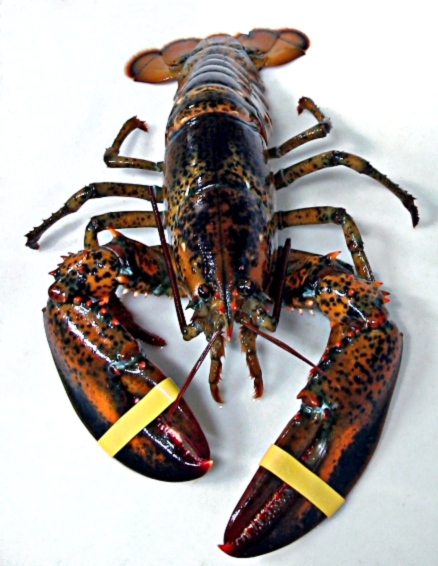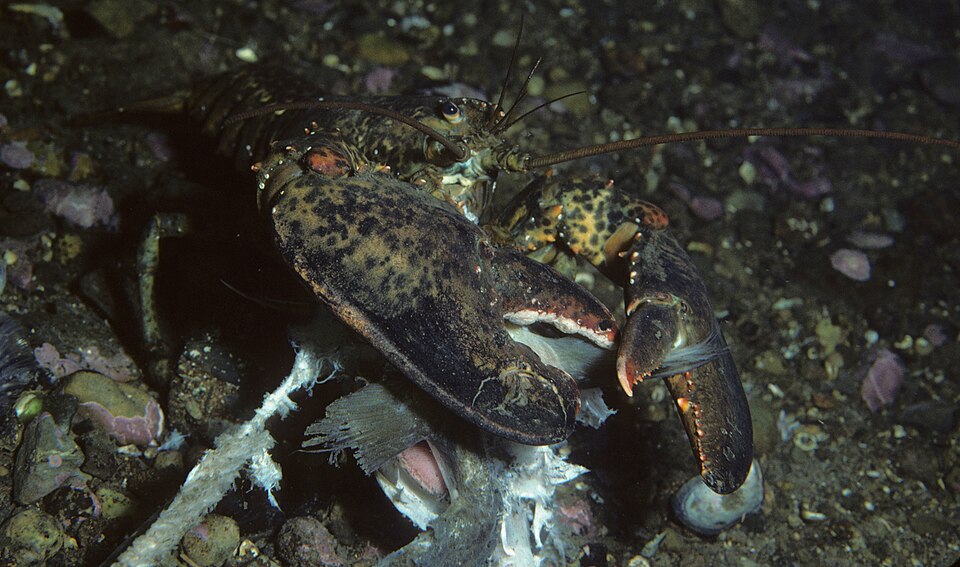
A lobster pulled from the waters off Cape Cod on April 16 is heading to a science aquarium instead of a dinner plate. The animal is brown on one side and bright orange on the other, with the split running the full length of its body from head to tail.
Wellfleet Shellfish Company, based in Eastham, Massachusetts, caught the lobster and donated it to the Woods Hole Science Aquarium in Falmouth. The company said it had fielded inquiries about the crustacean for days before making the announcement Monday. Representatives called it a "remarkable and exciting find."
The lobster is currently being kept in holding tanks at the Marine Biological Laboratory while the aquarium undergoes construction. Once the aquarium reopens, the animal will go on public display, giving visitors what the shellfish company described as "a rare look at one of the ocean's most striking natural anomalies."
Two-toned lobsters occur when two fertilized eggs fuse and develop as a single animal, according to Markus Frederich, a marine sciences professor at the University of New England in Maine. The result is an organism that is, in a sense, two individuals sharing one body, each half retaining its own coloration. Frederich has noted that estimates of how rare such lobsters are tend to be approximations rather than precise figures.
Lobsters can display a surprising range of colors. The standard American lobster is a mottled brown, but genetic mutations affecting the proteins that bind to pigments can produce blue, orange, spotted calico, and even pastel specimens sometimes called "cotton candy" lobsters. Oddly colored lobsters turn up at New England docks with some regularity through spring and summer, but the bilateral split seen in the Wellfleet catch is rarer than most single-color variants.
Two-toned lobsters have made news before. In 2024, Frederich spoke to the Associated Press about the biology behind similar finds, explaining the egg-fusion mechanism and cautioning against treating rarity estimates as hard numbers. The phenomenon is real but difficult to quantify precisely because commercial fishing does not systematically track color anomalies.
For now, the lobster sits in a holding tank, waiting for its aquarium debut. No reopening date for Woods Hole Science Aquarium has been publicly announced.