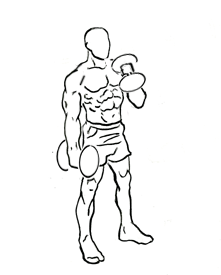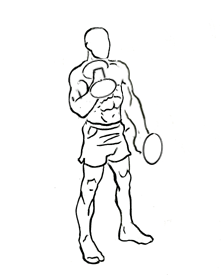
A form of exercise most people perform without realizing it may be one of the most efficient ways to build muscle, and researchers say it is especially promising for older adults and those just starting out.
Eccentric exercise, the portion of a movement where the muscle lengthens under tension, happens every time someone lowers a dumbbell, walks downhill, or descends a flight of stairs. Most people focus on the opposite motion, the concentric phase, where the muscle shortens, like curling a weight upward or rising out of a squat. But according to a study recently published in the Journal of Sport and Health Science, the eccentric phase may deliver more benefit per unit of effort.
Kazunori Nosaka, PhD, director of Exercise and Sports Science at Edith Cowan University in Western Australia and lead author of the study, said the findings carry a practical message for people who feel overwhelmed by the idea of exercise. "Every eccentric contraction counts. People may be discouraged by thinking they have to do lots of exercise to get fitter and healthier. But people can do a small amount of these exercises and still benefit," Nosaka told Healthline.
The study found that eccentric training can build muscle strength with less strain on the body and may offer specific advantages over concentric exercise for muscle rehabilitation and brain health. Those advantages matter most for people who find conventional exercise difficult, including older adults and individuals recovering from injury.
Muscles contract in three basic ways: concentrically, when they shorten; eccentrically, when they lengthen under load; and isometrically, when they hold a fixed position without changing length, like a plank. Of these, the eccentric contraction has historically been the least understood.
Lindsey Lepley, PhD, associate professor of athletic training at the University of Michigan School of Kinesiology and director of the Comparative Orthopaedic Rehabilitation Laboratory, explained why scientists spent decades puzzling over it. "The word eccentric literally means something that's odd or peculiar. This type of contraction was given that term because for a long time, scientists weren't able to explain it. How muscle produces force while it is being lengthened was a big question mark," Lepley said. She was not involved in the study.
The practical upside is significant. Because eccentric contractions generate more force with less perceived effort, they allow people to build strength without the cardiovascular demand or joint stress that sometimes discourages beginners or older exercisers. Walking downhill, for example, is technically an eccentric workout for the quadriceps. So is the controlled lowering phase of any standard resistance exercise.
Nosaka said his broader goal is to help normalize eccentric exercise as a legitimate and accessible training method, not just a footnote in a gym routine. For advanced athletes, incorporating deliberate eccentric work can add a new dimension to training. For someone who has been sedentary, it may offer a lower-stakes entry point into regular physical activity.