

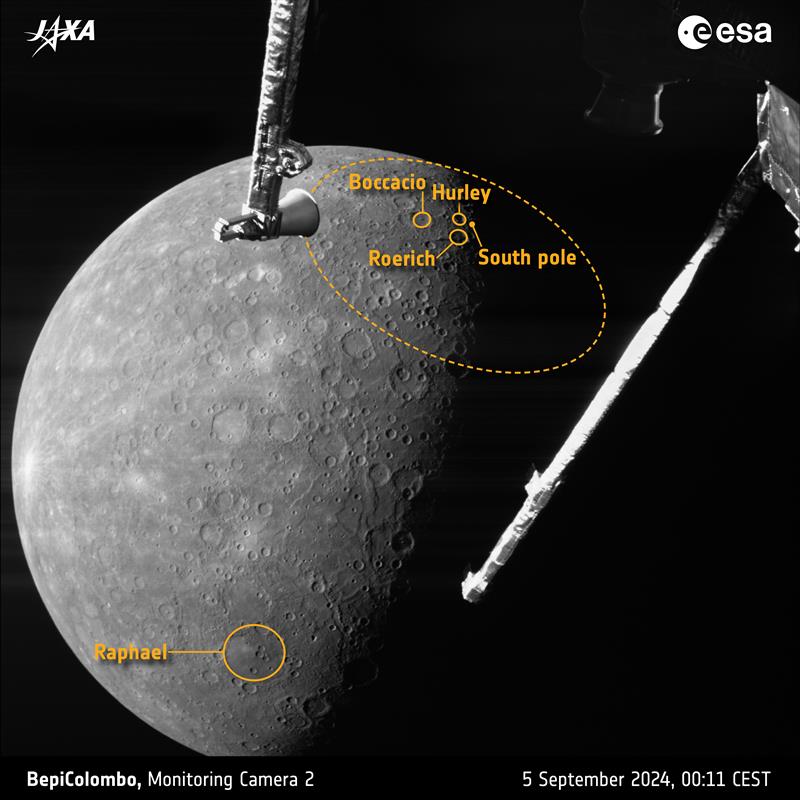
Mercury is the closest planet to the sun, with daytime temperatures reaching 430 degrees Celsius. It has no true atmosphere. By every expectation, it should be bone dry. Yet water ice sits in its polar regions, and scientists have spent years arguing about how it got there.
A new study published in the Journal of Geophysical Research: Planets, covered by Phys.org, offers the most detailed answer yet. The water was deposited by a single large impactor, such as a comet or asteroid, and the entire delivery happened within one Mercurian day, which equals 176 Earth days.
Previous studies had pointed in a similar direction, but this is the first study to fully model the impact. The new models also suggest the impactor was larger and slower than earlier estimates had proposed.
Mercury's water ice is found in permanently shadowed regions, known as PSRs, near the planet's north and south poles. These regions act as cold traps. Even in Mercury's extreme environment, temperatures in the PSRs stay cold enough to preserve ice. Both Earth-based telescopes and orbital spacecraft have detected reflective areas in these zones consistent with water ice.
Scientists had proposed several explanations for where the ice came from. Some suggested steady delivery over time from micrometeoroids or the solar wind. Others pointed to a single volatile-rich impact. More recent studies found that the ice appears relatively pure and young, at only a few hundred million years old. That finding pushed researchers toward the rapid, episodic delivery explanation rather than slow accumulation.
The leading candidate for the source of the impact is the event that created Hokusai crater, a feature 97 kilometers in diameter on Mercury's surface. The team built models around a Hokusai-scale impactor, using a 17 kilometer diameter comet or asteroid traveling at 30 kilometers per second, and tested what would happen to the water released during such a collision.
The researchers ran two scenarios. In the first, water was released into Mercury's thin exosphere, an ultra-thin layer of gas that is constantly being blown away by the solar wind and replenished. This scenario was used to update older estimates of how efficiently water moves through Mercury's exosphere. In the second scenario, water was released into a dense atmosphere generated by the impact itself, and the team simulated the full impact using a range of parameters for the Hokusai-forming event.
The simulations produced a specific number. A Hokusai-scale impact could deliver approximately 2.3 times 10 to the 13th power kilograms of water ice to Mercury's polar cold traps. That figure matched observed estimates of how much ice is currently present in those regions.
The finding matters for more than Mercury. Understanding how volatile materials like water are delivered and preserved on airless, sun-scorched bodies informs broader questions about where water comes from across the solar system and how it moves between objects. Mercury's ice, locked in shadow just kilometers from the most sun-baked surface in the inner solar system, has become one of the more useful test cases for those questions.
The study represents the first complete computational model of the Hokusai impact scenario, which gives researchers a more detailed baseline for comparing alternative hypotheses about Mercury's water sources.
![Issued in 1896 under title: Handbook of Arctic discoveries
"Polar bibliography": p. [318]-324
References at end of chapters
Subjects:](https://freenewspress.com/media/2026/05/26/mercury-polar-ice-896c19.jpg)