A team of researchers has discovered a way to watch atoms reorganize themselves in real time, and the result is a catalyst that breaks records for producing green hydrogen. The work was led by the University of Nottingham in collaboration with the University of Birmingham, Diamond Light Source, and Ulm University in Germany. The study appears in the journal Advanced Materials.
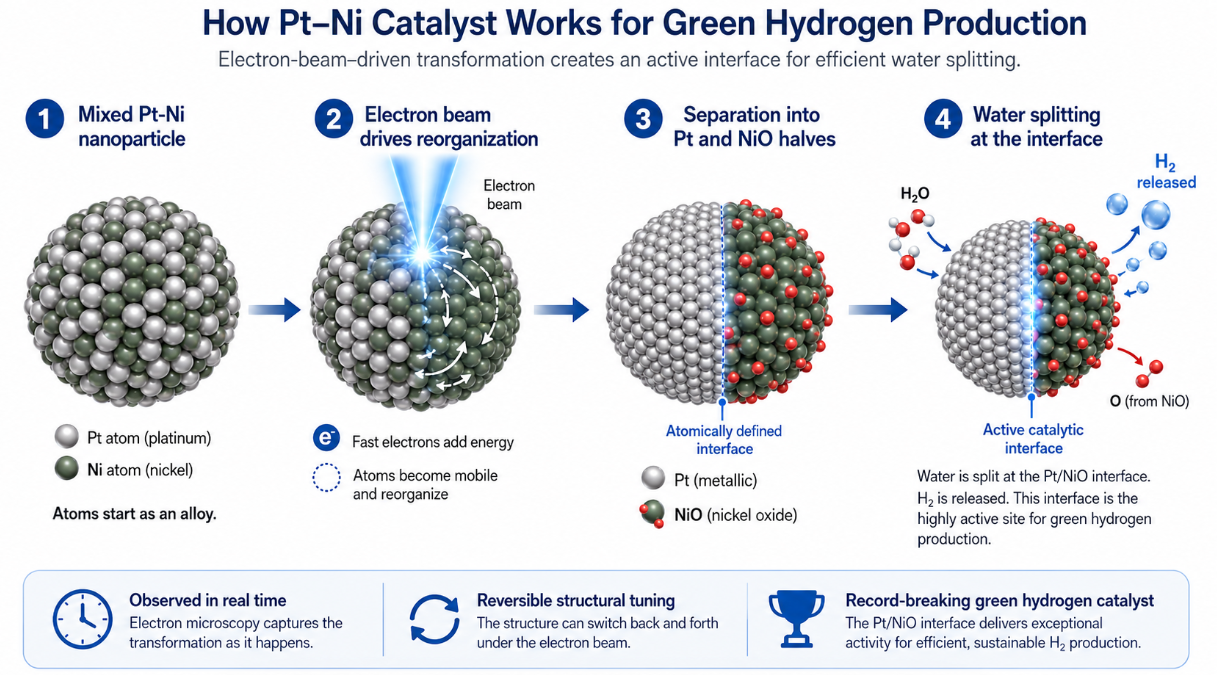
The process starts with tiny particles containing only a few dozen platinum and nickel atoms mixed together. Under an electron microscope, the two metals behave in a way that initially puzzled the scientists.
Dr. Emerson Kohlrausch, who led the experimental work at the University of Nottingham's School of Chemistry, described the moment. "Initially, when we looked at the platinum-nickel nanoparticles under the electron microscope, we saw that the two types of atoms are mixed, as one would expect in an alloy. However, only a few seconds later, the two metals started to separate from each other in front of our eyes. This was an astonishing observation, as it appeared to go against conventional thermodynamic behaviors."
The reason this matters is that atoms mixing together is a one-way street under ordinary conditions. When milk enters coffee, it does not separate back out. That behavior is governed by the second law of thermodynamics. Watching these metals pull apart spontaneously was not something the team expected to see.
The explanation lies in the electron beam itself. To image a material using electron microscopy, the sample must interact with a beam of fast electrons. Those electrons transfer energy to the atoms in the sample, stimulating them to move and occupy new positions. In the case of platinum-nickel, that energy is enough to drive the two metals apart.
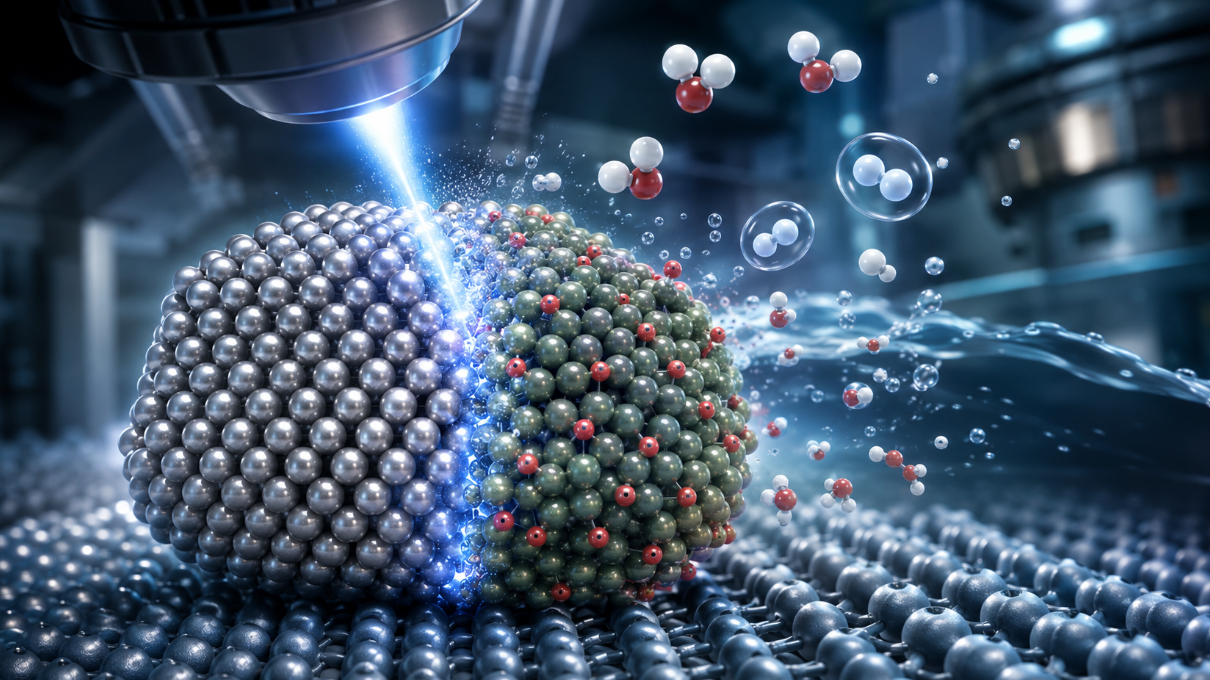
Once nickel separates from platinum, it picks up oxygen atoms from the surrounding environment and forms an oxide. Professor Andrei Khlobystov, Professor of Nanomaterials at the University of Nottingham, described what that produces. "This results in nanoparticles made of two halves—platinum metal and nickel oxide, separated by an atomically defined interface. We create new types of hybrid particles and observe their formation in realtime, which is unprecedented."
That interface between the two halves turns out to be where the chemistry happens. As soon as the metals separate while still touching at a boundary, the particles become highly active for splitting water molecules through an electrochemical process, releasing hydrogen gas. The result is a catalyst that performs at a record-breaking level for green hydrogen production.
Research team leader Dr. Jesum Alves Fernandes said the implications go beyond hydrogen. "What makes this discovery exciting is that we can reversibly tune the structure of the particle while directly observing the process at the atomic scale. This opens a new strategy for designing adaptive catalysts for a wide range of applications."
The team used the electron beam as both an imaging tool and a reaction driver, giving them the ability to observe and control atomic-level changes within the same experiment. The ability to reverse the process and watch it happen in direct space distinguishes this work from prior studies where structural changes in catalysts were inferred rather than seen.