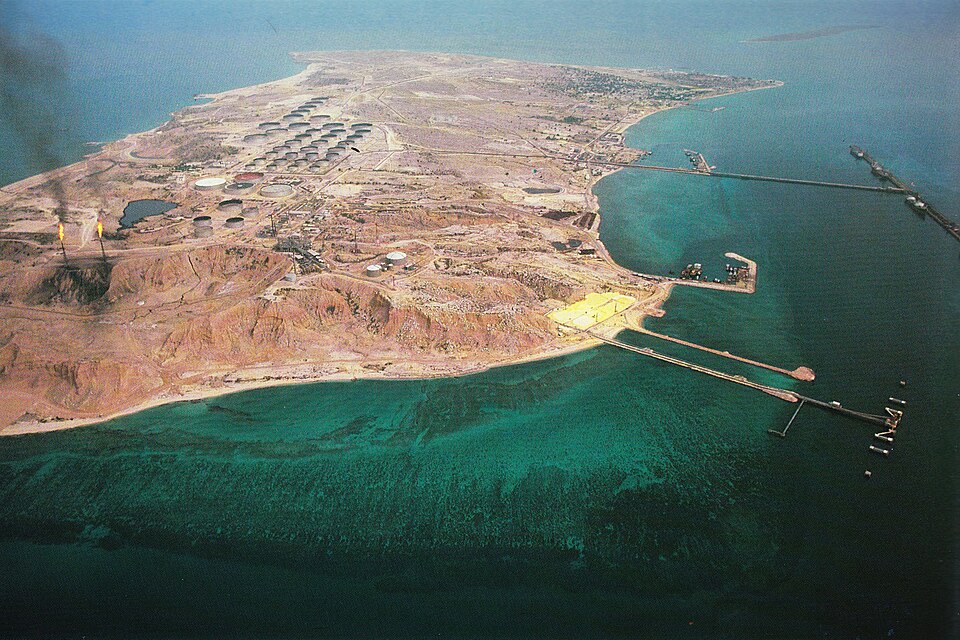
The U.S. military struck Iran again Wednesday night, and President Donald Trump on Thursday threatened to go further, vowing to seize the country's main oil export terminal at Kharg Island in what he called the not too distant future.
According to a report by CNBC, Trump posted on Truth Social that the U.S. military will attack Iran very hard Thursday night, following through on airstrikes carried out the night before. He threatened to take total control of Iran's oil and gas markets, comparing the potential action to what the U.S. did in Venezuela.
Kharg Island handles roughly 90% of Iran's crude oil shipments. The U.S. Navy has already imposed a blockade on Iranian ports and vessels, which has choked off most of those exports. U.S. forces struck military targets on the island earlier in the war but had avoided targeting oil and gas infrastructure directly until now.
Trump drew a parallel to Venezuela, where the U.S. effectively took control of oil exports after a military raid ousted former President Nicolas Maduro in January. Revenue from Venezuelan oil sales now goes into a Treasury Department account. "I think they'd like to see us come home, but we did it with Venezuela," Trump told Fox News in a live phone call. "Venezuela's worked out great for everybody."
He also acknowledged uncertainty about the plan almost immediately after floating it, saying he is not sure America has the stomach to take Kharg Island. On the airstrikes already carried out, he was more direct. "We dropped $250 million worth of bombs on them last night," he told Fox. "You know, the whole thing is crazy, but they're really in submission. They just don't know it yet."
Trump said he escalated military pressure on Iran after growing frustrated with Tehran for not quickly agreeing to a deal to reopen the Strait of Hormuz and abandon its nuclear program. The latest round of escalation began when Trump held Iran responsible for shooting down a U.S. Apache helicopter in the strait.
The war, which recently crossed the 100-day mark, has shut down the Strait of Hormuz and destroyed energy production facilities across the region, creating severe supply constraints in global energy markets. A fragile ceasefire has been in place, but tensions between Washington and Tehran have sharply risen in recent days.
Those energy disruptions are now rippling well beyond the Middle East. The European Central Bank on Thursday announced a quarter-point interest rate hike, bringing its key rate to 2.25%. It was the ECB's first rate increase since 2023. The bank said the decision was made to ward off inflationary pressure driven by the U.S.-Iran war.
"The war in the Middle East is generating inflation pressures, and the decision to raise rates is robust across a range of scenarios mapping out how the shock might evolve and affect the medium-term outlook for the euro area," the ECB's Governing Council said in a statement.
The bank raised its inflation forecast for the euro zone, saying it now expects headline inflation to average 3% in 2026, cooling to 2.3% in 2027 and 2% in 2028. Euro zone inflation hit 3.2% in May, driven by higher energy costs pushing the rate above the ECB's 2% target. The bank also cut its growth forecasts, projecting just 0.8% growth in 2026, up to 1.2% in 2027 and 1.5% in 2028. Officials said the downward revision reflected a more pronounced impact of the war on commodity markets, real incomes and confidence.
ECB President Christine Lagarde addressed reporters Thursday afternoon and stressed that officials are not locking themselves into any fixed course. "The outlook remains uncertain, with upside risks for inflation, and downside risks for economic growth. We are not pre-committing to a particular rate path," she said. She added that the full implications of the war for medium-term inflation and growth will depend on the intensity and duration of the energy price shock, as well as the scale of its indirect and second-round effects.
Mark Wall, chief European economist at Deutsche Bank, called the hike a significant moment, noting it was not only the ECB's first rate increase since 2023 but also a marker of how deeply the conflict has reshaped Europe's economic outlook. The euro zone economy grew by just 0.1% in the first quarter of the year.
Trump has not said when a decision on Kharg Island would be made or whether Congress has been consulted on a potential seizure of Iranian energy infrastructure.