Researchers have discovered the largest accumulation of whale carcasses and fossils ever found, buried in the depths of the southeastern Indian Ocean. The site stretches more than 1,200 kilometers, or about 750 miles, and contains bones dating back over 5 million years.
The discovery was reported in a study published Wednesday in the journal Nature. Scientists named the site the Diamantina Zone necropolis, after the area of deep-sea ridges and fractures where the fossils were found.
Nick Pyenson, a curator of fossil marine mammals at the Smithsonian National Museum of Natural History in Washington, D.C., who was not involved in the study, described the scale of the find to Live Science. "It covers over 1,200 kilometers [750 miles], which just defies belief," he said. "'Megasite' is a totally appropriate term. I think they've uncovered something really special."
Xiaotong Peng, a deep-sea researcher at the Chinese Academy of Sciences' Institute of Deep-sea Science and Engineering, led the team that conducted the survey. They used an underwater vehicle called the Fendouzhe submersible to explore the seafloor. After spotting one fossil, the team made 32 dives across a survey area of roughly 0.25 square miles. In total they identified 476 whale fossils and five more recent whale carcasses at depths ranging from 13,800 to 23,000 feet below the surface.
Based on those numbers, the researchers calculated that the broader area could hold seven to eight whale carcasses and around 750 fossils per square kilometer.
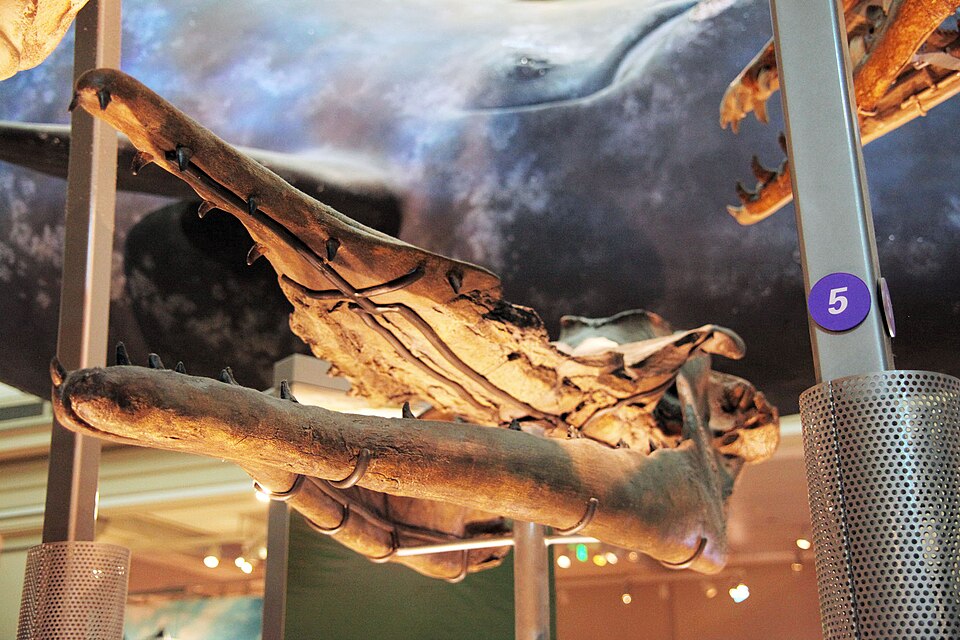
The largest carcass found is a 16.4-foot skeleton from an Antarctic minke whale. Most of the remains, however, are from beaked whales, which are poorly understood because they live in open water and spend much of their time diving deep.
The five active whale falls, where whales have died more recently, support dense communities of deep-sea life. Bacteria that survive without light or oxygen break down oils in the whale bones, releasing hydrogen sulfide. That chemical energy sustains jellyfish, brittle stars, bone-eating Osedax worms and bivalve mollusks, reaching densities of up to 2,840 individuals per square meter.
Most of those species may be new to science. DNA samples from the communities could match most organisms only to the genus or family level. Just one species was identified with confidence: a clam called Abyssogena southwardae. Stephen Godfrey, a researcher quoted in the study coverage, summed it up plainly: "The density is crazy, as is the fact that they're probably all new to science."