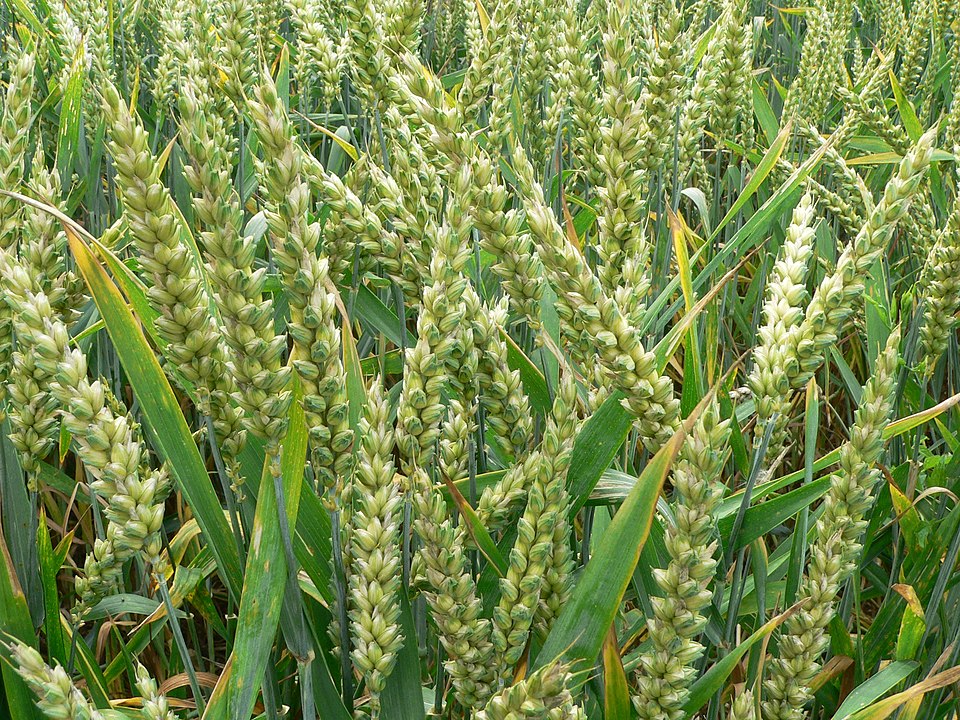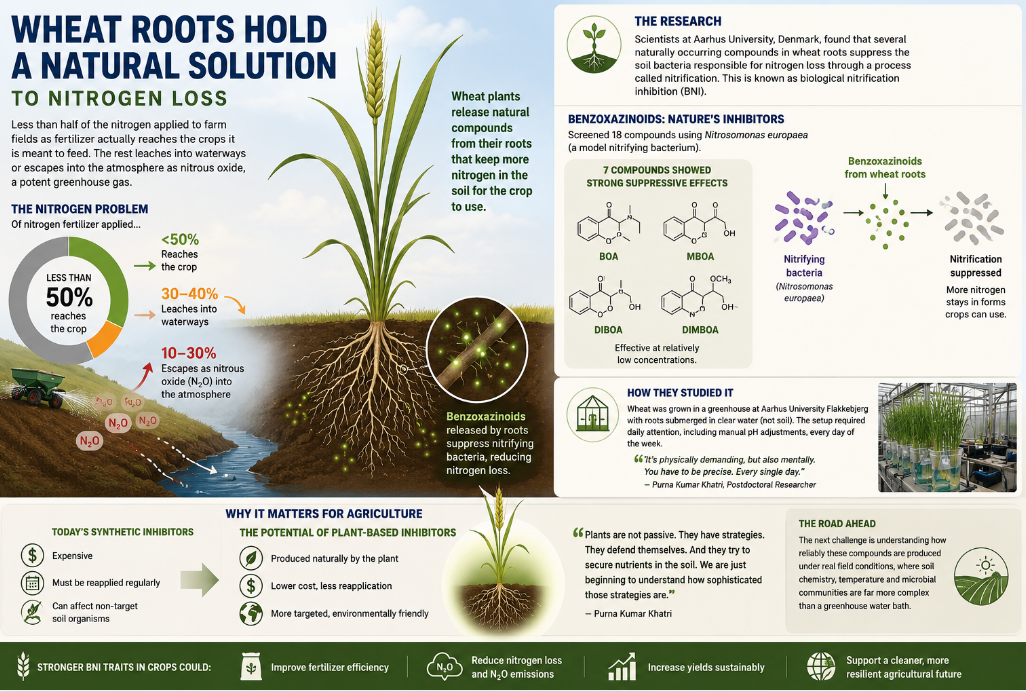
Less than half of the nitrogen applied to farm fields as fertilizer actually reaches the crops it is meant to feed. The rest leaches into waterways or escapes into the atmosphere as nitrous oxide, a potent greenhouse gas. A new study suggests that wheat plants may already carry a natural solution in their roots.
Research published in Plant Physiology and Biochemistry by scientists at Aarhus University in Denmark found that several naturally occurring compounds released by wheat roots can suppress the soil bacteria responsible for nitrogen loss. The finding adds new detail to a field called biological nitrification inhibition, or BNI, in which plants release chemicals that slow the activity of nitrifying microbes, keeping more nitrogen in a form that crops can use.
At the center of the research is a class of chemicals called benzoxazinoids. These compounds have been studied in cereals like wheat, maize and rye for decades, mostly for their role in plant defense against insects, weeds and nematodes. What postdoctoral researcher Purna Kumar Khatri and his colleagues demonstrated is that several of these same compounds also act as powerful inhibitors of nitrification.
The team screened 18 different benzoxazinoids using a bioluminescence assay with Nitrosomonas europaea, a standard model bacterium used in nitrification research. Seven compounds showed strong suppressive effects at relatively low concentrations. These included BOA, MBOA, DIBOA and DIMBOA.
Khatri conducted part of the experimental work in a greenhouse at Aarhus University Flakkebjerg, where wheat plants grew with their roots submerged in clear water rather than soil. The setup required daily attention, including manual pH adjustments, every day of the week. "It's physically demanding," he said, "but also mentally. You have to be precise. Every single day."
The broader significance of the work lies in what it suggests for agriculture. Synthetic nitrification inhibitors already exist and are used to reduce nitrogen loss, but they are expensive, must be reapplied regularly and can affect organisms in the soil beyond their intended targets. A plant that produces its own inhibitors naturally could offer a cleaner and cheaper alternative.
"Plants are not passive," Khatri said. "They have strategies. They defend themselves. And they try to secure nutrients in the soil. We are just beginning to understand how sophisticated those strategies are."
The researchers see this as a step toward breeding or selecting crop varieties with stronger BNI traits, which could improve fertilizer efficiency and reduce agricultural emissions without added chemical inputs. The next challenge is understanding how reliably these compounds are produced under real field conditions, where soil chemistry, temperature and microbial communities are far more complex than a greenhouse water bath.