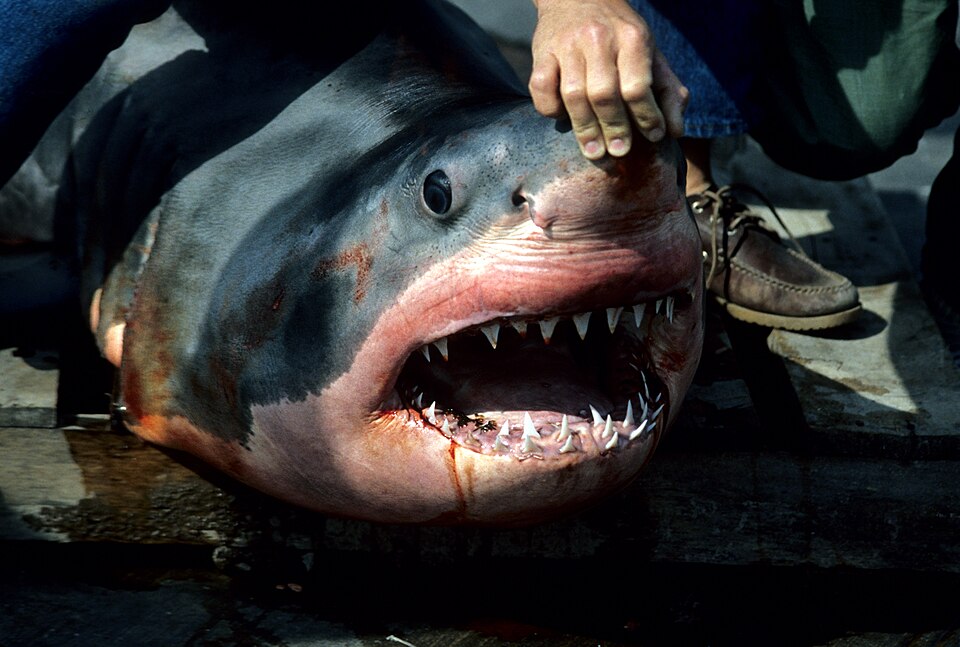
A video filmed by scuba divers removing abandoned ghost nets from a shipwreck between Tunisia and Sicily recently spread across global news. It showed an adult great white shark. For many people, the presence of a great white in the Mediterranean came as a shock. Scientists say it should not have.
According to a report by Phys.org, great white sharks have been documented in the Mediterranean for more than 150 years. Historical records show their presence across the region, from Spain and France to Italy, Malta and Greece. They were never common, but they appeared with some regularity. Over time, fishing pressure, prey depletion and accidental capture drove their numbers so low that sightings became extremely rare.
Scientists now describe Mediterranean great whites as a "ghost population." They are not extinct, but they are almost never seen. Most modern evidence comes from isolated encounters, fishermen's reports, photographs or brief video clips. Many reports are difficult to verify, adding to the species' mysterious status in the region. Some have assumed that any great white spotted in the Mediterranean must have wandered in through the Strait of Gibraltar, but research does not support that idea.
A 2020 genetic study led by the University of Bologna found something surprising. By analyzing DNA from historical shark remains, researchers determined that the Mediterranean great white population has been genetically isolated for approximately 3.2 million years. Their DNA is more closely related to Pacific populations than to those in the nearby Atlantic, pointing to a complex evolutionary history. The finding makes this one of the oldest and most distinct white shark populations anywhere on Earth.
The same study found extremely low genetic diversity within the population. That pattern suggests the group went through a founder event or population bottleneck at some point in its history. The population is considered critically endangered. Low genetic variability may make it more vulnerable to disease, environmental change or further population decline. Because it represents a distinct evolutionary lineage, its loss would reduce global white shark diversity in a way that could not be recovered.
The study also exposed a serious gap in scientific knowledge. Despite confirming that the population has persisted over millions of years, researchers noted that very little is known about where these sharks feed, migrate or reproduce in the Mediterranean today. That gap makes conservation planning difficult.
Recent evidence continues to confirm that the sharks are still out there, even if rarely. In April 2023, tuna fishermen accidentally caught a juvenile great white about 20 nautical miles off Alicante, Spain. The shark was just over 2 meters long and was genetically confirmed as Carcharodon carcharias. Because it was a juvenile, scientists raised the possibility that parts of the western Mediterranean may serve as nursery habitat for the species, though that question remains open.
The recent video from the shipwreck site adds to the record of documented sightings. For scientists studying a population that leaves almost no trace, each new encounter is another data point in an effort to understand a shark that has lived in these waters for millions of years.