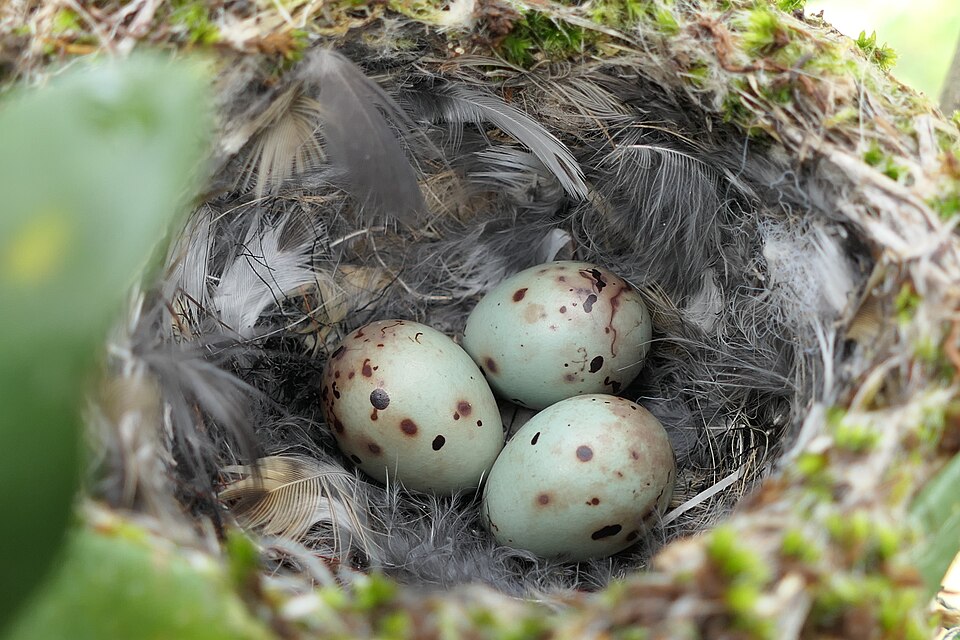
Birds are much smaller than many of their dinosaur ancestors, yet they lay larger eggs. A new study suggests the reason is brain size, according to Phys.org.
Researchers from the American Museum of Natural History and Princeton University analyzed reproductive and anatomical data from mammals, birds, and reptiles. They found that species with relatively larger brains consistently produce fewer but larger offspring. The findings were published in the journal Royal Society Open Science.
The pattern holds across all three major groups of land vertebrates. Species with bigger brains invest more in each individual offspring, either in the form of larger eggs or larger newborns. The energetic demands of developing a large brain appear to drive that investment.
"At first glance, this seems counterintuitive," said Stephanie Lechki, the lead author of the study and a postdoctoral fellow at Princeton University. "Many non-avian dinosaurs were enormous, yet even the biggest dinosaur eggs were smaller than the largest bird eggs. Our results suggest that the answer lies in brain evolution. As birds evolved larger brains, they also evolved larger offspring, which required larger eggs."
Previous research had proposed that differences in reproductive strategy across vertebrates might reflect variation in metabolic rates or brain size, but those studies largely examined mammals and birds separately. By combining data from all three groups into a single evolutionary framework, the new study reveals a consistent relationship that crosses the boundaries between major animal groups.
The research also adds context to well-known dinosaur fossils. Spectacular nesting specimens, including oviraptorosaurs discovered during museum expeditions to the Gobi Desert in the 1990s, have shaped scientists' understanding of dinosaur reproduction for decades. The new study places those finds in a broader picture.
"This work places those remarkable fossils into a much larger macroevolutionary picture," said study co-author Roger Benson, the museum's Macaulay Curator of Dinosaur Paleobiology.
Reptiles, including most non-avian dinosaurs, tend to produce many smaller offspring. Birds and mammals produce fewer but larger ones. The new study suggests that difference is not incidental. It tracks closely with how large the brain is relative to body size across each group.
The findings raise new questions about the evolutionary consequences of brain growth. If brain size drives offspring size, then the rapid expansion of brain size in the lineage leading to modern birds may have had wide-reaching effects on how those animals reproduced and how their populations grew over time.