

A team of physicists has proposed a new strategy for building materials that are both magnetic and electric at the same time, and that work at room temperature. If the approach holds up, it could open a path to a new class of ultrathin, flexible devices including low-power memory chips, sensitive sensors and spintronic components.
The research comes from scientists at Zhejiang University, the Chinese Academy of Sciences and Eastern Institute of Technology, as reported by Phys.org. Their results were published in Physical Review Letters.
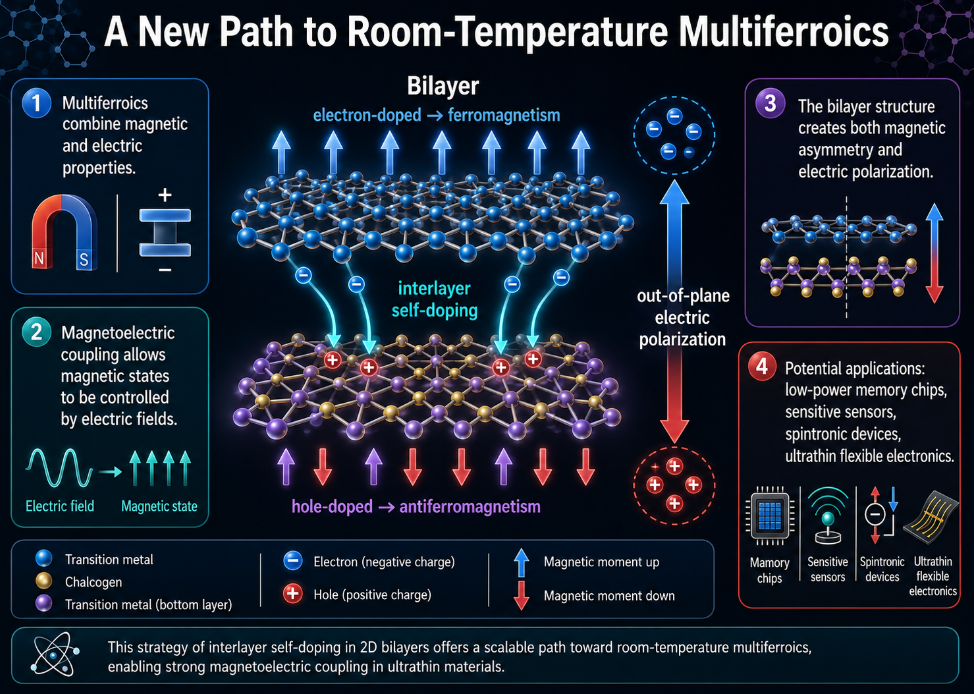
The materials in question are called multiferroics. They can exhibit more than one ferroic property at once, such as ferromagnetism and ferroelectricity. The most useful feature of a multiferroic is that its magnetic state can be controlled with an electric field, and vice versa. That kind of control, known as magnetoelectric coupling, is what makes these materials attractive for next-generation electronics. The problem is that achieving strong coupling at room temperature has been very difficult.
The new approach centers on a phenomenon the researchers call interlayer self-doping. The idea starts with a single atom-thin layer of a material in which the antiferromagnetic and ferromagnetic states are nearly equal in energy. When two such layers are stacked together into a bilayer, electrons spontaneously move from one layer to the other.
Senior author Yunhao Lu explained the logic behind the concept.
"We were intrigued by the long-standing observation that antiferromagnets prefer insulating states while ferromagnets favor half-filled metals," Lu told Phys.org.
"This led us to ask: Can we exploit this difference in band-filling preference to create a new type of multiferroic where charge transfer between two identical layers simultaneously stabilizes opposite magnetic orders and generates ferroelectricity?"
The answer, based on their simulations, is yes. The layer that loses electrons becomes hole-doped and stabilizes antiferromagnetism. The layer that gains electrons becomes electron-doped and stabilizes ferromagnetism. That asymmetry between the two layers produces an out-of-plane electric polarization, which is the electric counterpart needed to complete the multiferroic effect.
Lu described what makes this approach different from conventional multiferroics.
"Our proposed strategy starts with a 2D monolayer that has an 'intermediate' band filling—meaning its antiferromagnetic and ferromagnetic states are nearly degenerate," he said. "When we stack two such monolayers into a bilayer, electrons spontaneously transfer from one layer to the other (self-doping)."
Conventional multiferroics typically rely on a quantum mechanical effect called spin-orbit coupling to link their electric and magnetic properties. The interlayer self-doping approach does not. That distinction matters because spin-orbit coupling tends to produce weak magnetoelectric effects, limiting practical usefulness. The new method could produce stronger coupling without that constraint.
The team conducted their tests using computer simulations based on quantum mechanical theory. No physical prototype has been built yet. The research at this stage is entirely theoretical, but the simulations are grounded in established physics and are designed to guide future experimental work.
The researchers say the findings hint at the potential for developing low-power, ultrathin and flexible devices. The next step would be for experimental physicists to identify real materials that match the theoretical conditions the simulations describe and attempt to fabricate the bilayer structures in a lab.