Scientists from the Czech Republic have built microscopic robots that can navigate through soil and water, latch onto plastic particles, and be pulled out with a magnet. The results, published in the journal npj Asia Materials, showed removal rates as high as 94 percent in water tests.
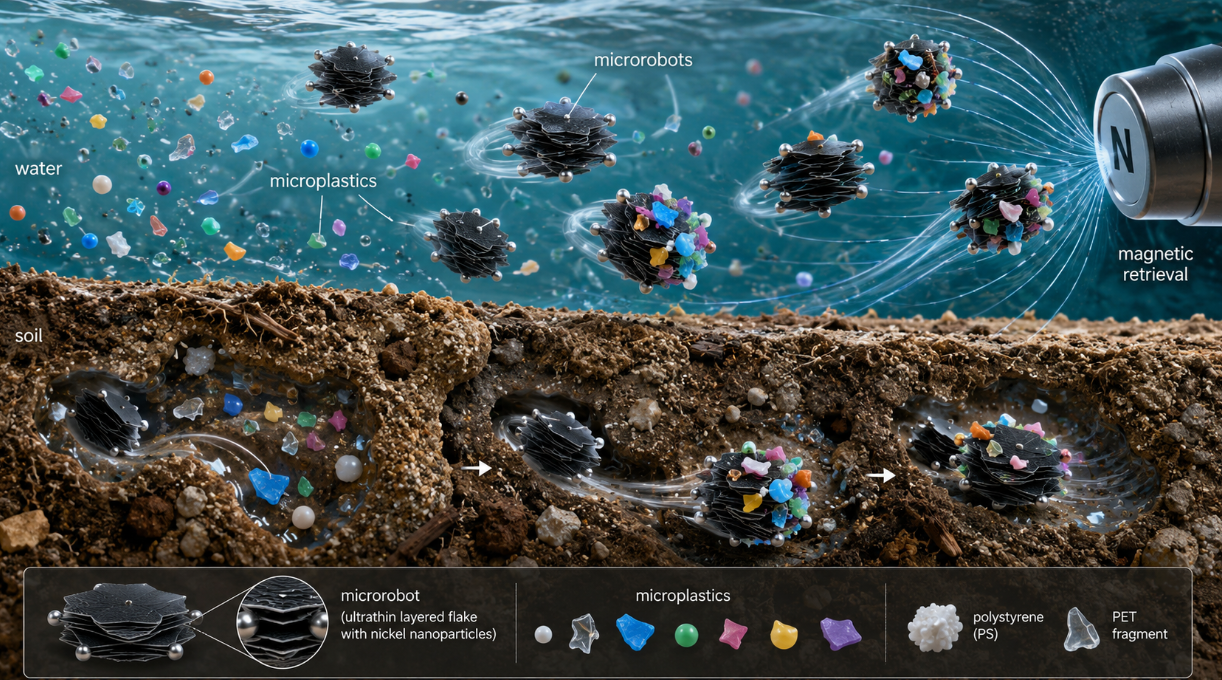
As reported by Phys.org, the robots start as microscopic MXene particles, a material made of ultrathin stacked layers with a large surface area. That surface chemistry helps the particles attract and hold plastic. Researchers then coated those particles with magnetic nickel nanoparticles so that rotating magnetic fields applied from outside could drive the tiny machines.
In tests, swarms of the microbots were released into water and soil samples contaminated with plastic. The magnetic fields caused them to spin and tumble through liquid and squeeze through tiny water-filled gaps in soil.
"In soil environments, the microrobots can navigate through water-permeated soil microenvironments, actively disrupt microplastic entrapment within soil matrices, and extract them," the study authors wrote in their paper.
As the robots moved, their sticky surfaces collided with microplastic particles, binding to them. A magnet then pulled the robots, along with the trapped plastic, out of the samples.
The numbers were strong. In water, the robots removed about 94 percent of polystyrene particles and 89 percent of PET, a common plastic used in bottles and packaging, in around an hour. In model soil, they removed about 81 percent of the polystyrene and 72 percent of the PET. Both figures beat the performance of the same MXene material used without magnetic motion, which relied on passive adsorption and could not actively move through the material.
Microplastics, defined as plastic particles under 5 millimeters, have become a serious problem in both soil and water environments. They damage soil fertility, disrupt nutrient cycling, and can move through the food chain. In soil especially, the particles become tightly trapped between minerals and organic matter, making them very difficult to remove with existing methods.
The researchers acknowledge that their tests were conducted in a lab, not in the field. Real-world conditions will be more complicated. There are also potential concerns about metal ion leaching from the nickel coating and the possibility that not all the magnetic robots can be fully retrieved after a cleanup.
Still, the team believes the platform has real potential. "This microrobotic cleanup platform represents a versatile and sustainable strategy for active pollutant decontamination in both aquatic and terrestrial ecosystems," the authors wrote.
Field trials will be the next step.