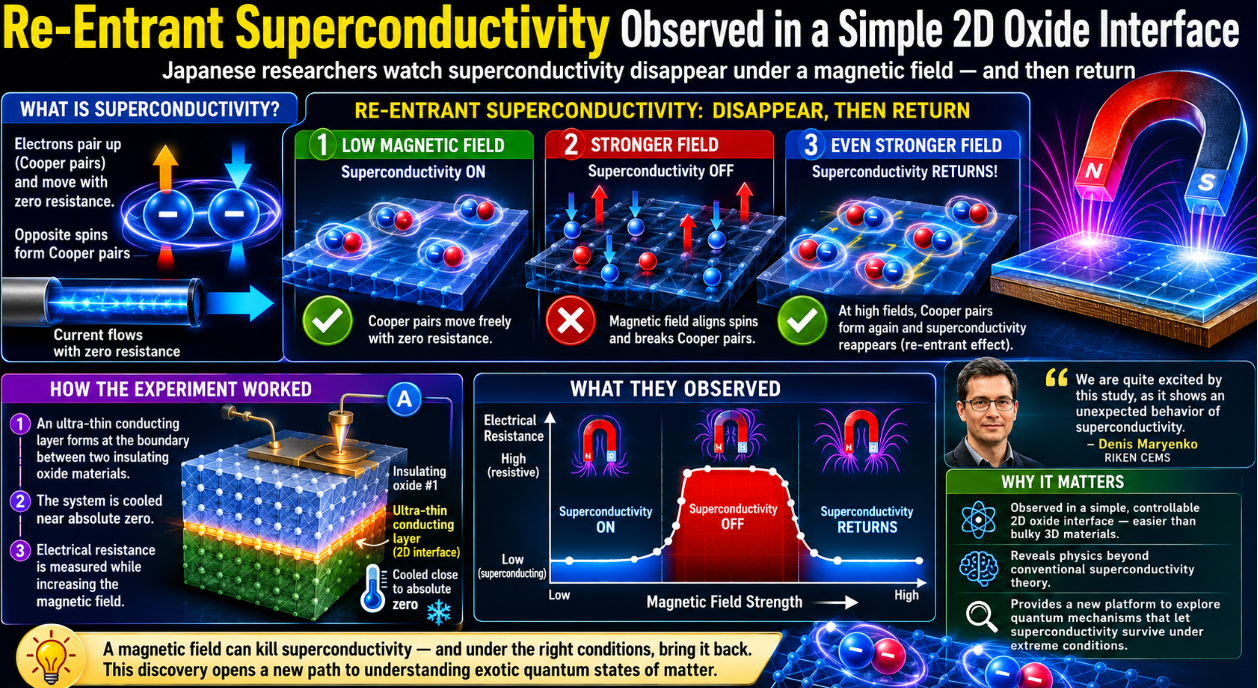
A magnetic field strong enough to shut down superconductivity in a material can, under the right conditions, bring it back. Researchers in Japan have now observed this behavior in a system far simpler and more controllable than any previously studied.
The phenomenon is called re-entrant superconductivity. Under normal circumstances, superconductivity arises when electrons form pairs, called Cooper pairs, with opposite spins. A magnetic field tends to align those spins, disrupting the pairing and killing the superconducting state. In rare cases, however, increasing the field further causes superconductivity to return. That return is what makes the phenomenon so puzzling to physicists.
According to Phys.org, a team led by the RIKEN Center for Emergent Matter Science in Japan published the findings in the journal Science Advances. The researchers created an extremely thin conducting layer at the boundary between two insulating oxide materials, cooled it to temperatures close to absolute zero, and then measured its electrical resistance while applying a magnetic field. That setup let them track precisely when the material entered and left the superconducting state.
The effect has been seen before, but mostly in bulk, three-dimensional materials where it is difficult to isolate the mechanisms responsible. Observing it in a well-defined two-dimensional interface puts it in a different physical category. Because oxide interfaces can be precisely engineered, the team says this system gives scientists a new platform for studying unconventional forms of superconductivity and the quantum mechanisms that allow it to survive under unusual conditions.
The results indicate that the magnetic field is not acting as a simple on-off switch. Instead, the superconducting state appears to depend on a delicate balance among electronic effects at the oxide interface. That balance points to mechanisms beyond the conventional description of how superconductivity works.
Denis Maryenko, the first author and a researcher at RIKEN CEMS, described the team's reaction to the results. "We are quite excited by this study, as it shows an unexpected behavior of superconductivity. We found this behavior in an extremely thin electronic system at the boundary betwe" — the published excerpt ends mid-sentence there, but the finding itself is clear. The system behaves in ways that standard superconductivity theory does not predict.
The discovery does not yet have an immediate practical application, but it gives physicists a controllable setting to study superconducting states that would be far harder to access in more complex bulk materials. The next step for the team is to use the oxide interface as a test bed for exploring what quantum mechanisms are actually allowing the superconducting state to return.