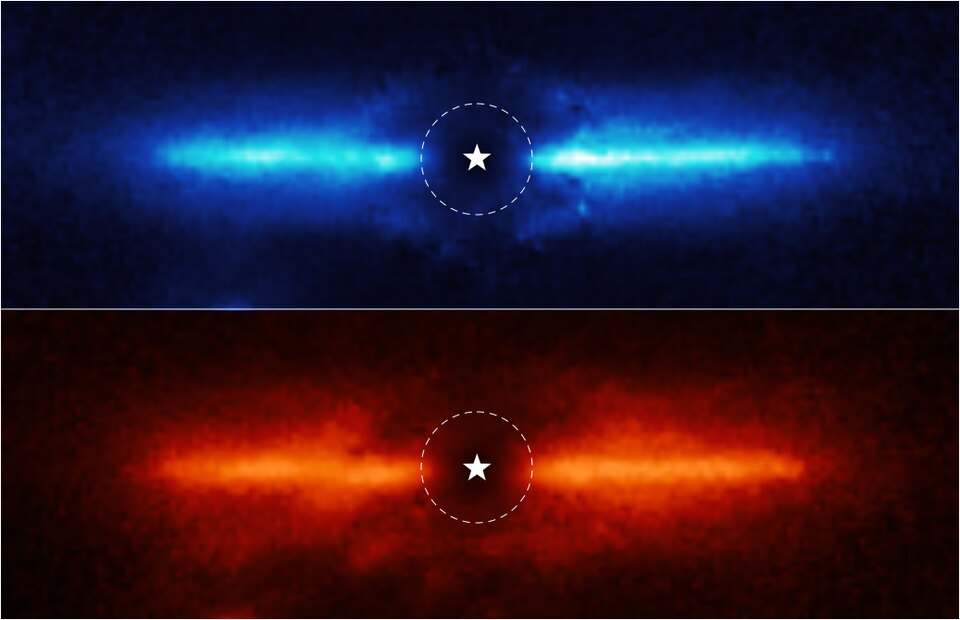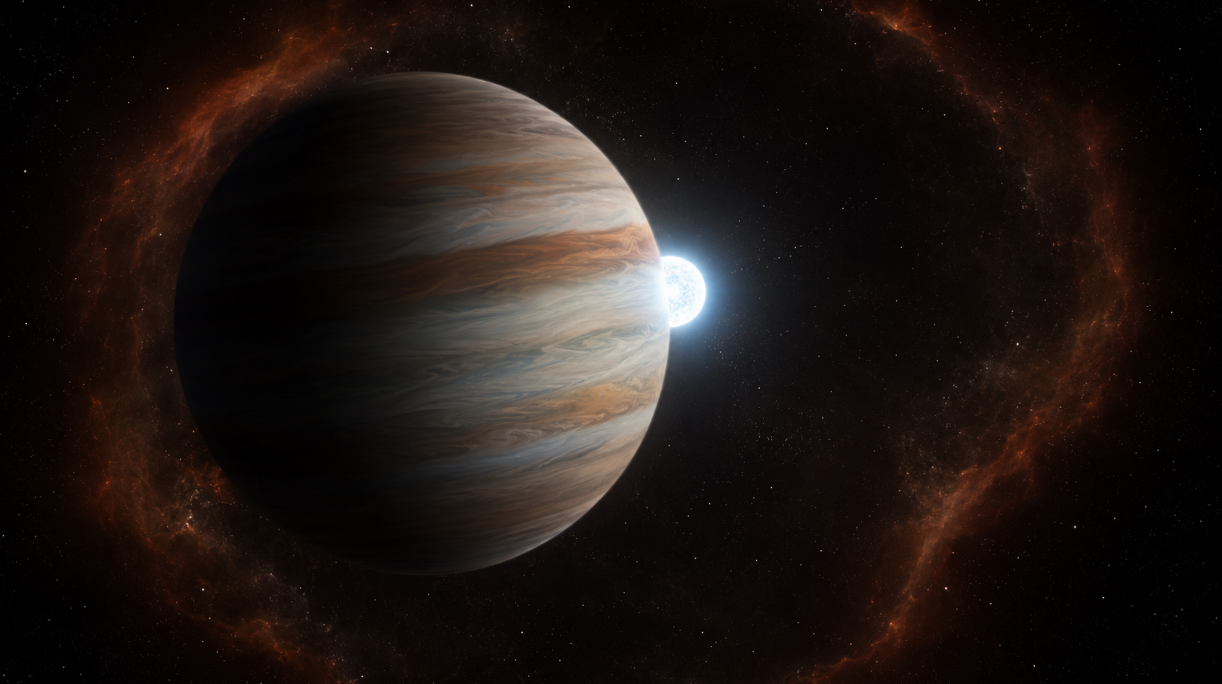
A gas giant the size of Jupiter is orbiting a burned-out dead star at a distance that should not be possible, and astronomers are still working out how it got there.
WD 1856 b is the only confirmed case of a planet that survived the death of a Sun-like star. It orbits a white dwarf, which is the dense remnant left behind after a star exhausts its fuel, swells into a red giant, and then collapses. A team of astronomers recently used the James Webb Space Telescope to examine the system for the first time, and what they found made an already strange situation harder to explain, according to a report by Ars Technica.
The planet was an accidental discovery. In 2020, astronomers pointed the TESS observatory at roughly 2,000 white dwarfs, searching for small objects like comets or asteroids that might transit across the face of these dead stars. Instead, they found a gas giant.
The white dwarf is about seven times smaller than the planet orbiting it. Each time the planet crosses in front of the star, its brightness should drop to nearly nothing. Instead, it dips by only about half. Christopher O'Connor, a theoretical astrophysicist at Cornell University and co-author of a recent study published in Nature, described the team's reaction when they first saw the data. "As soon as they looked at it, they said, okay, that's weird," O'Connor said.
O'Connor thinks the partial brightness dip is explained by a grazing transit, where only the edge of the planetary disk clips the face of the star. "That's a very unlikely viewing angle," he said, "but it's the only way to explain what we actually see."
The planet's location adds another layer of difficulty. It orbits at about 0.02 AU from the white dwarf, which is extraordinarily close. Current models of stellar evolution do not expect a planet to end up there. O'Connor explained the problem: "When the star expands to become a red giant, it consumes the inner planets." Then, as the star shrinks down to a white dwarf, it loses roughly half of its original mass, weakening its gravitational pull. "The outer planets, like gas giants, should migrate outward by about a factor of two," O'Connor said.
That means WD 1856 b should have moved away from its star, not toward it. How it ended up in such a tight orbit around a white dwarf remains an open question, and one that future James Webb observations may help answer.