

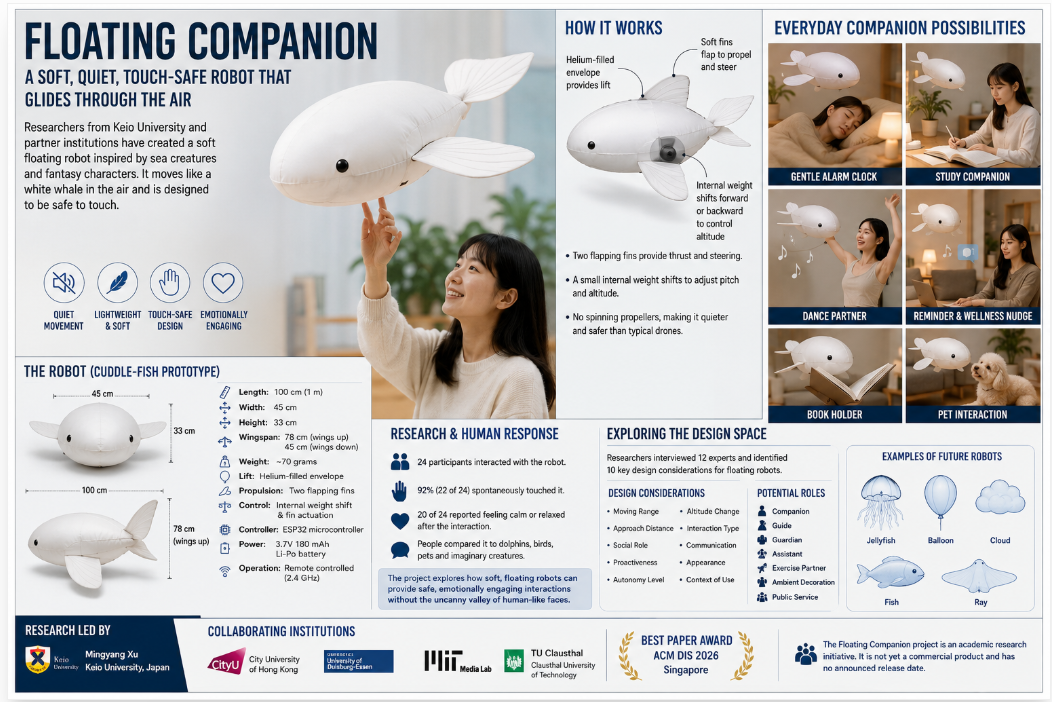
A team of international researchers has developed a floating robotic companion that moves through indoor spaces like a soft marine animal swimming through water.
The project, known as Floating Companion, is not currently associated with a commercial robotics company. It is an academic collaboration led by researcher Mingyang Xu of Keio University’s Graduate School of Media Design in Japan. Other contributors are affiliated with City University of Hong Kong, the University of Duisburg-Essen, the MIT Media Lab and Clausthal University of Technology.
The robot shown in the demonstration is based on an earlier platform called Cuddle-Fish. Its white inflatable body and broad flapping fins give it the appearance of a small whale, ray or fish drifting through the air.
Unlike a conventional quadcopter, the robot does not depend on rapidly spinning propellers to remain airborne. Its body is filled with helium, which provides most of the lifting force, while two slowly flapping wings propel and steer it. This allows the machine to move with less noise, wind and turbulence than a typical indoor drone.
The robot’s rounded body is made from aluminum-coated nylon film. The material forms both the helium envelope and its flexible wings. The design is intended to reduce the danger associated with collisions and eliminate exposed propellers and mechanical pinch points.
The researchers describe the robot as touch-safe, although it would be more accurate to say that its construction is designed to minimize injury risk rather than eliminate every possible risk.
Built to Fit Inside Homes
The documented Cuddle-Fish prototype measures approximately one meter long, 45 centimeters wide and 33 centimeters high when inflated. Its wingspan reaches 78 centimeters when the fins are raised, but narrows to about 45 centimeters when they are lowered, allowing the robot to pass through a standard interior doorway.
The entire robot weighs about 70 grams. Each fin is moved by a three-gram servo motor connected to lightweight carbon-fiber rods. An ESP32 microcontroller controls the motors, and power comes from a 3.7-volt, 180-milliamp-hour lithium-polymer battery.
When both fins flap together, the robot travels forward. Changing the frequency and angle of the flapping motion adjusts its speed. Operating the fins differently causes the robot to turn.
Altitude is controlled by shifting a small weight inside the helium envelope. Moving the weight forward tilts the robot downward, while moving it backward causes the body to pitch upward. The prototype’s fins flap between 0.3 and 1.5 times per second, far more slowly than the propellers on a conventional drone.
More Than One Robot Design
The 2026 Floating Companion project expands beyond the original fish-shaped prototype. Rather than presenting a single finished machine, the researchers developed a framework for imagining different forms of soft floating robots.
Possible examples include a fish that circles a person and provides gentle contact, a balloon-like robot that follows someone between floors, a jellyfish that uses rhythmic motion to guide breathing, a robot that plays with a pet and a cloud-shaped companion that reminds a person to take a break.
The team identified 10 major design considerations, including how far a robot should travel, how it changes altitude, how closely it approaches people, whether it interacts with humans or pets, what social role it assumes, how it communicates and how proactive it should be.
Potential roles include companion, guide, guardian, assistant, exercise partner, ambient decoration and public-service robot.
The demonstration video presents several speculative everyday uses. The robot descends toward a sleeping person as a gentler alternative to an alarm, nudges someone who has been working too long, blocks part of a screen to suggest taking a break, supports a book while someone reads and moves with music as a floating dance partner.
These demonstrations should be understood as proof-of-concept scenarios rather than features of a finished autonomous household product. The 2026 research paper describes the machines as experimental prototypes intended to demonstrate possible interactions.
People Were Willing to Touch It
The earlier Cuddle-Fish research included a study involving 24 participants. Twenty-two of them, or 92 percent, spontaneously touched the robot during the experiment.
Participants patted, stroked, hugged and tapped its body. Some placed their faces against it or reached for its flapping wings. Twenty of the 24 participants said they felt calm or relaxed after the experience.
Participants frequently compared the robot to dolphins, birds, pets and imaginary creatures. One described its movement as resembling whales swimming through a galaxy. The researchers found that people often assigned emotions and personality traits to the machine even though it lacked a face.
That response may help explain why abstract floating robots can feel emotionally engaging without copying the human form. Instead of communicating through facial expressions, they can use altitude, speed, circling, fin movements, gentle contact and body orientation.
It Is Not Yet Autonomous
One important limitation is that the documented robot was operated remotely by a researcher using a handheld 2.4-gigahertz controller. The user study employed a “Wizard of Oz” method, meaning participants experienced apparently responsive behavior that was actually directed by a human operator.
The prototype therefore does not yet independently recognize when someone has overslept, worked too long or needs a reminder. Those functions would require additional sensors, navigation software, environmental awareness and autonomous control.
The robot is also highly sensitive to moving air. Air conditioners, fans and open windows can push it off course, making outdoor operation especially difficult. Its helium gradually leaks through the envelope and must eventually be replenished. The researchers also said stronger materials would be required for prolonged everyday use.
Payload capacity presents another obstacle. Cameras, microphones, processors and larger batteries add weight, while helium provides only about one gram of lifting force per liter. Some processing could eventually be handled by a stationary computer that communicates wirelessly with the robot, reducing the amount of equipment it must carry.
The project remains a university research program rather than a product available for purchase. I found no announced manufacturer, price, crowdfunding campaign or commercial release date. The published work focuses on interaction design, user response and future research rather than manufacturing or sales.