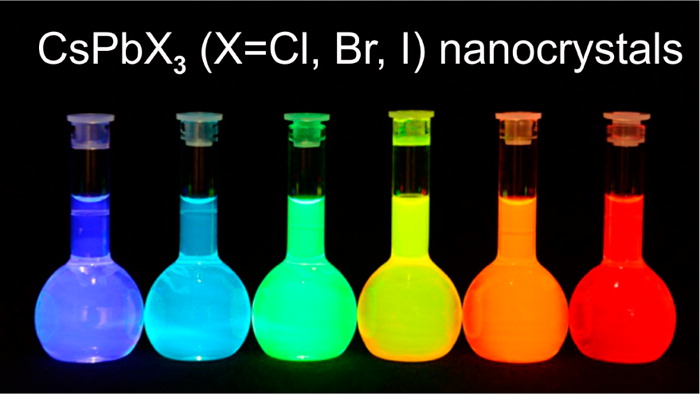
Tiny crystals smaller than 20 nanometers are already inside millions of televisions, laptops and display screens. But the technology has not reached its full potential, partly because no reliable method existed to check the quality of individual particles at scale. A team at Ludwig Maximilian University of Munich has now built one.
The new method, published in the journal Nature Materials, uses light to screen thousands of individual perovskite nanocubes directly in solution in a short amount of time. It measures the size and quantum yield of each particle separately, rather than averaging results across an entire sample.
Quantum yield refers to how efficiently a particle converts absorbed energy back into light. That number matters a great deal for device performance, but until now it could only be measured as an average across billions of particles at once.
"For their function in devices, these average values are insufficient," said Professor Emiliano Cortés, who leads research at LMU's Nano-Institute. "Each individual nanoparticle can behave differently — for example, in its size or in how efficiently it emits light, meaning how effectively it converts absorbed energy back into light."
The lead author of the study, Dr. Christoph Gruber, described the method as high-throughput quality control at the single-particle level. "This is crucial for the reliable production of materials and the devices built from them," he said. "Billions of nanoparticles determine the overall performance. Instead of relying on averaged values, we can now differentiate how strongly individual particles contribute and how much they vary within a sample."
The work also produced a concrete scientific finding. Professor Alexander Urban, whose team synthesized the nanocubes used in the study, found that smaller nanocrystals consistently perform better. "We can now look specifically at individual particles and identify clear trends: Smaller nanocrystals, for example, show a higher quantum yield — meaning they emit light more efficiently — than larger ones," Urban said. "This understanding is crucial for fully exploiting the potential of perovskites for high-performance and scalable optoelectronic devices."
Building the system was not straightforward. Thousands of particles had to be measured quickly, precisely and repeatedly. Dr. Andrea Mancini, co-first author of the study, said that "a major challenge was handling the large volumes of data and establishing a reliable analysis pipeline."
Perovskite nanocrystals are considered promising materials for the next generation of quantum technology, sensing devices and solar cells. The new screening method gives manufacturers a way to sort and select particles based on actual individual performance rather than batch averages, a step researchers say is necessary before the technology can be reliably scaled up.