

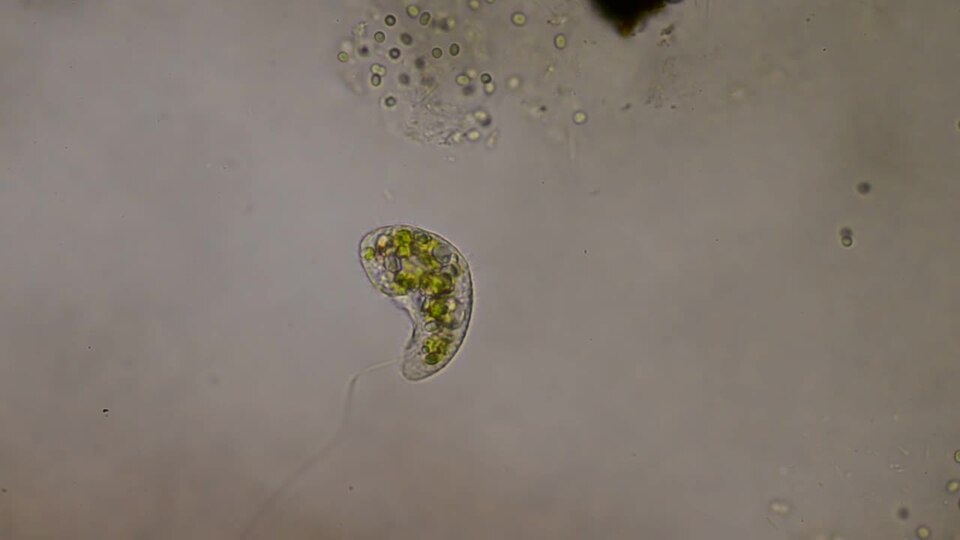
A microscopic organism found in oxygen-poor river sediments near Libreville, Gabon, navigates by carrying living magnetic bacteria inside its own cell. The discovery, published in the Proceedings of the National Academy of Sciences, reveals a strategy for magnetic sensing that scientists had not seen before in single-celled eukaryotes.
The organism, named Tropidoatractus magnetotacticus, is a ciliate, meaning it belongs to a group of more complex single-celled creatures that have a cell nucleus, unlike bacteria. An international research team led by Professor William Orsi from the Department of Earth and Environmental Sciences at Ludwig Maximilian University of Munich identified it. Scientists have long known that magnetotactic bacteria use Earth's magnetic field as a compass, but how more complex single-celled organisms acquire that same ability had remained largely unexplained.
Electron micrographs of the new ciliate revealed tiny magnetite particles arranged in chains that resemble strings of pearls. The images showed those particles do not belong to the ciliate itself. They come from living bacterial symbionts living inside the organism. The ciliate is essentially borrowing the magnetic hardware of another species.
According to a report by Phys.org, lead author Leon Kaub described the moment researchers first examined the cells. "When we first observed these cells, we immediately realized we were looking at something different. Discovering that they navigate by using these endosymbionts revealed a fascinating new way in which eukaryotes can exploit the Earth's magnetic field," Kaub said.
The arrangement does not stop at two partners. Genetic analyses confirmed the ciliate also hosts methane-producing archaea as a third partner inside its cell. Those archaea process metabolic waste products from the ciliate, which helps create conditions favorable for the energy metabolism of all the partners in the low-oxygen sediment environment. The magnetic orientation ability helps the ciliate swim downward more efficiently into those anoxic zones, where all three partners are better suited to survive.
Co-author Mitali Chitnis pointed to the broader significance of the find for understanding how magnetic sensing evolves. "Our discovery opens up new perspectives on the evolution of magnetoreception," Chitnis said. "It indicates that this capability can emerge not just through the evolution of a single organism, but also from the long-term symbiosis of various microorganisms."
Orsi suggested the discovery is unlikely to be an isolated case. "Now that this type of symbiosis has been discovered, I anticipate that many more similar cooperations will be discovered in anoxic environments and that these associations are more common than previous known," he said.
The study changes how researchers may approach searching for magnetic sensing in the microbial world. Rather than looking only at organisms that evolved the trait internally, scientists may now look for organisms that acquired it by taking on the right partners.