

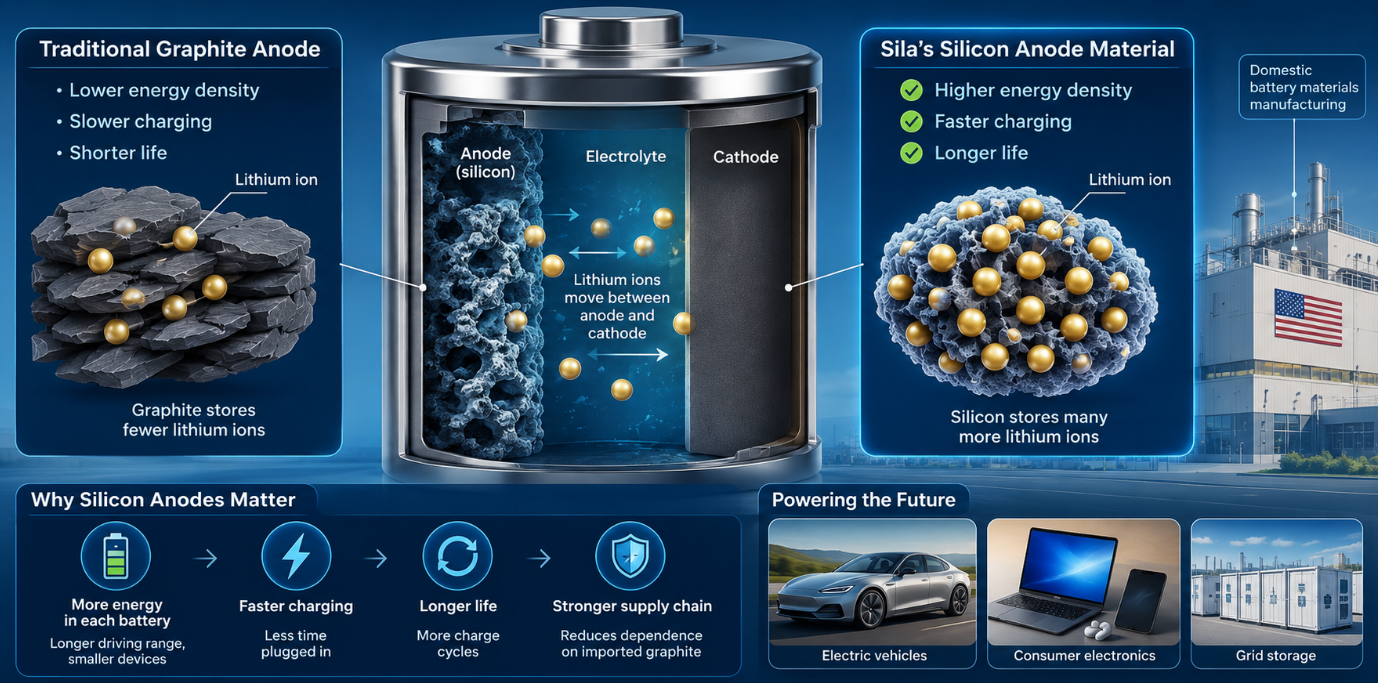
A battery materials company called Sila has raised $300 million in private funding to expand manufacturing of a silicon-based anode material it says outperforms the graphite used in today's lithium-ion batteries.
According to a report by Business Wire, the funding will be used to scale what the company describes as gigascale anode manufacturing. The investment reflects growing demand for better battery materials as electric vehicles, consumer electronics, and grid storage systems all push the limits of current battery chemistry.
Sila's core product is a silicon-based anode material designed to replace graphite, which is the standard material used in the negative electrode of lithium-ion batteries. Silicon can store significantly more energy than graphite, which is why battery researchers have pursued it for years. The challenge has always been that silicon expands and contracts dramatically as it charges and discharges, which causes it to crack and degrade quickly. Sila says its material addresses that problem through a proprietary manufacturing process.
The company has framed the investment in national security terms as well as commercial ones. The Business Wire report notes that the funding is meant to strengthen what Sila calls America's technology sovereignty, a reference to the fact that battery supply chains, and graphite production in particular, are heavily concentrated in China. Building domestic manufacturing capacity for alternative anode materials reduces that dependence.
Sila has previously supplied its anode material to consumer electronics products. Scaling to gigascale production means moving into the volumes required to supply electric vehicle manufacturers, which demand far larger quantities of battery material than any consumer device market.
The $300 million round adds to funding Sila has raised in previous years as it has worked to move from laboratory-scale chemistry to industrial-scale production. The company has not announced specific vehicle or manufacturing partnerships in connection with this round, but the size of the investment suggests it is preparing for commitments at a significant scale.
Battery anode technology has become a competitive space, with several companies pursuing silicon-based and other alternatives to graphite. The race matters because the anode material is one of the key factors determining how much energy a battery can store, how fast it can charge, and how long it lasts over repeated charge cycles.
Sila's expansion comes as the United States government has also been pushing through grants and loans to build domestic battery manufacturing across the supply chain, from raw materials to finished cells.