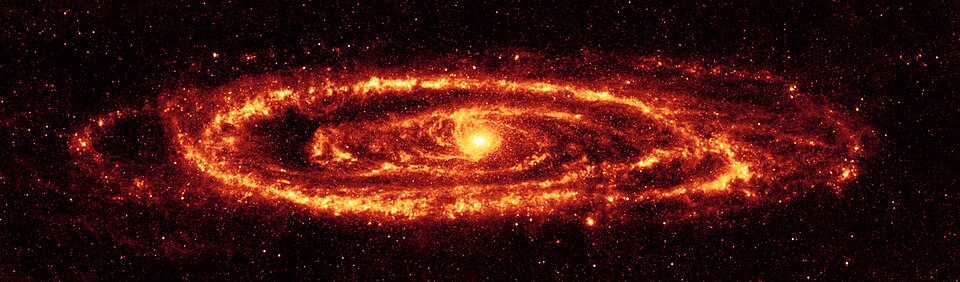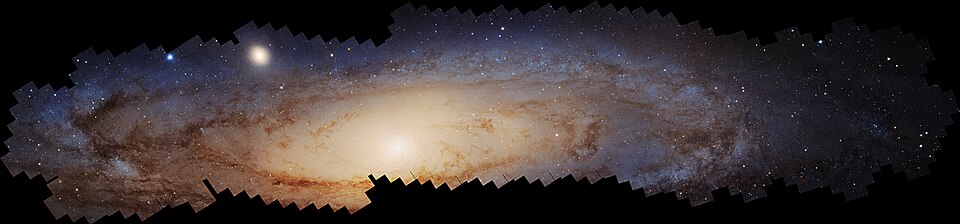
The Andromeda galaxy, the nearest large spiral galaxy to Earth, has been steadily producing fewer new stars over the past 500 million years and is now forming them at a fraction of its earlier rate. A new study using data from the Hubble Space Telescope lays out that decline in detail, offering a clearer picture of how large galaxies age.
According to Live Science, the research was published July 27 in The Astrophysical Journal. It draws on two major Hubble surveys that together mapped roughly two-thirds of Andromeda's disk, cataloging around 200 million stars in the process.
Andromeda, also known as M31, sits 2.5 million light-years away in the constellation Andromeda. It is a giant spiral galaxy with about twice the mass of the Milky Way. Because it is the closest large spiral galaxy to us, it serves as an unusually detailed laboratory for studying how galaxies form and change over time. It is also the only major galaxy in the universe currently moving toward the Milky Way, while nearly all others are rushing away.
The numbers behind the decline are striking. The study found that Andromeda formed stars at a rate of around one solar mass per year 500 million years ago. By 40 million years ago, that rate had dropped by half. Today, the rate has fallen to just one-fifth of a solar mass per year.
Researchers found that most of this recent star formation has been concentrated in a ring about 32,000 light-years from the galaxy's center. The decreasing activity within that ring accounts for much of the overall decline, which points to the galaxy winding down from an earlier, more active period rather than abruptly exhausting its raw material.
That earlier period of high activity is already well documented. Andromeda experienced a dramatic burst of star formation about 2 billion years ago, which is thought to have built roughly one-fifth of all the stars in the galaxy. Astronomers believe that starburst was triggered by a merger with another galaxy, most likely the compact elliptical galaxy M32, which now orbits Andromeda.
The new findings suggest that what astronomers are seeing today is the long, gradual aftermath of that burst. Star formation in the galaxy has been declining steadily in the time since, with no sharp cutoff but a slow fade concentrated in that ring structure tens of thousands of light-years from the center.
The timing of the study is notable. NASA's Nancy Grace Roman Space Telescope is expected to build on Hubble's work and deliver even broader views of Andromeda and other nearby galaxies. That means the portrait of Andromeda assembled from Hubble data may soon be expanded significantly, giving researchers more tools to study how galaxies like our own eventually age and quiet down.