NASA's $4.3 billion Roman Space Telescope lifted off Sunday morning from historic Pad 39A at Kennedy Space Center in Florida, beginning a journey of more than three months to reach its new home roughly one million miles from Earth. The launch came at 7:26 a.m. EDT, when the Falcon Heavy's three core stages roared to life, producing a combined 3.7 million pounds of thrust and climbing away on an easterly trajectory over the Atlantic Ocean.
According to CBS News, the telescope rode atop a SpaceX Falcon Heavy rocket, only the 13th flight of that vehicle, and the launch provided a sky show for area residents, tourists, and space center workers. The rocket's two strap-on side boosters separated about two and a half minutes after liftoff and returned for landings, as is standard for the Falcon Heavy.
The spacecraft is named after Nancy Grace Roman, NASA's first chief astronomer, who championed the Hubble Space Telescope and became known as the "Mother of Hubble." Roman has an unusual backstory: the telescope was originally designed as a spy satellite for the National Reconnaissance Office before being donated to NASA. Its mirror is Hubble-class in quality, but the telescope's field of view is more than 100 times wider than Hubble's, allowing it to image vast sections of the sky at once with a 300-megapixel wide-field camera.
Roman will travel to the second Sun-Earth Lagrange point, known as L2, the same location where the James Webb Space Telescope currently orbits. At L2, the competing gravitational pulls of the Earth and Sun allow a spacecraft to maintain a steady orbit while using minimal fuel, and the position offers an unobstructed view of the sky. "It takes us a good three-plus months to get out there, and we're spending that time checking everything out and doing a whole bunch of calibrations and making sure everything is working the way we know it can," said NASA integration and test scientist Jeremy Perkins. "It's basically like our time to kick the tires and just make sure that the focus is right, the pointing is right."
Once operational, Roman's primary targets include dark matter and dark energy, two of the universe's most elusive phenomena. Dark matter, which cannot be seen but exerts gravitational influence, is thought to hold galaxies together and define the large-scale structure of the cosmos. Dark energy is the force believed to be driving the accelerating expansion of the universe. Roman will study how gravity subtly bends light across enormous distances to help map both.
NASA science chief Nicky Fox described the mission's scope after Sunday's launch. "Roman is going to revolutionize the way we look at our universe," she said. "It is going to measure dark matter, which is like the fabric of the universe; it's the thing you can't see, but we know it's there. It's going to measure dark energy, which kind of powers the universe. [There is] sort of a cosmic struggle between dark matter that wants to pull things together and dark energy that wants to push things apart. And [Roman] will allow us to finally kind of explain our universe and understand our place in it."
Scientists also expect Roman to expand the catalog of known exoplanets dramatically. Roughly 6,200 exoplanets have been discovered to date. By the end of Roman's mission, that number is expected to climb well above 100,000. "Roman's vast reach will allow us to find the weird, the rare and the unusual," senior project scientist Julie McEnery said on the eve of launch. "We'll redefine what it means to find a needle in a haystack."
Beyond exoplanets, Roman is expected to catalog around 20 billion stars, 2 billion or more individual galaxies, and tens of thousands of supernova explosions. Scientists will use observations of a specific type of exploding star, called a Type Ia supernova, as a standard measure of cosmic distance to refine their understanding of dark energy. A month of Milky Way observations by Roman would take Hubble a century to complete, according to McEnery.
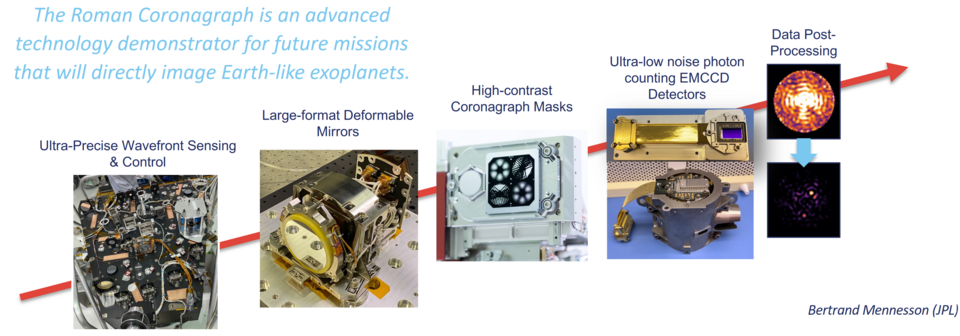
Roman also carries a second instrument: an experimental coronagraph with shape-shifting mirrors designed to block the glare of distant stars, allowing astronomers to analyze light reflected from Jupiter-sized planets and study their chemical composition. Roman, Webb, the European Space Agency's Euclid spacecraft, and the National Science Foundation's Vera C. Rubin Observatory in Chile are all expected to work in coordination, with Roman spotting new worlds and Webb zooming in to study them in detail.