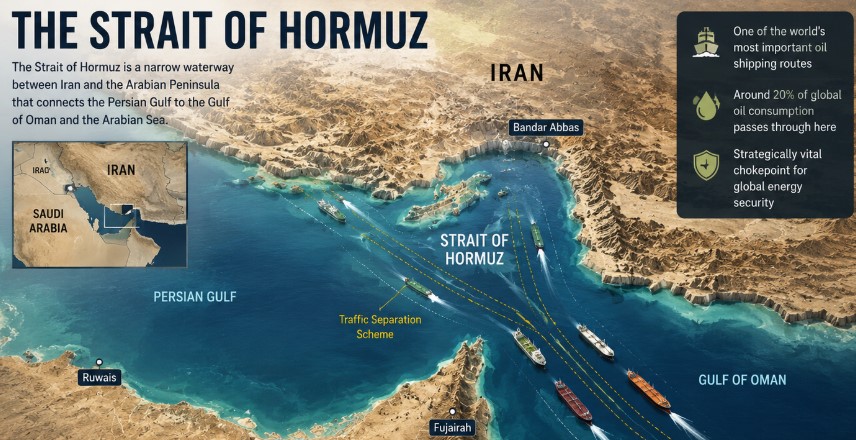
The United States and Iran traded military strikes over the weekend for the first time in several weeks, reigniting a six-month conflict and sending global oil prices above $91 per barrel.
U.S. Central Command announced strikes Sunday against what it described as Iranian rocket launchers on Larak Island in the Strait of Hormuz. Iran's Revolutionary Guard Corps said it retaliated by targeting U.S. military bases in Jordan and the United Arab Emirates. Iranian state media reported Monday that the attack on Larak Island killed two people and wounded several others.
Iran's IRGC also claimed a supertanker attempting to transit the Strait of Hormuz without permission was struck by sea mines, stopping the vessel and starting a fire on board. CENTCOM rejected that claim directly. "This is FALSE," CENTCOM said in a statement posted on social media. "No ships have hit mines in the Strait of Hormuz." The U.K. Navy's Maritime Operations Center, which monitors such attacks, did not corroborate the Iranian claim. The most recent incident it reported was a tanker "struck by an unknown projectile whilst transiting inbound in the Strait of Hormuz" on Saturday.
The dispute over shipping lanes sits at the center of the broader conflict. The Trump administration insists a southern route near Oman's coastline is safe and open for commercial vessels. Tehran refuses to recognize that lane and demands all ships coordinate with Iranian authorities to use a northern passage close to its own shores. Despite U.S. military escorts for some vessels, the number of daily transits through the strait remains at less than half the pre-war level, according to CBS News.
The renewed fighting came after the Trump administration announced a shift last week toward what it called "economic warfare," imposing new sanctions in an attempt to break the military stalemate. A barrel of international benchmark Brent crude sold for over $91 on Monday, up more than 3% from the previous day.
Six months of conflict have produced a sharp divide in who benefits economically. According to a report by Al Jazeera, the closure of the Strait of Hormuz and Iranian strikes on Gulf energy infrastructure have driven major profits for Western oil companies. ExxonMobil reported $14.5 billion in profit in the second quarter of this year, its best quarterly result in four years. Chevron posted $12 billion for the same period, its highest in six years. Shell and BP both more than doubled their year-on-year quarterly earnings, posting profits of $9.8 billion and $5.73 billion respectively. Saudi Aramco netted $33.4 billion in profit in the most recent quarter, a one-third increase from 2025.
Not every energy company gained. Abu Dhabi's state-owned ADNOC reported a 52 percent drop in second-quarter profit to $665 million, citing the closure of the strait. Airlines and carmakers have also taken losses while banks and energy firms have profited, Al Jazeera reported.
American taxpayers have absorbed significant costs. U.S. Defense Secretary Pete Hegseth told Congress in late July that the war had cost $37.5 billion up to that point. Observers cited in the Al Jazeera report suggested the true figure is almost certainly higher.