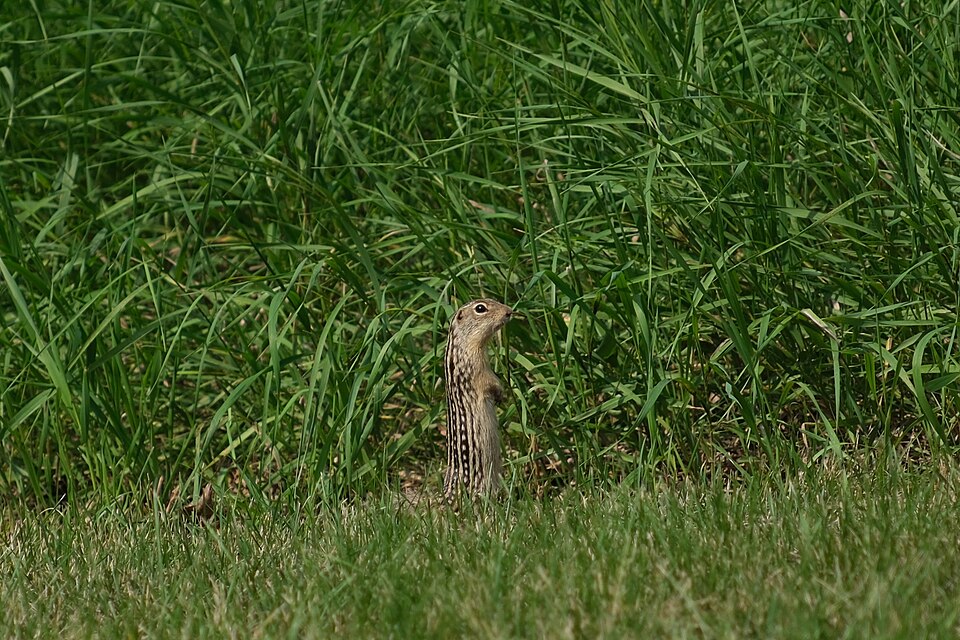
Most mammals lose sensitivity to touch in the cold. The thirteen-lined ground squirrel does not.
A new Yale study published in Current Biology found that these hibernating animals can detect touch at temperatures as low as 4°C (39°F), roughly the temperature inside a refrigerator. For most mammals, including humans, that kind of cold would permanently damage the nerve cells responsible for sensing physical contact.
According to a report by Phys.org, researchers at Yale School of Medicine studied mechanosensory neurons, the specialized nerve cells that convert physical contact into electrical signals. These cells have long protrusions that extend into the skin. When something touches those protrusions, the cells fire a signal to the brain.
The team incubated ground squirrel mechanosensory neurons at 10°C and then stimulated them to measure the electrical response. In other mammals, that temperature would kill or permanently damage those cells. In the squirrels, the neurons produced a strong, clear signal.
That lab result led the researchers to a direct test. They gently touched hibernating squirrels with a paintbrush while the animals' body temperatures were around 4°C. Every squirrel woke up.
"Even though they are completely out, they still sense touch so acutely that a single poke triggered arousal," said Slav Bagriantsev, Ph.D., professor of cellular and molecular physiology at Yale and co-principal investigator of the study.
Elena Gracheva, Ph.D., professor of neuroscience and cellular and molecular physiology, described the broader significance of the finding. "This was the first time we've demonstrated that any mammalian species can detect touch at this low a temperature," she said. Gracheva served as co-principal investigator alongside Bagriantsev.
The two researchers have worked together on sensory differences across species for nearly a decade. In 2017, they found that thirteen-lined ground squirrels and some other hibernating animals do not perceive cold the way most mammals do. That earlier study focused on cold receptors. This new work turned to mechanoreceptors, a different class of sensory cells entirely.
The researchers believe this touch sensitivity may have evolved as a survival mechanism. The squirrels do not feel cold during hibernation, but they retain the ability to sense physical contact. The researchers propose that this may allow them to detect nearby predators while dormant, giving them a chance to rouse and escape.
The findings could have implications beyond squirrel biology. Understanding how these neurons function at low temperatures may open new avenues for research into cold-related nerve damage in humans and into the biology of hibernation more broadly.