

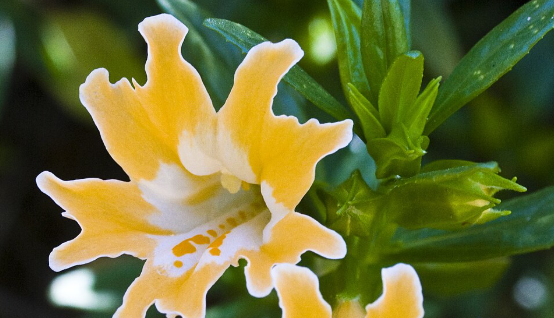
A small wildflower that grows along the windswept coasts of Oregon and California can survive salt exposure that kills nearly every other plant around it. Researchers are now close to understanding how, and they believe the answers could help make food crops more resilient.
The plant is the yellow monkeyflower, and the study of its salt tolerance was published this month in the American Journal of Botany, according to Phys.org. The senior author is David Lowry, a biologist at Michigan State University. The lead author is Madison Plunkert, a plant biology Ph.D. student in MSU's Ecology, Evolution, and Behavior program.
Lowry has been watching this plant for nearly two decades. About 20 years ago, he noticed that when he sprayed inland and coastal monkeyflowers with salty water in a greenhouse, the inland plants wilted, turned brown, and many died. The coastal plants survived. The question was why.
The salt environment on the Pacific Coast is intense. "It's kind of hard to conceptualize unless you've gone out to the coast in California or somewhere else, and the wind is blowing 30 or 40 miles an hour, and you're actually experiencing the salt landing on you," Lowry said. The accumulation is visible and even tasteable. "A salty film gets all over the windshields of cars," he explained. "If you lick the leaves of these plants, you can even taste it."
Salt is lethal to most plants. It causes roots and leaves to dry out and stunts growth. Anyone who has seen rust and peeling paint on beachfront homes has seen what salt does to durable materials. For plants, the effects are faster and more severe.
To study how coastal monkeyflowers cope, the team built a device that mimics oceanfront conditions inside a Michigan lab. "We call it the 'Saltmobile,'" said Plunkert. "It's a cart with airbrushes and bottles of seawater that we've surrounded with a trash bag so that we don't fill up the hallway with a haze of salt spray."
Using this setup, the researchers tested monkeyflower plants collected from five coastal locations alongside inland counterparts. The yellow monkeyflower, Lowry said, "has evolved multiple adaptations to salt spray," though the specific mechanisms are still being mapped.
Monkeyflowers are already known for their ability to survive in extreme environments. Across western North America, from the Pacific Coast to the Great Plains, they colonize abandoned copper mine margins, hot springs, and serpentine soils that are toxic to most other plants.
The researchers say their findings could extend beyond the lab and beyond monkeyflowers. Salt stress on crops comes from multiple sources: ocean spray, road salt applied during winter, and worsening storm surges that push saltwater onto agricultural land. Understanding the genetic and physiological traits that allow monkeyflowers to survive could eventually inform efforts to breed or engineer crops with similar tolerance.