

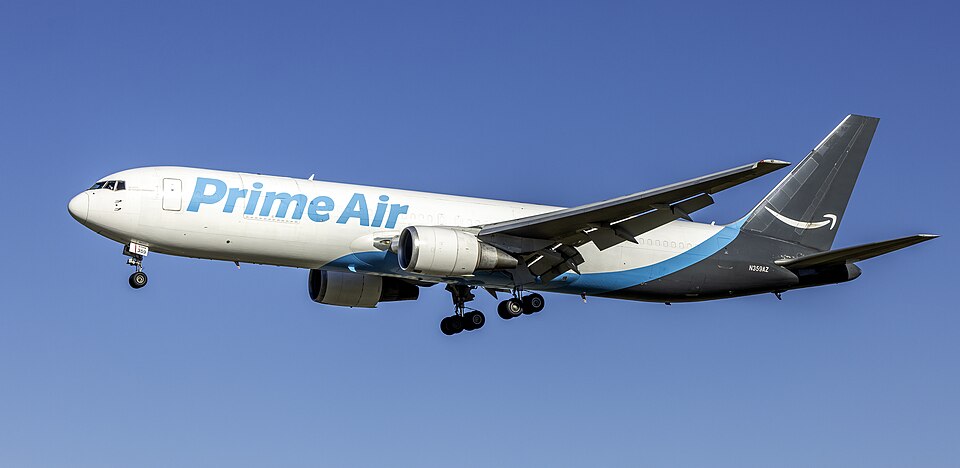
An Amazon cargo plane crashed at Miami International Airport on Sunday, resulting in the deaths of five people and injuries to several others. The Boeing 767-33 Alpha operated by 21 Air LLC was returning from San Juan, Puerto Rico, when it overshot the runway and crashed into two vehicles. The plane struck a Ford Econoline van inside the airport before continuing past the end of the runway and hitting a Toyota Corolla Cross LE SUV outside. NTSB chair Jennifer Homendy said that all five people killed were in those two vehicles, with the Ford van being completely torn apart by the impact.
The accident occurred at about 1:53 p.m. ET, and the aircraft traveled roughly 1,300 feet beyond the paved surface before coming to rest. The van was a 2012 Ford Econoline owned by Professional Ocean Service Corporation, an airline cleaning contractor, and had seven people inside. The two pilots aboard the cargo plane survived. The flight was the aircraft's third trip of the day, after earlier flying from Cincinnati to Miami and then from Miami to San Juan.
The crash occurred as the plane was landing on runway 30 and left a trail of jet fuel across the impact site, according to The Independent. A 32-person NTSB team is on the scene conducting an investigation and recovering physical evidence from the crash, according to a report from CBS News. Flight data and cockpit voice recorders were recovered from the wreckage for further analysis by the agency. Both recorders were being sent to the NTSB's headquarters for downloading and analysis.
The NTSB is examining flight history, crew training, radar data, and aircraft performance as part of its investigation, the BBC reported. Investigators are also reviewing whether the runway should have had an engineered materials arresting system to prevent such crashes. The system, known as EMAS, uses crushable material at the end of a runway to help stop an aircraft during an overrun and is not required at every airport. Miami International Airport does not have an EMAS at the end of Runway 30, although the airport has a 1,000-foot safety area that complies with federal requirements.
Weather conditions at the time included a thunderstorm near the airport with gusting winds up to 26 knots. Investigators have not determined whether the weather contributed to the accident. The NTSB is also examining where the plane touched down, its speed and braking performance, and why the pilots did not abandon the landing and perform a go-around.
Amazon said it was heartbroken by the incident and working closely with authorities during the investigation. The company operating the aircraft, 21 Air LLC, also expressed condolences and said it was cooperating fully with the inquiry. Investigators also plan to examine the relationship between Amazon and 21 Air, including the safety provisions contained in contracts and company policies.
Five people were killed in the crash, and at least five others were injured, including three in critical condition. Two of the injured were taken to Jackson Memorial Hospital, while the other three were transported to Ryder Trauma Center in critical condition. Homendy described the scene as one of 'utter devastation,' with debris scattered across the area and black smoke visible from the crash site.
Witnesses said the crash looked like something from a movie due to the intensity of the impact and damage caused. Two runways at Miami International Airport were closed following the crash as part of ongoing safety efforts. Flights resumed Sunday evening, although the airport continued operating at reduced capacity while investigators worked at the scene.
The aircraft involved was manufactured in 1994 and had been converted from passenger service into a freighter. Homendy said investigators would examine the aircraft's age and ownership history as part of the inquiry. She also said the NTSB would not determine probable cause while investigators were at the crash site, because the initial work focuses on documenting the scene and collecting evidence that could otherwise be lost.
The NTSB plans to issue safety recommendations after completing its investigation into the cause of the crash.