

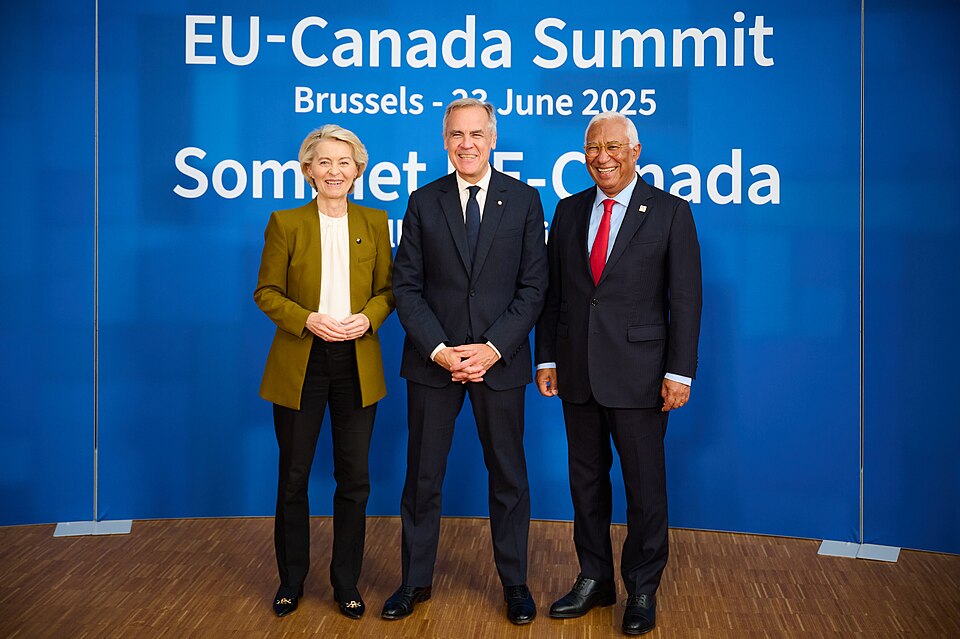
Canadian Prime Minister Mark Carney has expressed support for deeper integration with the European Union, as tensions rise between Canada and the United States under Donald Trump's leadership. Carney's remarks come after European Commission President Ursula von der Leyen proposed that Canada could become the EU’s first “associate member,” although no such formal membership category currently exists. The move is part of a broader strategy to reduce Canada’s reliance on the United States and to build stronger economic, security, and political alliances with Europe.
Carney emphasized that the proposed partnership should strengthen both Canada and Europe rather than create another dominant power bloc. Carney’s visit to Strasbourg, France, was well received by European lawmakers who greeted him warmly and took photos with him. He also received a standing ovation when he addressed the European Parliament, according to CBS News.
The United States has long been Canada's primary economic partner, with about 70% of Canadian exports going to the U.S. Statistics Canada reported that 71.7% of Canadian merchandise exports went to the United States in 2025. This heavy dependence makes Canada vulnerable to Trump’s trade policies and threats of tariffs.
Trump criticized the specific proposal for a closer Canada-EU relationship and suggested it could be considered a hostile act toward the United States. He warned that the United States could impose heavy tariffs on Europe if he believed the arrangement was intended to harm U.S. interests. Trump also called the proposal “laughable.”
Carney argued that middle powers are stronger when they work together instead of dealing individually with larger powers. He said the international order is changing and called for Canada and Europe to build a deeper strategic partnership. His speech focused on protecting markets, democratic institutions and national sovereignty.
The Canadian leader outlined plans for cooperation across fields including critical minerals, defense, artificial intelligence, energy, digital trade and financial services. He also discussed deeper cooperation in space, research and advanced technologies. Canada will host EU leaders in Montreal for a summit on October 29 and 30.
This shift reflects growing concerns about the stability of the current global system and the need to diversify international relationships. The proposed associate relationship is being discussed at a time when both Canada and the EU are seeking stronger strategic ties.
Canada already has a major trade agreement with the EU through the Comprehensive Economic and Trade Agreement. Canada has also joined the EU’s SAFE defense procurement program, expanding cooperation in the defense industry. The new proposal would go beyond the current trade relationship and cover a wider range of economic and security issues.
Carney’s approach signals a desire to create more resilient partnerships that can withstand geopolitical pressures. The move also reflects Canada's efforts to protect its sovereignty while still engaging with the U.S. in a balanced way. Carney said closer ties with Europe could make Canada a stronger partner for the United States rather than an adversary.
European leaders are showing interest in deepening cooperation with Canada, especially as they face their own challenges from global instability. The Canadian government’s strategy is to reduce its exposure to U.S. policies and to build a more diversified set of international relationships. The government has also set a goal of sharply increasing exports to markets outside the United States.
This development may mark a turning point in Canada's foreign policy, shifting away from its historical focus on the United States. Carney’s vision includes collaboration in critical areas such as research, financial services, and space exploration. Canadian and EU officials have also discussed critical minerals, energy security, defense production and artificial intelligence.
Carney has made it clear that Canada is seeking a partnership based on shared strength rather than the creation of another dominant bloc. Von der Leyen’s proposal shows that EU leaders are considering a new form of relationship with Canada that goes beyond the existing trade agreement. However, the proposal still requires negotiations and agreement among EU governments.
As the U.S. continues to assert its power in global trade, Canada is exploring other options to secure its future. The summit in Montreal will provide a platform for discussing these new directions in Canada-EU relations. The EU lists the Canada-EU summit for October 29 and 30 in Montreal.
Canada's evolving relationship with the EU may have long-term implications for how North America and Europe approach global challenges. The situation underscores a broader trend toward regional cooperation as countries seek to balance their relationships with dominant powers.