

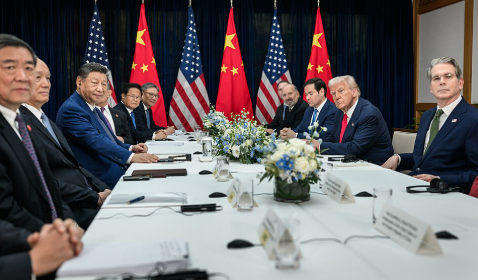
President Donald Trump hosted Chinese leader Xi Jinping for a three-day state visit in Washington. The visit was marked by a military review and a state dinner along with several other ceremonial events. Trump personally greeted Xi when he arrived at Joint Base Andrews.
The leaders visited the National Archives together on the final day of the trip. They viewed the Declaration of Independence and the Constitution along with other founding documents. The stop came after talks at the White House.
The United States and China agreed to extend their temporary trade truce by two months until January 10. The extension gives negotiators more time to work toward a broader trade agreement. Rare earth supplies remain one of the major issues between the two countries.
The two sides also reached an agreement to lower tariffs on about $30 billion in non-sensitive goods.
The United States will lower tariffs on products including toys and small appliances. China will reduce tariffs on some agricultural products and medical devices. The White House said the countries would continue working on concerns involving rare earths and other critical minerals.
Iran was also discussed during the visit. China remains a major buyer of Iranian oil and the conflict has become another source of disagreement between Washington and Beijing.
The visit contrasted with Trump's more confrontational approach toward China during his first term. Trump welcomed Xi with extensive ceremonial treatment during the Washington visit. Both leaders publicly emphasized cooperation despite continuing disagreements between their governments.
Artificial intelligence was another major topic of discussion. The two countries agreed to establish a bilateral communication channel for AI incidents. Officials are expected to continue discussions about AI safety.
The visit did not resolve the deeper issues in the U.S.-China relationship.
Southeast Asian countries are closely watching the relationship between Washington and Beijing. Some analysts see reduced tensions as helpful because countries in the region could face less pressure to choose between the two powers. Other analysts remain concerned about major decisions being made without enough input from smaller countries.
Japan is also strengthening its defense relationship with the United States. Japanese Defense Minister Shinjiro Koizumi and U.S. Defense Secretary Pete Hegseth recently agreed to further strengthen the capabilities of the alliance. Japan has also been reviewing its defense strategy as concerns about China and security around Taiwan continue.
The Washington visit produced some agreements but left many of the largest disputes unresolved. Trump and Xi are expected to meet two more times before the end of the year.