

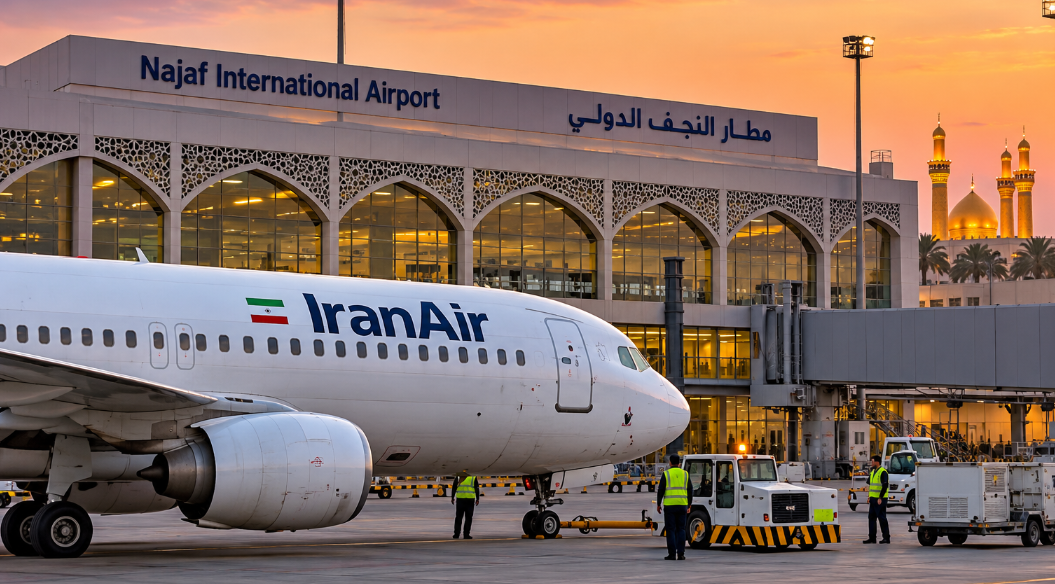
Iraq has allowed Iranian airlines to operate up to 40 daily flights to and from Najaf International Airport. Mahan Air is excluded from the arrangement. The move restores a major travel connection between Iran and one of Iraq’s most important religious cities.
Iraq's ambassador to Tehran Yasser Abdulzahra al-Hajjaj said Baghdad had not made its own decision to suspend Iranian flights. The disruption followed U.S. sanctions that caused foreign ground-handling companies to stop servicing Iranian carriers.
The Iraqi government said the United States granted the exemption after Baghdad sought relief for pilgrimage and other civilian travel. According to Reuters Iraq had previously halted flights to and from Iran in line with the sanctions.
The exemption is particularly important because Najaf is the main Iraqi destination for flights arriving from Iran.
Najaf is one of the holiest cities in Shia Islam and is home to the shrine of Imam Ali. Large numbers of Iranian pilgrims travel there throughout the year while Iraqi pilgrims also use the route to visit religious sites in Iran. Iranian officials said about 12,000 to 13,000 people had been traveling between the two countries each day on Iranian airlines before the restrictions.
The flight disruption began after the U.S. Treasury announced new sanctions against Iran’s aviation sector on September 8. Treasury sanctioned 36 targets and said the measures were designed to cut support for Iran’s aviation industry because Washington says some carriers and related companies have helped transport military personnel or equipment.
Foreign companies that provide ground handling and other airport services then faced the risk of violating U.S. sanctions if they continued working with affected Iranian airlines.
That pressure caused flights to stop at several Iraqi airports. Services involving Iran were suspended at Najaf as well as Baghdad; Erbil; and Sulaimaniyah. Some passengers were forced to use lengthy land routes that could take 12 hours or more.
The disruption also led to public protests in Iraq. Demonstrators gathered outside Najaf International Airport and in several other cities while calling for the flight connection to be restored. Iranian officials argued that the restrictions were hurting ordinary travelers who depended on the routes for religious visits; education; medical treatment; and business.
Baghdad began direct talks with Washington in an effort to obtain exemptions. Iraqi officials argued that civilian travel should be allowed to continue while safeguards remained in place to prevent sanctioned activity. Reuters reported that Iraq proposed passenger screening and information sharing as part of the effort.
The first relief involved Iraqi Airways. The national carrier received a special U.S. Treasury exemption allowing it to resume certain flights to Iran. Iraqi officials said the waiver covered travel connected to pilgrimage and other civilian needs.
The broader Najaf agreement followed soon afterward. Iraq's prime minister's office said Washington responded positively to Baghdad's request and allowed Iranian carriers to resume up to 40 daily flights. The arrangement does not include Mahan Air.
Mahan Air has faced U.S. sanctions for years because Washington accuses the airline of supporting Iran's Islamic Revolutionary Guard Corps. The U.S. Treasury says the airline has transported personnel; weapons; and military equipment. Mahan Air denies wrongdoing and Iran has repeatedly rejected U.S. sanctions against its aviation industry.
The exemption does not amount to a full restoration of normal air travel between Iran and Iraq. Flights connected to Iran remained suspended at Baghdad; Erbil; and Sulaimaniyah under the latest reports. That means Najaf is currently carrying much of the available air traffic between the two countries.
Before the restrictions Iran's ambassador to Baghdad said roughly 25 daily Iranian flights operated to Najaf while about 15 traveled to Baghdad. The newly approved limit of 40 daily Najaf flights could therefore absorb a substantial share of the traffic that previously used several Iraqi airports.
The dispute highlights Iraq's difficult position between the United States and neighboring Iran. Washington remains an important political and economic partner for Baghdad while Iran has deep religious; commercial; and political ties with Iraq.
Iraqi officials have tried to present the exemption as a way to protect civilian travel without challenging U.S. sanctions more broadly. Foreign Minister Fuad Hussein said restored flights support cooperation with Washington while also helping religious visitors reach holy sites.
Iran has taken a much more critical position on the sanctions. Its Foreign Ministry has described U.S. restrictions on its aviation industry as unlawful and harmful to civilians. Tehran has called on Iraq to restore all remaining flights rather than limiting service to Najaf.
The U.S. Treasury says its sanctions are aimed at Iran's government and military networks rather than ordinary travelers. Treasury sanctioned 27 Iranian airlines in September as part of a wider campaign targeting the country's aviation sector.
The Najaf exemption shows that Washington is willing to allow limited exceptions when humanitarian or religious travel is affected. It also gives Baghdad a temporary way to keep an important passenger route open while the wider sanctions remain in force.
For travelers the immediate effect is that direct air service between Iran and Najaf can continue on approved airlines. Passengers traveling through other Iraqi airports may still face restrictions until further exemptions are issued or sanctions policy changes.