

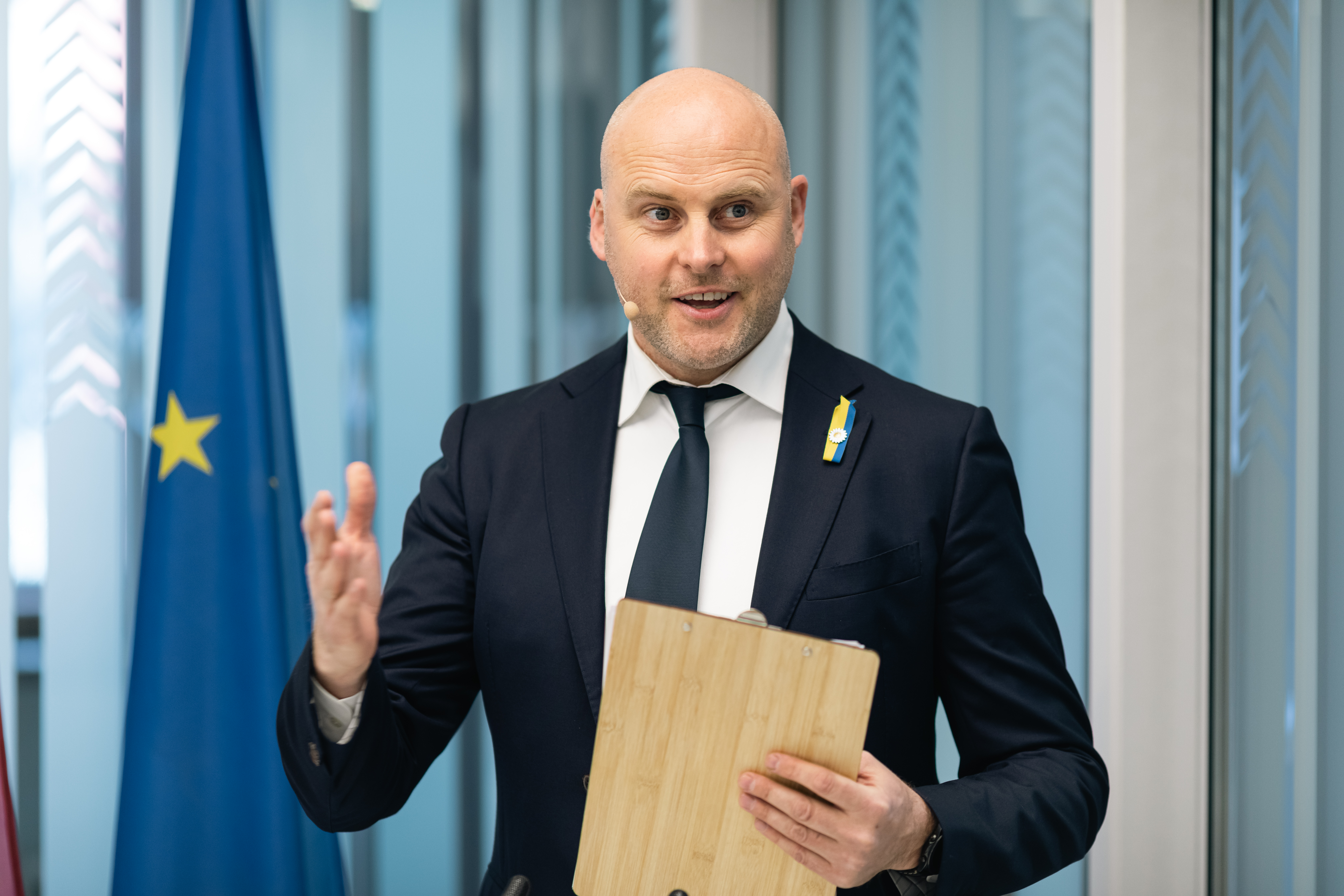
Latvian Prime Minister Andris Kulbergs’ United List appeared headed for a strong showing in Saturday’s parliamentary election as voters weighed concerns about Russia, support for Ukraine and problems closer to home such as rising living costs.
An exit poll released after voting ended showed the centrist United List receiving 35.6 percent of the vote. That was far ahead of the other parties competing for seats in Latvia’s 100-member parliament, known as the Saeima.
Latvia First and the Progressives each received about 11.3 percent in the exit poll. Sovereign Power followed with about 10.8 percent.
Official results were still being counted Saturday night, and the exit poll did not determine how the final coalition government would be formed.
Latvia uses proportional representation, and political parties generally need at least 5 percent of the nationwide vote to win seats in parliament. Fourteen political lists competed in Saturday’s election.
Nearly 1.56 million people were eligible to vote in the Baltic country, which has a total population of more than 1.8 million.
Kulbergs became prime minister in May after the previous government collapsed during a political crisis over its handling of military drones that entered Latvian airspace.
His four-party governing coalition includes United List, New Unity, the National Alliance and the Union of Greens and Farmers.
United List had been polling at about 14 percent before the election, making the much stronger exit poll showing one of the biggest developments of election night.
Kulbergs told reporters that he had not expected such a strong result. However, even a large victory would not give United List enough seats to govern alone.
Latvia’s fragmented political system makes coalition governments common. Kulbergs said after the exit poll that he did not want to form a government with Latvia First.
Security has been one of the major issues during the campaign.
Latvia shares borders with Russia and Belarus and has strongly supported Ukraine since Russia launched its full-scale invasion in 2022.
The country is also a member of NATO and the European Union.
Latvia and other Baltic countries have warned about possible sabotage, cyberattacks, disinformation and other forms of what governments describe as Russian hybrid warfare.
Russia has rejected accusations that it is conducting such campaigns.
Latvia increased security around the election. NATO also strengthened protection of Latvian airspace, with Germany sending Eurofighter aircraft to the country during the election period.
Kulbergs campaigned on promises to improve Latvia’s defenses against drones and maintain defense spending near 5 percent of gross domestic product.
However, economic issues were also important to voters.
Latvia has lower living standards than neighboring Estonia and Lithuania, and voters have expressed concerns about wages, healthcare, transportation and the rising cost of everyday goods.
Economic conditions are especially difficult in parts of eastern Latvia.
The Latgale region, which borders Russia and Belarus, has struggled with population decline and fewer employment opportunities than Riga and surrounding areas.
Daugavpils, Latvia’s second-largest city, has a large Russian-speaking population and has become an important political battleground.
Russian-speaking voters once tended to support parties that specifically represented their linguistic and cultural interests.
That voting bloc has become more divided.
Harmony, which was once one of Latvia’s largest political parties and repeatedly won the most votes in national elections, lost its representation in parliament in 2022.
Newer parties have tried to attract some of those voters by focusing on economic concerns and calling for changes to Latvia’s policies toward Russia and Ukraine.
Sovereign Power, led by Jūlija Stepaņenko, has criticized continued spending on aid to Ukraine and argued that more government money should remain in Latvia.
The party says it wants Ukraine to prevail but has called for negotiations and an end to additional Latvian financial support for the war.
Latvia First, led by businessman and longtime politician Ainārs Šlesers, has also increased its support.
The party campaigned heavily on economic issues and sought support from Russian-speaking voters.
Despite disagreements over the level of aid to Ukraine and relations with Russia, most Latvian political parties continue to support the country’s membership in NATO and the European Union.
Security concerns have become even more important as the war in Ukraine continues and European governments increase defense spending.
Latvia’s geographic position places it directly on NATO’s eastern border.
For many voters, however, Saturday’s election was not only about the threat from Russia.
Wages, healthcare, government spending and the cost of living also played major roles.
The exit poll suggests Kulbergs has strengthened his political position considerably since taking office in May.
But the final balance of power will depend on official results and which parties cross the 5 percent threshold.
Even with United List far ahead in the first exit poll, negotiations with other parties will be necessary before Latvia’s next government can be formed.