

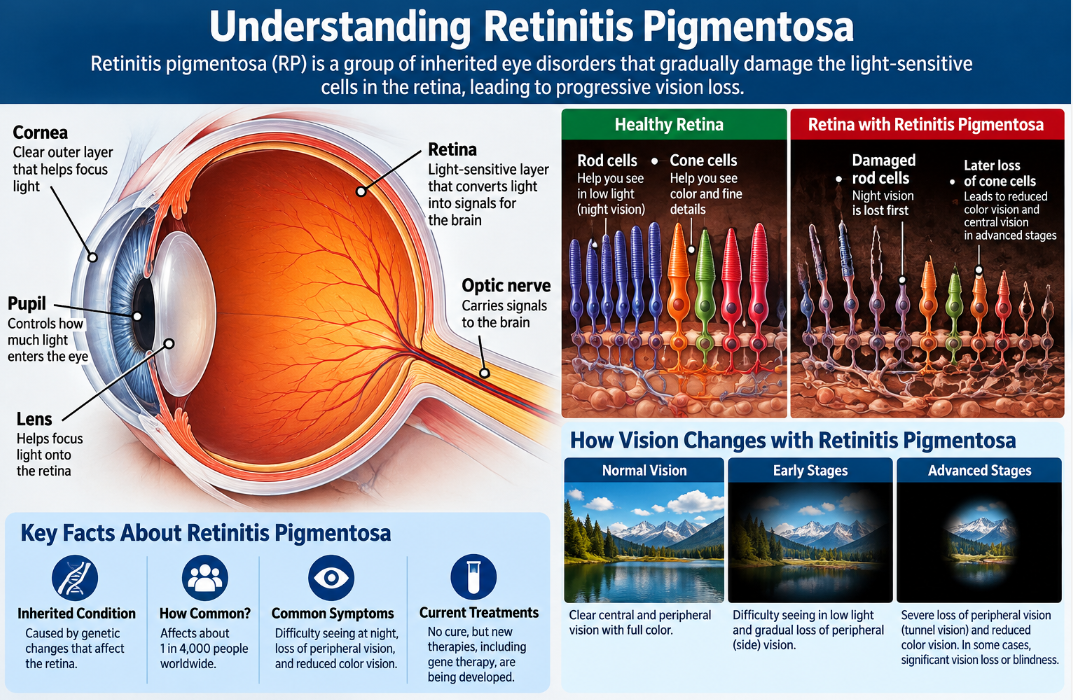
A new treatment using gene therapy has shown promise in restoring some vision to people who were previously blind. This breakthrough was first demonstrated in a single patient in 2021, and now researchers have expanded their work to include more individuals. The condition being treated is retinitis pigmentosa which causes the gradual loss of light-sensitive cells in the retina.
The condition often begins with difficulty seeing at night or in dim lighting. As the disease progresses patients may lose their peripheral vision and develop tunnel vision. In advanced cases it can cause severe vision loss or blindness.
RP affects approximately 1 in 4,000 people worldwide. It is caused by genetic changes that interfere with the normal function of retinal cells. Symptoms often appear during childhood or early adulthood but the rate of vision loss varies widely.
There is currently no cure for most forms of retinitis pigmentosa. However, genetic treatments and other experimental therapies are being developed to help preserve or restore limited vision. One promising approach uses gene therapy and special goggles to make surviving retinal cells respond to light.
In this therapy, a single injection is administered directly into the eye, according to The Guardian. The injection uses a harmless synthetic virus to deliver genetic instructions for creating a light-sensitive protein. These instructions are given to a group of surviving ganglion cells that still function in the eye.
Patients also wear special goggles designed to activate the treated retinal cells. According to researcher Botond Roska, patients can now detect objects but not faces. The treatment improved light sensitivity in seven of ten participants with six showing clinically meaningful improvement.
The improvement appears to last for several years, with some patients showing stable results after four or five years.
This progress marks a significant step forward in treating vision loss caused by certain eye diseases. The research team has moved from testing on just one patient to working with ten individuals.
Each patient’s response has been carefully monitored to assess the therapy's effectiveness. The treatment does not fully restore normal vision but offers a meaningful improvement in light perception. The therapy is still experimental and requires further study before it becomes widely available.
However, the results so far suggest that gene therapy may be a viable option for treating some forms of blindness.
The team continues to refine the method and explore its potential applications. This development brings renewed hope for people living with vision loss due to retinal degeneration.
Botond Roska co-leads the research group working on this approach with José-Alain Sahel of the University of Pittsburgh. His team’s work has laid the foundation for future clinical trials and broader use of the technique. The findings were published in the New England Journal of Medicine on October 7.