

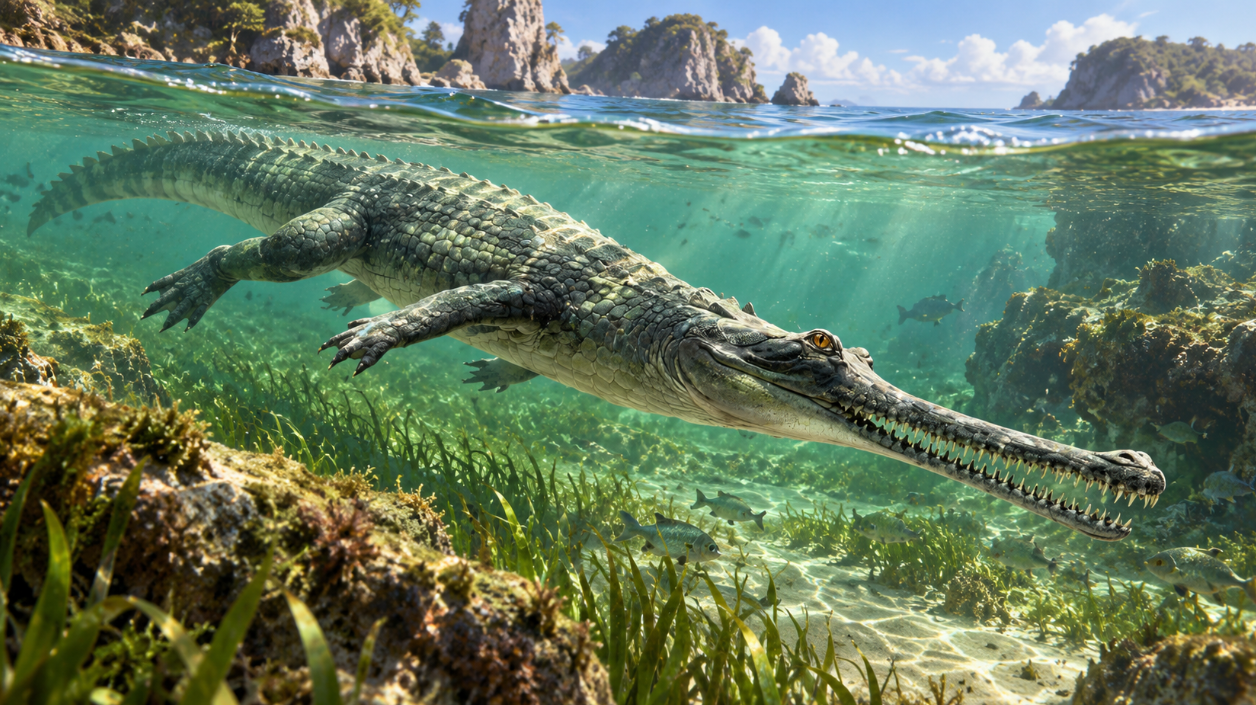
The Great Sphinx of Giza has long intrigued people with its mysterious history and distinctive appearance. Now, a new study of a fossil from the same ancient limestone formation has revealed a previously unknown crocodile species. This reptile, named Herugavialis cairensis, shares an unusual feature with the Sphinx itself — a missing tip of its snout.
The crocodile lived around 45 million years ago in coastal waters of the Tethys Ocean, according to Science News. It belonged to a group known as gavials, which are fish-eating reptiles with long, narrow snouts. The two living gavial species are found in tropical Asia today, but fossils show they once lived all over the world.
The fossil was first discovered in the 1920s near Cairo and initially classified as a type of Tomistoma. However, new research has shown that this classification was incorrect.
Paleontologist Paul Burke studied the fossil in detail while working on his doctoral degree at University College London. He later moved to the Swedish Museum of Natural History where he continued his work.
By comparing measurements with other gavial fossils and living species, Burke and his team found that this animal was not a Tomistoma. They named the new species Herugavialis cairensis, honoring the Egyptian god Heru, who is connected to the Sphinx.
The fossil’s snout tip was broken off, just like the nose of the Great Sphinx. This discovery provides further evidence that gavials once lived in coastal waters, not just freshwater areas.
The region around Egypt was once covered by shallow seas that hosted many crocodile species, according to a report from Popular Science. Scientists believe this finding shows a more complex history of gavial evolution in Africa than previously thought.
Gavials are not as well known to the public as other crocodiles or alligators. Yet both living gavial species are threatened with extinction and still survive in parts of Asia.
The research was published in the journal Royal Society Open Science on October 7. This new species helps explain how crocodiles evolved in ancient Egypt and beyond.
It also shows that the area around the Sphinx had a rich diversity of marine life long ago. The discovery supports earlier theories about how crocodiles spread and changed over millions of years.
It highlights the importance of studying ancient fossils to understand the history of modern animals. Herugavialis cairensis adds a new chapter to the story of life in Egypt's ancient seas.
Its name links it directly to the Sphinx and its ancient history. The fossil was found in the same limestone formation from which the Great Sphinx of Giza was carved.
This makes it a rare and significant find in the area’s geological record. It also shows how much more there is to learn about ancient life in Egypt.
The study brings together old and new methods of fossil research.